
25m Telecom Tower: Optimal Urban Cell Site Solution
2025-12-20
A 25m telecom tower provides 1.5-3 km coverage radius in urban areas and 3-5 km in suburban zones, supporting 6-12 cellular antennas on just 1-2 m² footprint when configured as a monopole. Built to ANSI/TIA-222-G standards with hot-dip galvanized steel, these towers withstand 200 km/h wind loads and deliver 20-30 years of reliable service.
That's the short version. Here's why 25 meters has become the sweet spot for urban cell deployments.
Your network planning team needs coverage without wasting money on unnecessary height. A 30m tower costs 15% more but only adds marginal coverage in dense urban environments. A 20m tower saves upfront costs but forces you to deploy more sites to maintain signal quality.
25m hits the balance. You get sufficient elevation to clear 2-3 story buildings while keeping foundation costs reasonable and installation timelines short.
Coverage Area: What 25m Actually Delivers
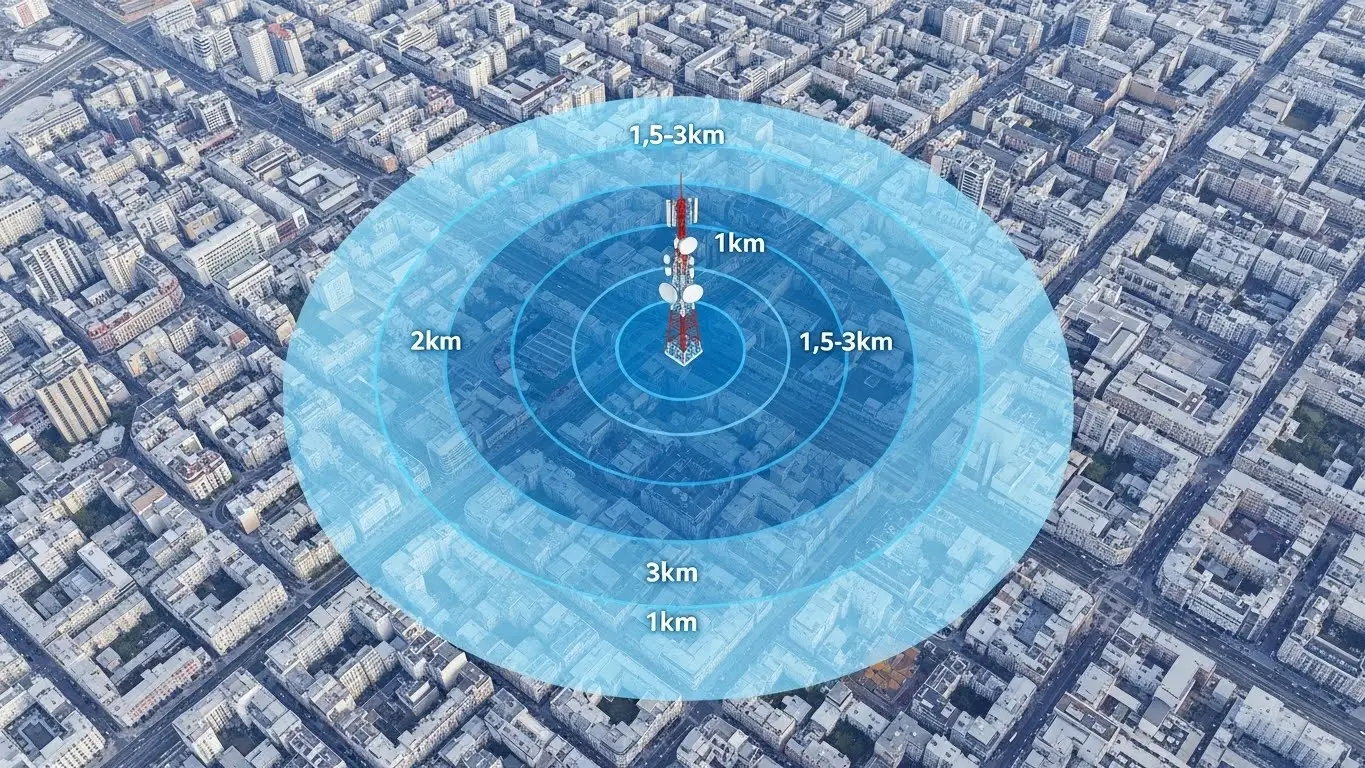
Urban deployments see 1.5-3 km coverage radius from a 25m tower. That translates to 7-28 km² of coverage area per site. In suburban or semi-rural settings, you can push that to 3-5 km radius (28-78 km²).
The difference? Obstacle density. Urban environments have buildings, trees, and RF interference that limit propagation. Our engineering team designs around these constraints when we specify tower heights for client projects across Southeast Asia and Africa.
Here's the coverage breakdown by environment:
| Environment | Coverage Radius | Coverage Area | Typical Use Case |
|---|---|---|---|
| Dense Urban | 1.5-2.5 km | 7-20 km² | City centers, business districts |
| Urban | 2-3 km | 13-28 km² | Residential areas, suburbs |
| Suburban | 3-4 km | 28-50 km² | Mixed residential/commercial |
| Semi-Rural | 4-5 km | 50-78 km² | Towns, light industrial zones |
Frequency matters too. Lower bands (700-900 MHz) travel further. Higher bands (2.3-3.5 GHz for 5G) need denser tower placement regardless of height. If you're deploying 5G mid-band spectrum, expect coverage on the lower end of these ranges.
Monopole vs Lattice: Which Configuration Works Better?
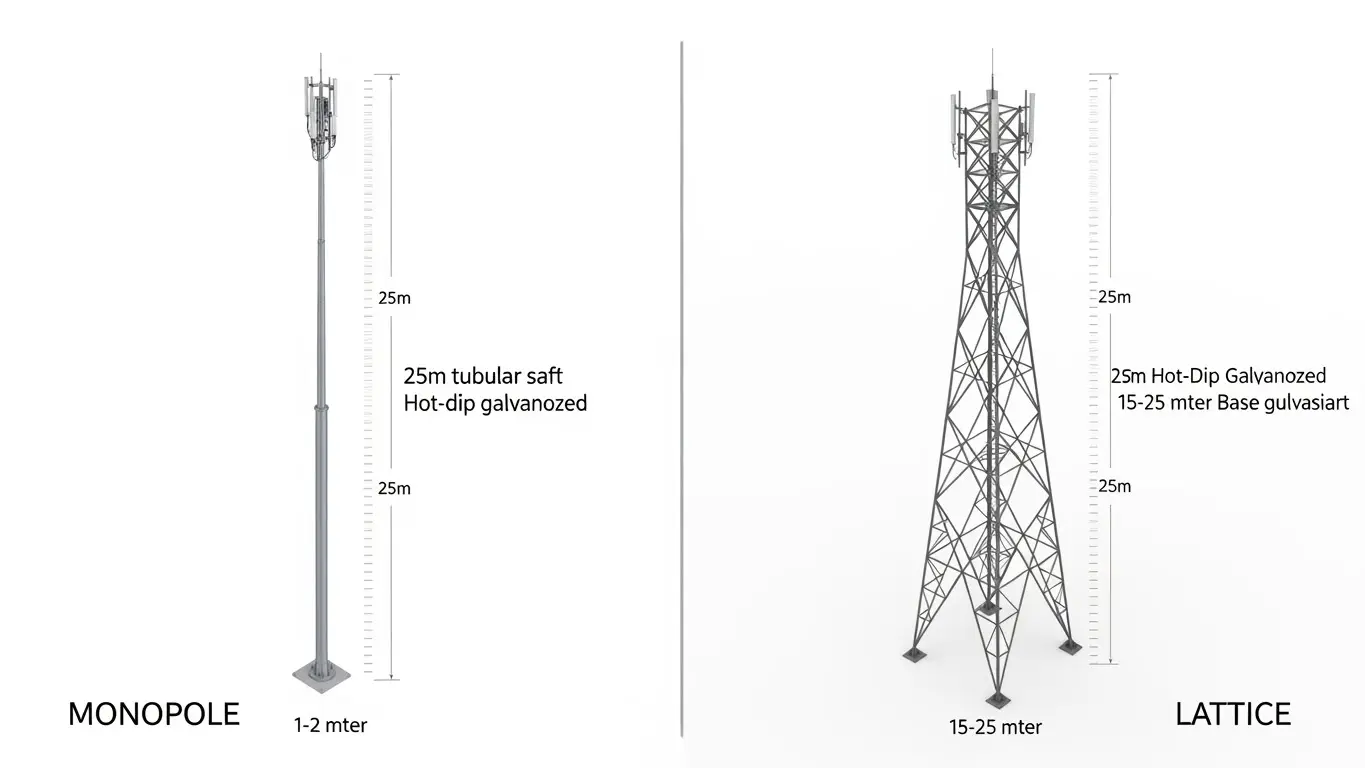
We manufacture both types at our facility in Chengdu. The choice depends on your site constraints and budget.
Monopole towers use a single tubular shaft. They need only 1-2 m² of ground space—perfect when you're leasing rooftop space or dealing with tight urban lots. Installation takes 3-5 days including foundation work. Material cost runs higher because steel plates require specialized bending equipment.
Lattice towers use angular steel members in a 3-leg or 4-leg framework. They need 15-25 m² footprint but support heavier equipment loads. Installation takes 7-10 days. Material costs are lower, but you pay more for foundation work and site preparation.
Here's the practical comparison:
| Factor | 25m Monopole | 25m Lattice (3-leg) |
|---|---|---|
| Footprint | 1-2 m² | 15-25 m² |
| Installation Time | 3-5 days | 7-10 days |
| Antenna Capacity | 6-9 antennas | 8-12 antennas |
| Wind Resistance | Up to 200 km/h | Up to 200 km/h |
| Typical Cost | $18,000-$32,000 | $15,000-$26,000 |
| Best For | Urban sites, rooftops | Rural sites, high-capacity hubs |
Urban deployments favor monopoles. You get faster installation, smaller footprint, and cleaner aesthetics. Suburban or rural sites can use lattice towers when you need to mount equipment for multiple carriers or heavy microwave backhaul dishes.
In our 17 years manufacturing towers, we've seen the market shift heavily toward monopoles for 25m height. About 70% of our urban telecom projects now specify monopole configuration.
Technical Specifications That Matter
Your RFQ should specify these parameters for a 25m tower:
Materials: We use Q235B, Q345B, or Q420B steel for structural members. International clients typically request ASTM A36, GR50, or GR65 equivalents. Yield strength matters—Q345B offers 345 MPa minimum, suitable for high wind loads.
Galvanization: Hot-dip galvanizing per ISO 1461 with 100+ micron coating thickness. Our galvanizing factory in Guanghan processes all towers in-house, ensuring consistent zinc coating that resists corrosion for 20-30 years.
Wind Loading: Standard design accommodates 200 km/h (55 m/s) wind speeds. Coastal installations or typhoon zones may require reinforcement. We calculate wind loads per ANSI/TIA-222-G for international projects or GB 50009 for domestic Chinese work.
Antenna Mounting: Monopoles space antennas vertically at 3-4.5 meter increments. A 25m monopole typically provides 4-5 mounting positions, accommodating 6-9 panel antennas total (assuming standard tri-sector configuration).
Foundation: Monopole foundations need 2-3 meter diameter, 3-4 meter depth. Lattice towers use either three separate footings (1.5m diameter each) or a mat foundation. Soil bearing capacity drives final design—our engineering team provides foundation drawings after geotechnical review.
| Specification | Standard Value | Notes |
|---|---|---|
| Height | 25m (82 feet) | Measured from ground to top platform |
| Steel Grade | Q345B / ASTM GR50 | 345 MPa yield strength |
| Galvanization | ISO 1461, 100+ microns | Hot-dip process |
| Wind Speed | 200 km/h (55 m/s) | Design load, can be increased |
| Seismic | Grade 8 intensity | Per Chinese GB standards |
| Temperature | -35°C to +45°C | Operational range |
| Deflection | <1/1000 (0.1%) | Top displacement under max load |
| Service Life | 20-30 years | With proper maintenance |
Installation Timeline and Process
Site preparation takes 2-3 days. You'll need equipment access, temporary power, and space for material staging. Foundation work requires another 3-7 days depending on soil conditions and concrete curing requirements.
Tower erection happens next. Monopole sections arrive on flatbed trucks—each section weighs 1-3 tons depending on taper and wall thickness. A mobile crane lifts and connects sections via internal flanges. The whole process takes 1-2 days for the tower itself.
Add another 1-2 days for antenna installation, cable runs, and equipment mounting. Total timeline from site prep to commissioning: 7-14 days for monopole, 10-18 days for lattice.
Weather delays are common. Plan for contingencies, especially during rainy seasons. Our project teams typically add 20% buffer time when scheduling installations across tropical regions like Southeast Asia.
Cost Breakdown: What You'll Actually Pay
Pricing varies by configuration, location, and order volume. Here's what we typically see for 25m towers from our facility:
Monopole configuration: $18,000-$32,000 for tower structure and galvanization. Add $8,000-$15,000 for foundation, installation labor, and transportation. Total project cost: $26,000-$47,000.
Lattice configuration: $15,000-$26,000 for tower structure. Foundation and installation: $10,000-$18,000. Total: $25,000-$44,000.
International shipping adds $2,000-$5,000 depending on destination. Our export division handles documentation for African, European, and South American markets.
| Cost Component | Monopole | Lattice |
|---|---|---|
| Tower Structure | $10,000-$20,000 | $8,000-$15,000 |
| Galvanization | $1,500-$3,000 | $1,500-$3,000 |
| Foundation Materials | $2,000-$4,000 | $3,000-$5,000 |
| Labor (Installation) | $8,000-$14,000 | $10,000-$16,000 |
| Transportation | $2,000-$4,000 | $2,500-$5,000 |
| Engineering/Design | $1,500-$3,000 | $1,500-$3,000 |
| Total Range | $25,000-$48,000 | $26,500-$47,000 |
Volume orders reduce unit cost. A 10-tower order typically saves 15-20% versus single-unit pricing. Our 40,000-ton annual capacity means we can handle large deployment projects without extending lead times.
Why 25m Works Better Than 20m or 30m
Compared to 20m towers: You gain 30% more coverage area. That means fewer sites to achieve the same network footprint. The cost difference? Only about $3,000-$5,000 per tower. If that extra height lets you skip one site deployment, you've saved $30,000-$50,000 in total project costs.
Compared to 30m towers: You save 15% on tower costs and reduce foundation requirements. In dense urban areas, the extra 5 meters provides minimal coverage benefit because you're already clearing most obstructions at 25m. You also avoid FAA lighting requirements that kick in above certain heights in some jurisdictions.
25m has become the default specification for urban cell sites. After analyzing hundreds of our telecommunication tower deployments across multiple countries, we see consistent results: optimal coverage-to-cost ratio for typical urban cell radius of 2-3 km.
Foundation Requirements by Tower Type
Soil conditions drive foundation design. Clay soils need deeper footings than rocky substrates. Your geotechnical report should specify bearing capacity—typically 150-200 kN/m² minimum for tower sites.
Monopole foundations use a single reinforced concrete pier. Diameter: 2-3 meters. Depth: 3-4 meters. Concrete volume: 15-25 m³. Reinforcement includes steel cage with 20-25mm rebar at 150-200mm spacing.
Lattice foundations have three options:
- Individual spread footings (one per leg)
- Combined footings with grade beams
- Mat foundation (for poor soils)
Individual footings work best. Each footing: 1.5m diameter, 2.5-3.5m depth. Total concrete: 12-20 m³ across three footings.
Engineering design must account for overturning moments from wind load. The taller the tower, the larger the foundation needs to be. At 25m, foundation costs remain reasonable—taller towers quickly escalate foundation requirements and costs.
Maintenance Schedule: Keeping Your Tower Operational
Annual inspections catch problems early. Check for:
- Corrosion spots (especially at welds and bolt connections)
- Loose bolts and hardware
- Structural cracks or deformation
- Guy wire tension (if applicable)
- Antenna alignment and mounting integrity
- Lightning protection system continuity
Re-torque bolts every 2-3 years. Connection points experience thermal cycling that can loosen fasteners over time. Critical connections should meet AWS D1.1 welding standards—we certify all welders at our facility to this specification.
Galvanization typically lasts 20+ years in non-coastal environments. Coastal installations may need touch-up coating after 10-15 years due to salt air exposure. Budget $1,500-$3,000 annually for inspection and minor maintenance.
Major structural issues are rare with properly designed towers. We've had towers in service since 2008 that still perform to original specifications. The key? Quality fabrication upfront and consistent inspection schedules.
Antenna Configuration and Capacity
A 25m monopole supports 6-9 panel antennas in standard tri-sector configuration (3 sectors × 2-3 antennas per sector). Each sector covers 120-degree arc, providing 360-degree coverage.
Modern panels measure 1.5-2 meters tall and weigh 15-30 kg each. Add microwave backhaul dishes (2-4 dishes typically), and you're looking at 400-600 kg equipment load at height. Well within design limits for quality tower construction.
Multi-carrier deployments use higher antenna counts. If you're leasing space to 2-3 operators, you might mount 12-15 antennas total. This pushes toward lattice tower configuration for better load distribution.
5G equipment adds another dimension. Massive MIMO antennas are larger and heavier than traditional panels. A 64T64R antenna weighs 40-50 kg. Plan accordingly when specifying tower loading.
Vertical separation between operators should be at least 3 meters to minimize interference. Our tower design services include antenna layout optimization for multi-tenant sites.
Site Selection Criteria for 25m Towers
Network planning identifies coverage gaps. Once you know where you need a site, evaluate specific locations:
Space requirements: Monopole needs 10-15 m² total including guy wire anchors (if used) and equipment shelter. Lattice towers need 40-60 m² for tower base, shelter, and access.
Access: Construction crews need equipment access. A 25m tower requires mobile crane with 30-35 meter boom. Verify access roads can handle 30-ton crane weight.
Utilities: Power and fiber backhaul are essential. Budget $10,000-$30,000 for utility connections if not already present.
Zoning and permits: Height restrictions vary by jurisdiction. Many urban areas limit structures to 25-30m without special permits. This is one reason 25m has become standard—it often falls under permitting thresholds.
RF environment: Avoid sites with excessive interference. Co-location on existing towers is often cost-effective if structural capacity allows.
We've helped clients site hundreds of towers across Africa and Asia. Proper site selection saves thousands in construction costs and avoids permit delays.
Urban vs Rural Deployment Strategy
Urban deployments prioritize:
- Minimal footprint (monopole preferred)
- Fast installation (limited construction windows)
- Aesthetic integration
- Higher site density (smaller coverage radius)
Rural deployments optimize for:
- Maximum coverage per site
- Lower cost per km² covered
- Fewer permitting constraints
- Multi-carrier sharing to justify remote sites
25m towers excel in urban scenarios. For rural coverage, consider 30-40m heights to maximize radius and reduce total site count. The economics shift—you pay more per tower but deploy fewer sites.
Our export markets show this pattern clearly. African urban deployments use 25m monopoles. Rural coverage uses 35-45m lattice towers with higher capacity. It's about matching tower specification to deployment density.
Comparison: Steel vs Concrete Pole Options
Some manufacturers offer concrete monopoles as an alternative to steel. Steel poles offer distinct advantages for telecom applications:
Steel pros:
- Lighter weight (easier transport and installation)
- Better load distribution for multiple antennas
- Can be galvanized for 20-30 year life
- Easier to modify or extend
- Better performance in seismic zones
Concrete pros:
- Lower maintenance in certain environments
- Fire resistance
- Sometimes lower material cost
At 25m height, steel remains the preferred choice. Concrete becomes more competitive for shorter structures (8-15m) or specific applications like railway electrification towers where different loading characteristics apply.
Our manufacturing focuses on steel because it delivers better performance for the majority of telecom deployments. The combination of strength-to-weight ratio and corrosion resistance makes hot-dip galvanized steel hard to beat.
Frequently Asked Questions
Urban coverage ranges from 1.5-3 km radius depending on frequency band and obstacles. Suburban or semi-rural areas see 3-5 km radius. Actual coverage depends on antenna configuration, power levels, and local topography. Lower frequency bands (700-900 MHz) achieve better range than higher bands (2.3-3.5 GHz).
Monopole configuration supports 6-9 panel antennas with standard tri-sector layout. Lattice towers handle 8-12 antennas depending on structural design. Add 2-4 microwave backhaul dishes to these counts. Multi-carrier sites may need 12-15 antennas total, which usually requires lattice tower configuration for proper load distribution.
Monopole towers require 7-14 days from site preparation through commissioning. This breaks down to 2-3 days site prep, 3-7 days foundation work, 1-2 days tower erection, and 1-2 days equipment installation. Lattice towers take 10-18 days due to more complex assembly. Weather and site access affect actual timelines.
Complete installed cost ranges from $25,000-$48,000 depending on configuration and location. Monopole towers cost $26,000-$47,000 installed. Lattice towers run $25,000-$44,000. This includes tower structure, galvanization, foundation, labor, and local transportation. International shipping adds $2,000-$5,000. Volume orders reduce unit pricing by 15-20%.
25m provides sufficient elevation to clear typical 2-3 story urban buildings while maintaining cost efficiency. It delivers 30% more coverage than 20m towers but costs 15% less than 30m towers. This height typically falls under permitting thresholds in many jurisdictions, simplifying approval. The balance of coverage, cost, and regulatory compliance makes 25m the industry standard for urban deployments.

Hey, I’m Chunjian Shu
"X.Y. Tower: Reliable, innovative solutions for high-quality towers and electrical equipment with professional service.
