
How to Choose a Telescopic Mast Tower for Your Site
2025-12-15
To choose the right telescopic mast, prioritize payload weight and wind surface area over simple height. For rapid, temporary deployments under 30 meters, choose pneumatic aluminum masts. For heavy, long-term loads (50kg+) or extreme heights, opt for electromechanical or galvanized steel mechanical masts compliant with TIA-222-H wind standards. Always match the retracted height to your transport limits.
Why is Payload Surface Area More Critical Than Weight?
Most buyers obsess over the weight of their equipment (cameras, antennas, lights), but the Effective Projected Area (EPA)—the surface area exposed to the wind—is the true killer of telescopic masts.
A 10kg omnidirectional whip antenna exerts far less stress on a mast than a 5kg solid microwave dish. Why? Wind load. As wind hits the surface area of your payload, it creates a lever arm effect that multiplies force down the entire mast structure.
Unique Insight: In 2026, with the rise of Starlink Flat High-Performance dishes for mobile command centers, we are seeing masts fail not because of the weight of the dish (only ~13 lbs), but because the flat surface acts as a sail in 60mph gusts.
Pro Tip: Calculate your Total EPA before looking at a catalog. If your EPA exceeds 2.5 sq. ft., move from a standard pneumatic mast to a locking mechanical mast to prevent rotation and deflection.
Which Material Is Right for Your Environment?
The material of your mast dictates its lifespan, weight, and stiffness. Don't just pick "aluminum" because it's light; pick it based on your operational environment.
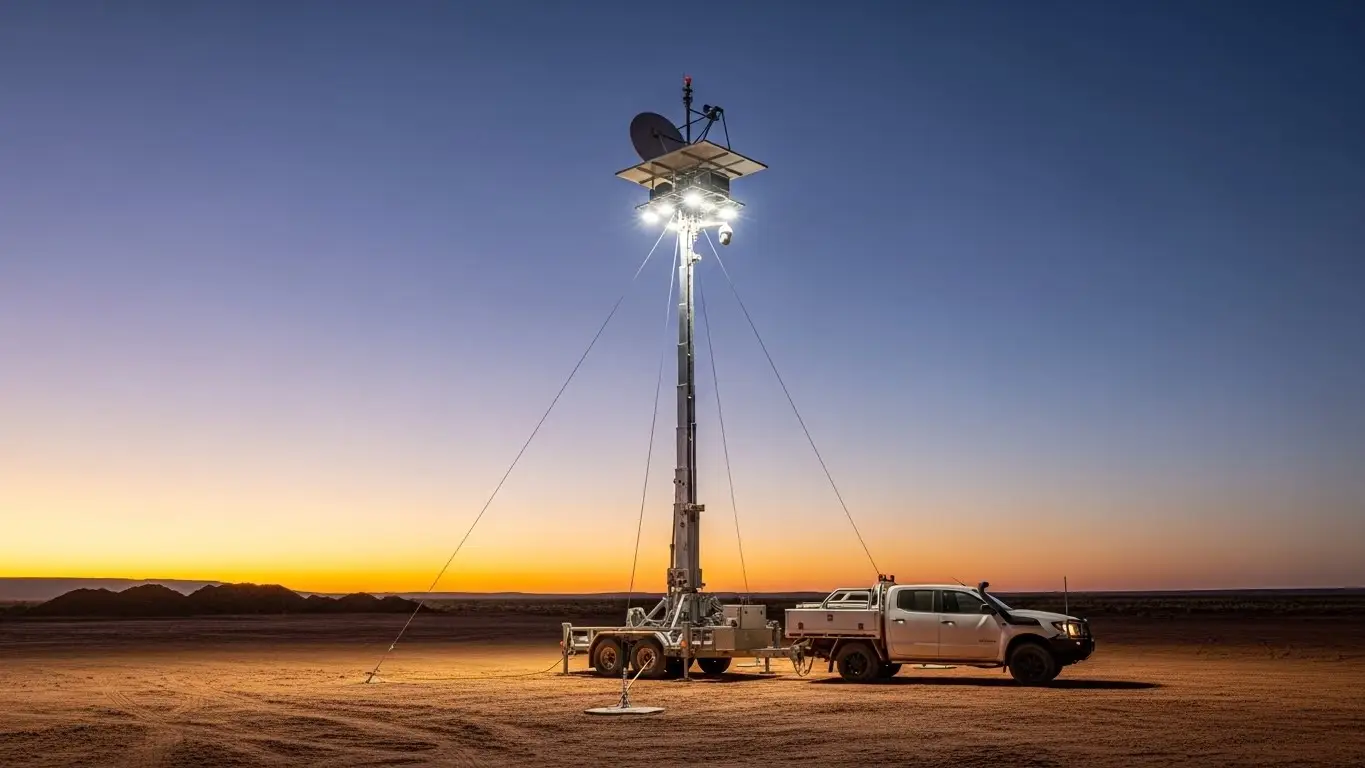
1. Aluminum Alloy (6061-T6 / 6063-T6)
- Best For: Rapid deployment, vehicle-mounted systems (COWs), and portable field use.
- Pros: Lightweight, naturally corrosion-resistant (anodized).
- Cons: Can dent easily; lower stiffness than steel.
- XYTOWER Context: Our telescopic unguyed towers guide highlights aluminum as the standard for tactical and emergency response units where speed is paramount.
2. Galvanized Steel (Q345 / Q460)
- Best For: Long-term stationary sites, high wind zones, and heavy payloads (>100kg).
- Pros: Superior stiffness (less sway), extreme durability.
- Cons: Heavy; requires a trailer or crane for deployment.
- XYTOWER Context: For permanent surveillance or heavy-duty comms, XYTOWER uses high-grade Q460 steel hot-dip galvanized to ASTM A123 standards to ensure a 30+ year lifespan.
3. Carbon Fiber Composite
- Best For: Man-portable military packs or weight-critical aerospace applications.
- Pros: Incredible strength-to-weight ratio.
- Cons: Prohibitively expensive (5x cost of aluminum); catastrophic failure mode (snaps vs bends).
Pneumatic vs. Mechanical: Which Mechanism Wins?
The deployment mechanism isn't just about how it goes up—it's about how long it stays up.
Pneumatic Masts (The "Air" Lift)
Uses air pressure to push sections up.
- Non-Locking: Requires constant air pressure. Good for short durations (1-4 hours).
- Locking: Uses mechanical collars to hold sections in place, allowing you to remove air pressure.
- Best Use: News vans, light towers, short-term emergency comms.
Mechanical Masts (Winched/Screw)
Uses a system of cables, screws, or chains driven by a motor or hand crank.
- Key Advantage: Precise height control. You can stop a mechanical mast at any intermediate height, whereas locking pneumatic masts often have specific "lock intervals."
- Best Use: Custom mast tower manufacture often favors mechanical systems for sensitive microwave links where any vertical drift is unacceptable.
Understanding Wind Load Ratings (TIA-222-H)
In the US and global markets, TIA-222-H is the gold standard for antenna supporting structures. It moved from "fastest mile wind" to "ultimate wind speed" calculations based on risk categories.
How to Read the Specs:
- Operational Wind Speed: The speed at which the mast can be extended or retracted safely (usually lower, e.g., 35 mph).
- Survival Wind Speed: The speed the mast can withstand while extended and guyed without structural failure (e.g., 80 mph).
Data Point: A mast rated for 80 mph survival unguyed will typically be 3x heavier and 2x more expensive than one rated for 80 mph guyed. Always use guy wires if your footprint allows—it is the cheapest way to double your safety factor.
Step-by-Step Selection Guide
Follow this process to avoid costly procurement mistakes.
- Calculate Payload Specs:
- Total Weight (Equipment + Cables + Mounts)
- Total EPA (Wind Surface Area)
- Determine Height Constraints:
- Extended Height: Required line-of-sight.
- Nested (Retracted) Height: Must fit inside your vehicle or standard shipping container.
- Select Deployment Frequency:
- Daily Use? Go Pneumatic (fastest).
- Weekly/Permanent? Go Mechanical/Winched (less maintenance).
- Check Power Availability:
- 12V/24V DC? Vehicle systems.
- 110V/220V AC? Trailer or grid systems.
- Manual Hand Crank? No power backup needed.
- Review Environmental Factors:
- Coastal/Marine? Requires anodized aluminum or 316 stainless steel hardware.
- Sand/Dust? Requires sand scraper rings on collars.
Frequently Asked Questions
Locking masts have mechanical collars that physically hold each section up, allowing you to turn off the air compressor for long-term deployment. Non-locking masts rely entirely on air pressure and will slowly retract if the compressor stops or leaks, making them suitable only for very short-term use.
Yes, for maximum stability. While many masts are "self-supporting" up to a certain wind speed (e.g., 40 mph), adding a 3-point or 4-point guy wire system significantly increases the survival wind speed (often to 70-80 mph) and reduces sway, which is critical for directional antennas.
Use the formula: Force = Pressure × Area × Drag Coefficient. For a simplified estimate, assume a drag coefficient of 1.2 for flat plates (like solar panels) and 0.6 for cylinders. XYTOWER engineers use TIA-222-H standards to perform these calculations precisely for your specific site conditions.
Generally, no. Most telescopic masts are not designed for "mobile-on-the-move" loads due to the dynamic forces of braking and cornering. They must be fully retracted and locked before the vehicle moves. However, specialized stiffened military masts exist for this exact purpose.
With proper maintenance (cleaning seals, lubrication), a high-quality aluminum pneumatic mast can last 10–15 years. Rubber seals typically need replacement every 3–5 years depending on UV exposure and dust conditions.

Hey, I’m Chunjian Shu
"X.Y. Tower: Reliable, innovative solutions for high-quality towers and electrical equipment with professional service.
