
Why Should You Choose a Tower Manufacturer in China for Export Projects?
2025-12-16
Choosing a Chinese tower manufacturer in 2026 offers a strategic advantage: 20–30% lower production costs driven by integrated steel supply chains and massive economies of scale. With mature ISO 9001 quality controls and global shipping experience, top-tier Chinese factories like XYTOWER deliver international-standard infrastructure faster and cheaper than Western competitors.
Why This Matters
In 2026, the global demand for telecom and power transmission infrastructure is hitting record highs, driven by 5G densification in Southeast Asia and grid modernization in Africa and the Middle East. However, infrastructure budgets remain tight.
For procurement officers and EPC contractors, the "China Strategy" is no longer just about finding the cheapest option—it is about finding the only option that can deliver 40,000+ tons of steel annually without a two-year backlog. China produces over 50% of the world's crude steel, giving its manufacturers an unbeatable speed and volume advantage.1 But with rising tariffs and logistical complexities, knowing how to source from China is just as important as knowing why.
The Economics: Understanding the Cost Advantage
It is a common misconception that Chinese towers are cheaper solely due to low labor costs. While labor is a factor, the real savings come from the supply chain ecosystem.
1. Raw Material Proximity
China is the world's largest producer of steel.2 A factory in Chengdu (like XYTOWER) does not import steel billets; they source them from local mills at domestic market rates.
- Global Steel Price: ~$700–$800 USD/ton
- Domestic China Steel Price: ~$460–$500 USD/ton (2025 estimates)
2. Integrated Galvanizing
In Europe or the US, a tower might be fabricated in one facility and trucked 200 miles to a galvanizer. Leading Chinese manufacturers own their hot-dip galvanizing lines. This eliminates intermediate transport costs and reduces handling damage.
Cost Comparison Estimate (100-Ton Order):
| Cost Component | Western Manufacturer | Chinese Manufacturer | Savings |
| Raw Steel | $85,000 | $55,000 | ~35% |
| Fabrication Labor | $40,000 | $15,000 | ~60% |
| Galvanizing | $25,000 | $18,000 | ~28% |
| Logistics (to Site) | $5,000 (Local) | $12,000 (Ocean) | (Negative) |
| TOTAL | $155,000 | $100,000 | ~35% Overall |
Quality Myths vs. Reality: Can You Trust the Steel?
A decade ago, "Chinese Steel" was a derogatory term in construction. Today, that narrative is outdated. China’s "New Quality Productivity" policy has forced the retirement of inefficient mills, leaving only high-tech producers.
The Standard Equivalence
The key to safety is ensuring your Chinese manufacturer isn't just following local codes (GB) but is translating them to International Standards.
- Steel Grades: A competent exporter knows that Chinese Q355B is the direct chemical and structural equivalent of American ASTM A572 Gr 50.
- Galvanizing: The zinc coating must meet ASTM A123 or ISO 1461. Top factories use automated temperature controls to ensure the zinc bonds correctly without "Sandelin Effect" peeling.
Expert Insight: Always demand a Mill Test Certificate (MTC) before production begins. This document traces the heat number of the steel batch, ensuring it meets the required yield strength.
Capacity & Speed: The "Factory of the World" Advantage
When a typhoon hits the Philippines or a new 5G license is awarded in Nigeria, speed is critical. Western factories often have lead times of 12–16 weeks for large orders.
The Chinese Alternative:
- Scalability: Factories like XYTOWER have an annual capacity of 40,000 tons.
- Turnaround: A standard lattice tower order can often be fabricated and galvanized in 3–4 weeks.
- Export Readiness: Experienced manufacturers have dedicated "nesting" teams who calculate exactly how to pack tapered tower sections into a 40ft HQ container to minimize "shipping air."
Logistics: Navigating the "Last Mile" from China
Sourcing from China means you are now a logistics manager. Here is what you need to know about moving heavy steel in 2026.
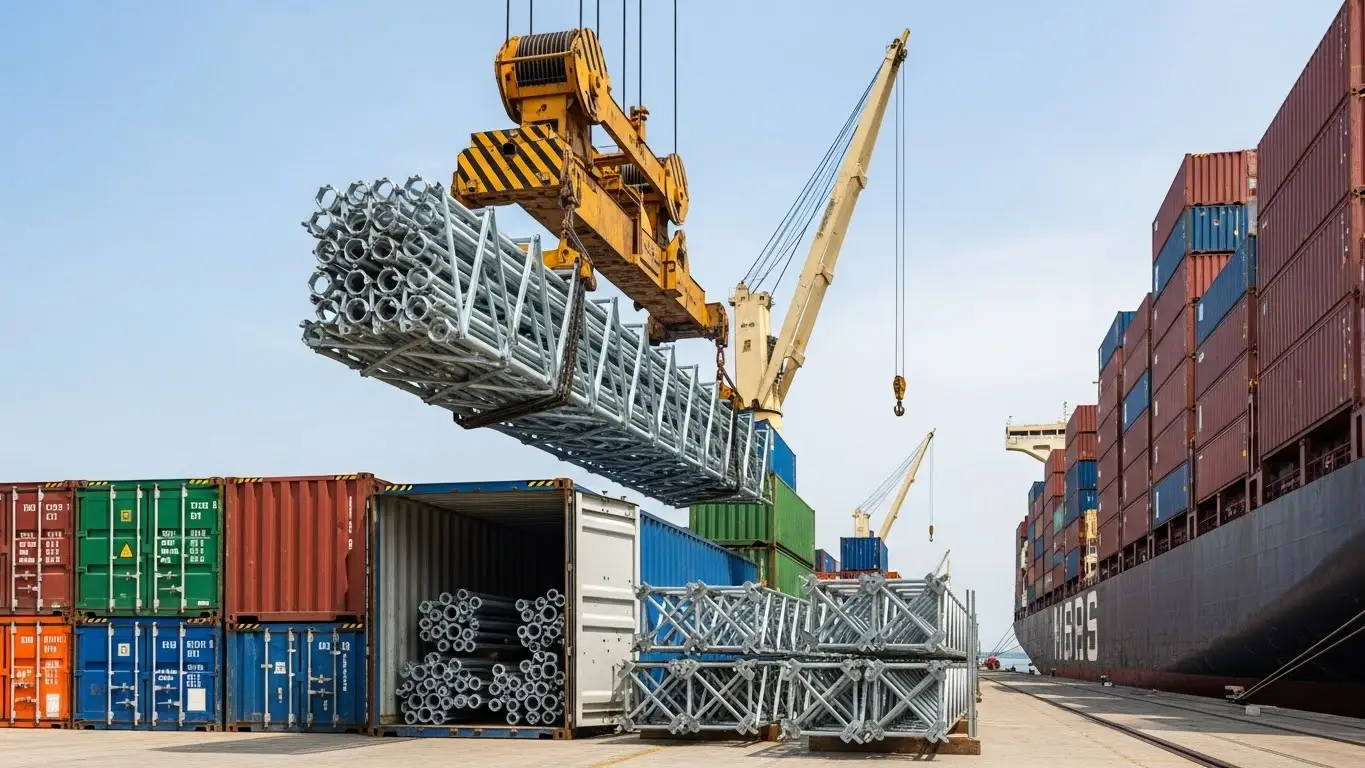
1. "Nesting" Saves Millions
Towers are bulky. If you ship them fully assembled or poorly packed, you are paying to ship air.
- Lattice Towers: Individual angle bars are bundled.
- Monopoles: Tapered sections act like "Russian dolls," sliding inside one another (nesting) to fit 3-4 pole sections in the footprint of one.
- Transport Guide: Collapsible Antenna Tower Transport Guide
2. The Tariff Elephant
If you are importing to the USA, Section 232 tariffs (25% on steel) apply.3 However, for many other regions (Southeast Asia, Africa, South America), trade agreements often allow for lower or zero duties.
- Tip: Check if your tower is classified under HS Code 7308.20 (Towers and lattice masts of iron or steel).
Common Mistakes to Avoid
❌ 1. Specifying "Generic" Steel
Don't just say "High Strength Steel." Specify the grade (e.g., Q345B). If you leave it vague, a budget shop might use Q235 (Mild Steel), which has 30% less yield strength.
❌ 2. Ignoring Third-Party Inspection
Never ship without a check. Hire a third-party agency (like SGS or BV) to visit the factory in China before the container doors seal.4 They should verify:
- Zinc thickness (Elcometer test).
- Weld quality (Magnetic particle test).
- Assembly fit-up (Trial assembly of one tower).
❌ 3. Forgetting the "Extras"
Chinese quotes are often FOB (Free on Board). This means once it hits the ship, it's your problem. Ensure you have a freight forwarder who understands DDP (Delivered Duty Paid) if you want a hassle-free delivery to your site.
Expert Tips for 2026 Sourcing
- Look for the "ISO Stack": Don't just check for ISO 9001. Look for ISO 14001 (Environment) and ISO 45001 (Safety). A factory with all three is a mature, global player, not a fly-by-night workshop.
- Why this matters: Do Telecom Towers Meet ISO 9001 and Safety Compliance Standards?
- Ask for Trial Assembly Photos: Before mass production, ask the factory to assemble one prototype tower in their yard. This proves the bolt holes align and the geometry is correct before 50 containers arrive at your site.
- Consider Hybrid Materials: For specific rapid-deployment needs, ask if they can source aluminum components. While China is known for steel, their aluminum fabrication is world-class.
Frequently Asked Questions
Ocean freight typically takes 15–25 days to Southeast Asia, 30–40 days to the Middle East/Africa, and 40–50 days to the Americas or Europe. Always buffer your project schedule by 2 weeks for customs clearance.
Standard terms are 30% T/T deposit to start production and 70% balance against the Bill of Lading (before the goods arrive). Letter of Credit (L/C) is also common for large infrastructure projects >$100k.
Specify ASTM A123 standards in your contract and demand a report on the steel's Silicon content. Silicon between 0.04% and 0.15% causes the "Sandelin Effect," leading to peeling zinc.
Yes. While we use GB (Chinese) steel, our engineering teams use software like PLS-TOWER to design structures that meet Eurocode 3 or TIA-222-H load requirements.
For custom towers, usually one container (20 tons) is the practical minimum to make shipping economical. However, for standard monopoles or accessory parts, smaller orders are negotiable.
This is why "packing lists" are critical. Reputable exporters provide a detailed manifest for every container. We recommend counting bundles upon arrival. XYTOWER provides a warranty to replace missing or damaged parts immediately.
Key Takeaways
- Cost Efficiency: Expect 20–30% total savings compared to Western fabrication.
- Scale: Chinese factories can handle massive volume (40k+ tons) with short lead times.
- Standards: Ensure your supplier translates GB standards to ASTM/EN equivalents explicitly.
- Logistics: "Nesting" design is critical to reducing ocean freight costs.
- Verification: Always use Mill Test Certificates and Third-Party Inspections to guarantee quality.

Hey, I’m Chunjian Shu
"X.Y. Tower: Reliable, innovative solutions for high-quality towers and electrical equipment with professional service.
