
Choosing the Right Mobile Tower Height for Signal Coverage
2025-12-14
The ideal mobile tower height typically ranges from 50 to 200 feet (15-60 meters) for urban macro cells, and 150 to 400 feet (45-120 meters) for rural coverage. However, "taller" isn't always "better." The right height is a precise calculation that balances Line of Sight (LOS) physics, the frequency of your equipment (4G vs. 5G), and local zoning regulations. While a 300-foot guyed tower offers maximum rural reach, a 100-foot monopole is often the engineering sweet spot for capacity-dense urban networks.
The Physics of Height: Why It Matters
To choose the right height, you must understand the two invisible forces fighting your signal: Earth’s curvature and The Fresnel Zone.
1. Line of Sight (LOS) and Radio Horizon
Radio waves traveling over 100 MHz behave like light—they travel in straight lines. They cannot pass through hills or the curve of the earth. Raising the antenna extends the "Radio Horizon."
- Rule of Thumb: Doubling the tower height typically increases the coverage area by four times (assuming flat terrain).
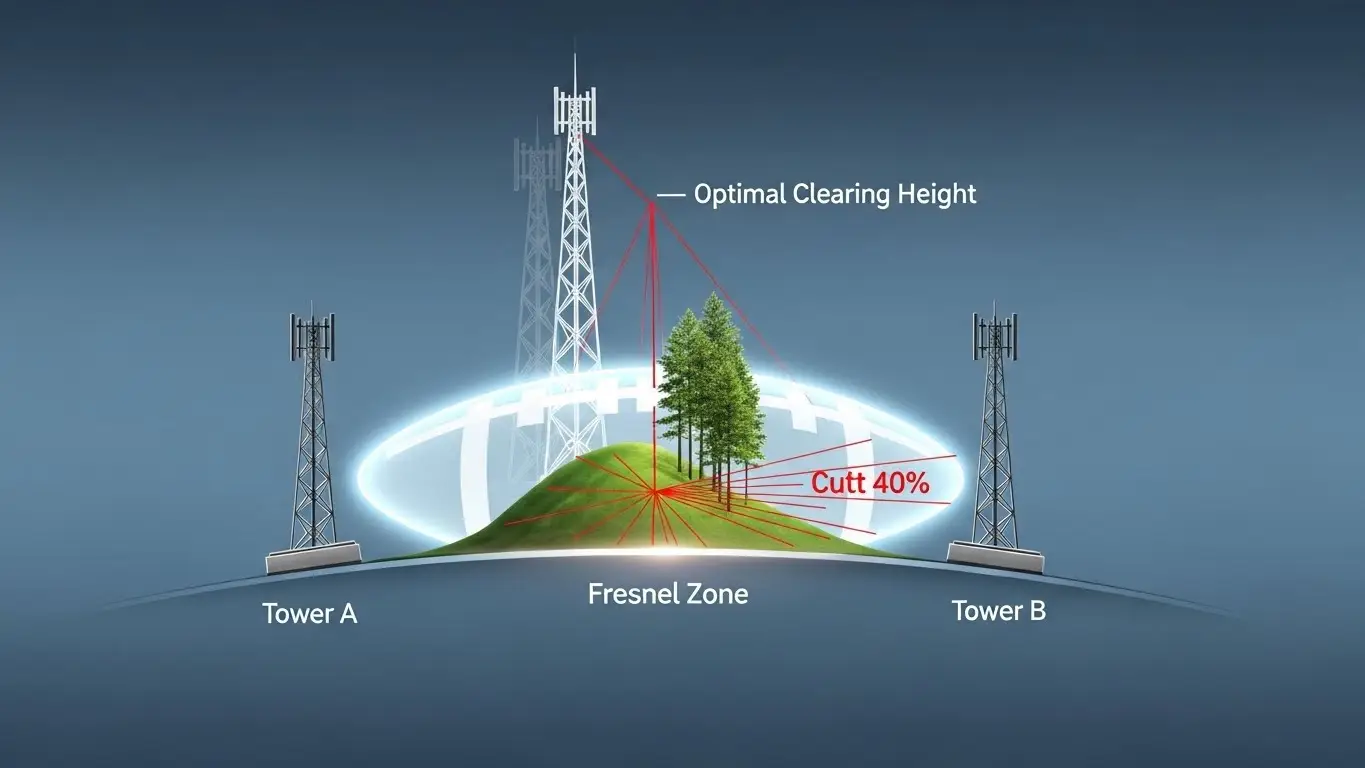
2. The Fresnel Zone
This is the football-shaped area of space between the transmitter and receiver. It’s not enough to just "see" the other antenna; you need to keep this tunnel clear of obstructions like trees or buildings.
- The 60% Rule: At least 60% of the Fresnel Zone must be clear of obstacles to maintain signal integrity. If your tower is too short, the bottom of this zone hits the ground, weakening the signal before it arrives.
Recommended Heights by Environment
One size does not fit all. The environment dictates the necessary elevation to clear obstacles.
| Environment | Typical Height Range | Tower Type Recommendation | Primary Challenge |
| Dense Urban | 50 – 100 ft (15-30m) | Monopole Towers / Rooftop Mounts | Interference & Building Clutter. Towers must be below the interference floor but above street traffic. |
| Suburban | 100 – 150 ft (30-45m) | Mobile Antenna Towers (Monopole) | Zoning Restrictions. Must look aesthetic while clearing 2-story homes and tree lines. |
| Rural / Highway | 200 – 400+ ft (60-120m) | Lattice / Guyed Towers | Terrain & Earth Curvature. Max height required for max distance. |
| Temporary / Event | 30 – 100 ft (9-30m) | Portable Antenna Towers | Rapid Deployment. Height limited by trailer stability and wind load. |
4G vs. 5G: The Frequency Factor
The technology you deploy drastically changes your height requirements.
Low-Band 4G/5G (600-900 MHz)
- Behavior: Travels far and penetrates walls.
- Height Strategy: Go High. Mount these on tall rural lattice towers to maximize the "umbrella" coverage over 20-40 miles.
Mid-Band & mmWave 5G (2.5 GHz - 39 GHz)
- Behavior: Travels short distances; easily blocked by leaves/glass.
- Height Strategy: Go Lower & Denser. For high-frequency 5G, placing antennas too high causes signal overshooting (missing the users on the ground). These are best mounted on shorter monopoles or Mobile Antenna Towers closer to street level (30-50 ft).
Regulatory Limits: The 200-Foot Ceiling
Before ordering a 300-foot tower, check the "soft cap" in the United States and many other regions.
- FAA Regulations: Any structure 200 feet or taller generally requires:
- Lighting (High-intensity strobes).
- Painting (Aviation Orange and White).
- Complex notification processes.
- The "sweet spot": Many developers build to 195 or 199 feet. This maximizes height while avoiding the expensive maintenance of aviation lighting and painting.
Portable Towers: Height vs. Load Capacity
When using Portable Antenna Towers, height becomes a trade-off with stability.
- Wind Load: As you extend a telescopic mast, the surface area exposed to wind increases.
- The Trade-Off: A portable tower might support 1,000 lbs at 30 feet, but only 300 lbs at 100 feet.
- Key Advice: Never maximize both height and payload. If you need extreme height for a portable setup, ensure you are using a heavy-duty Lattice COW (Cell on Wheels) with proper outriggers.
Frequently Asked Questions
Not always. In urban areas, a tower that is too tall can "overshoot" the target devices on the ground or pick up interference from distant towers. It creates a "noise" problem rather than a coverage solution.
A simplified formula for the optical horizon in miles is $1.23 \times \sqrt{\text{Height in feet}}$.
Example: A 100 ft tower has a horizon of ~12.3 miles.
Note: Real-world signal range is usually less due to terrain and frequency absorption.
For "Small Cell" 5G (mmWave), antennas can be as low as 20–30 feet (on light poles). However, for a macro site covering a neighborhood, 80–120 feet is standard to clear local tree lines.
Both can work. A Monopole is preferred for aesthetics and smaller footprints (urban), while a lattice tower is cheaper and more stable for heavy wind loads (rural).
Key Takeaways
- Match Height to Frequency: Use tall towers for Low-Band (rural coverage) and shorter, denser towers for High-Band (urban capacity).
- Respect the Fresnel Zone: Ensure your tower is tall enough to clear obstacles by at least 60% of the signal path radius.
- The 199-Foot Rule: Building just under 200 feet avoids costly FAA lighting and painting requirements.
- Portable Constraints: Remember that Portable Antenna Towers lose load capacity as they extend; balance your equipment weight with your height needs.
Conclusion
Choosing the right mobile tower height is not a guessing game—it is an engineering decision driven by physics and regulations. Whether you need a massive 300-foot lattice structure for rural connectivity or a rapid-deploy 60-foot portable unit for an event, the goal remains the same: clear the obstacles to clear the connection.
Ready to find the perfect structure for your height requirements? Explore our range of Mobile Antenna Towers to start planning your network.

Hey, I’m Chunjian Shu
"X.Y. Tower: Reliable, innovative solutions for high-quality towers and electrical equipment with professional service.
