
Collapsible Antenna Towers: Transport and Vehicle Fit Guide
2025-12-15
A collapsible antenna tower typically retracts to between 15% and 25% of its full extended height, depending on the number of sections. For example, a 15-meter (50 ft) mast usually nests down to 2.5–3 meters (8–10 ft), allowing it to fit on a standard roof rack or inside a long-wheelbase van. To ensure a safe vehicle fit, you must calculate the "Nested Height" plus the head-load equipment, ensuring it stays within your vehicle’s payload capacity and legal overhang limits.
The "Nesting Ratio": Will It Fit?
The first question every fleet manager asks is, "How short does it get?" The answer lies in the Nesting Ratio.
Collapsible towers (telescopic masts) are built from concentric tubes. To get a taller tower that collapses smaller, you need more sections. However, more sections mean a wider base diameter and higher cost.
Typical Retracted Lengths:
| Extended Height | Sections | Typical Nested (Retracted) Length | Vehicle Fitment |
| 6 Meters (20 ft) | 4-5 | 1.5 - 1.8 m (5 - 6 ft) | Pickup Bed / SUV Roof |
| 10 Meters (33 ft) | 5-6 | 2.0 - 2.4 m (6.5 - 8 ft) | Standard Van / Service Truck |
| 15 Meters (50 ft) | 6-7 | 2.7 - 3.5 m (9 - 11.5 ft) | Long Sprinter Van / Trailer |
| 30 Meters (100 ft) | 8-9 | 5.0 - 6.0 m (16 - 20 ft) | Flatbed Truck / Heavy Trailer |
Note: These are estimates. Always check specific specs from a custom mast tower manufacture guide.
Transport Modes: Horizontal vs. Vertical
How you transport the mast dictates which type of system you should buy.
1. Horizontal Transport (Roof or Bed)
This is the most common method for temporary sites. The mast lays flat during transit and is hinged up for deployment.
- Best For: Telescopic unguyed towers made of aluminum or lightweight steel.
- Critical Check: Ensure your mast's internal fluids (if hydraulic) or seals (if pneumatic) are rated for horizontal positioning. Some oil-lubricated mechanical masts must remain upright to prevent leakage.
- Vehicle Match: Roof racks on SUVs, ladder racks on utility trucks.
2. Vertical Integration (Through-Roof or Rear-Mount)
The mast is permanently mounted upright on the vehicle.
- Best For: "Drive-and-broadcast" news vans or mobile surveillance units.
- Constraint: The Nested Height cannot exceed the vehicle's clearance limits (bridges, tunnels). A mast that sticks up 2 meters above a van roof is a hazard.
- Vehicle Match: Internal mounting in Vans (Sprinter/Transit) or rear-bumper mounts on HMMWVs/Tactical trucks.
Choosing the Right Tower for Your Vehicle
Don't buy the tower first; evaluate your vehicle's payload and dimensions.
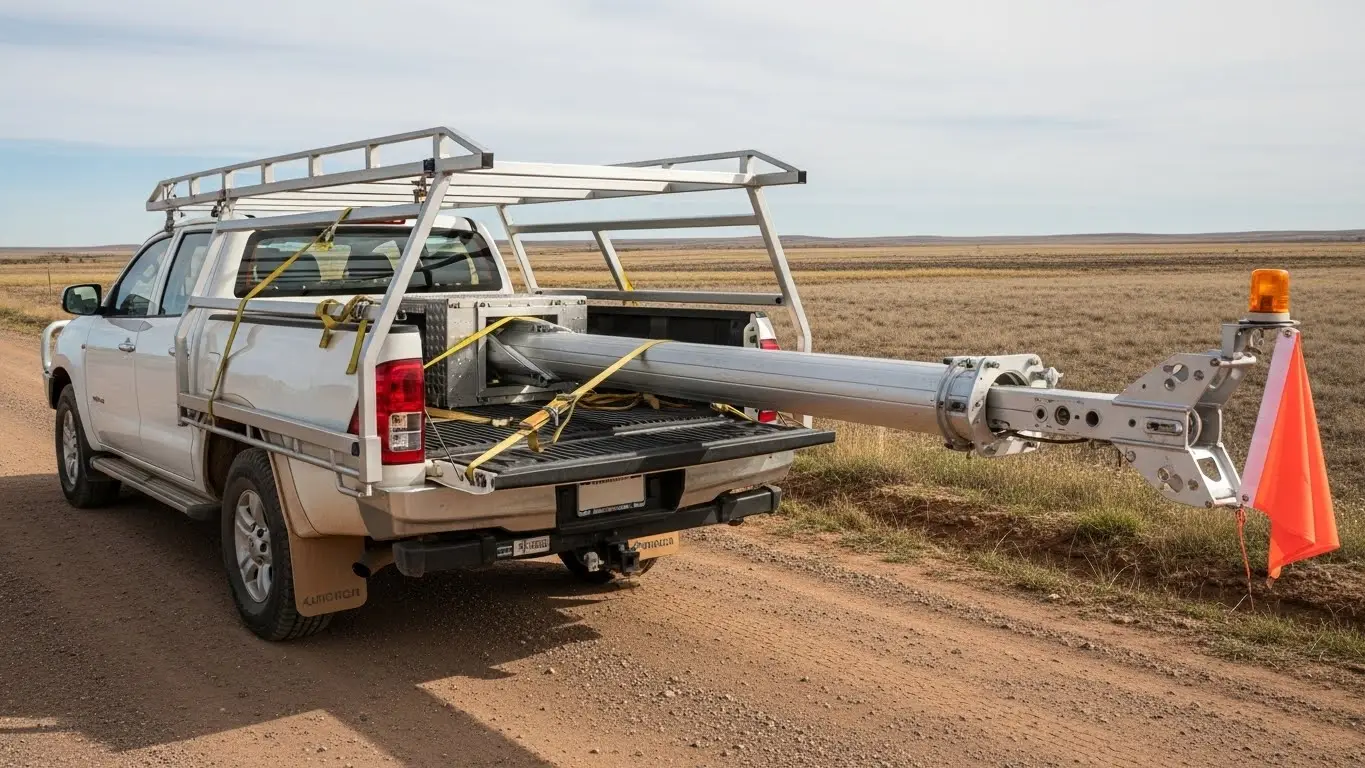
For Pickup Trucks (F-150 / Hilux class)
- Payload Limit: ~1,000 kg (2,200 lbs).
- Bed Length: 1.5m - 2.4m (5 - 8 ft).
- Recommendation: A 10-12m pneumatic aluminum mast. It is light enough to not affect suspension handling and short enough to fit on a "headache rack" (cab protector) without illegal overhang.
For Trailers (COWs)
- Payload Limit: High (Axle dependent).
- Recommendation: A heavy-duty Galvanized Steel Mechanical Mast. Since weight is less of a concern, you can opt for a cheaper, heavier steel mast that offers better stability for microwave dishes.
- Link: See how to select these in our choose telescopic mast tower guide.
For Compact SUVs / Jeeps
- Payload Limit: Low (~500 kg).
- Recommendation: A lightweight pneumatic mast (6-8m max). Use a hitch-mounted carrier or roof basket. Beware of creating a high center of gravity that creates rollover risk.
Legal Considerations: The "Overhang" Rule
If your collapsible tower is longer than your vehicle, you risk fines.
- Rear Overhang: In many jurisdictions (like the US and EU), loads cannot extend more than 1.0 - 1.5 meters beyond the rear tail lights without a red warning flag or light.
- Front Overhang: Usually strictly prohibited or limited to 0.5 meters.
- Height Clearance: If vertical, ensure your total clearance is under 3.5 meters to clear standard underpasses safely.
Frequently Asked Questions
Usually, yes, but only if the mast has a "Keyed" or Non-Rotating feature. If the mast sections can spin freely, your expensive antenna will bounce and rotate during transit, damaging the cables. Secure it with a transport strap.
High-quality pneumatic masts use sealed collars and should not leak air or fluid when laid horizontally, provided the purge valves are closed. However, mechanical screw-drive masts are often preferred for horizontal transport as they have no fluids to leak.
"Nested Height" is the length of the tubes themselves. "Stowed Height" typically includes the base plate, top mounting bracket, and any accessories. Always use Stowed Height for vehicle fitment.
Most vehicle masts run on 12V/24V DC compressors sourced directly from the vehicle's battery. For larger trailers, a separate generator or 110V/220V AC connection is standard.
Key Takeaways
- Calculate the Ratio: Expect a collapsed length of roughly 20% of the total extended height.
- Watch the Weight: A steel mast might fit physically but exceed your roof rack's dynamic weight rating (often only 75kg).
- Orientation Matters: Check if your specific mast model allows horizontal transport without seal damage.
- Mind the Gap: Measure your garage and bridge clearances if mounting vertically.
Conclusion
Selecting a collapsible antenna tower is a game of "Tetris" with your vehicle's dimensions. By focusing on the nesting ratio and adhering to legal overhang limits, you can turn any pickup truck or trailer into a powerful mobile command center. Whether you need a lightweight aluminum unit for speed or a heavy steel rig for stability, measuring twice ensures you only deploy once.
Ready to outfit your fleet? Consult our custom mast tower manufacture guide to engineer a solution that fits your exact vehicle specifications.

Hey, I’m Chunjian Shu
"X.Y. Tower: Reliable, innovative solutions for high-quality towers and electrical equipment with professional service.
