
How Many Bolts in 132kV Transmission Tower? Complete Count Guide
2025-12-28
A typical 132kV transmission tower contains 1,200 to 2,500 bolts depending on tower type, height, and configuration. Suspension towers require 1,200-1,500 bolts, angle towers need 1,800-2,200 bolts, and dead-end towers use 2,000-2,500 bolts. The distribution includes main leg bolts (400-600), bracing member bolts (500-800), cross-arm assembly bolts (200-350), and foundation anchor bolts (16-24).
Here's the quick breakdown:
| Tower Type | Height Range | Typical Bolt Count | Primary Use |
|---|---|---|---|
| Suspension | 25-35m | 1,200-1,500 | Straight line sections |
| Angle | 30-40m | 1,800-2,200 | Direction changes |
| Tension/Strain | 30-40m | 1,600-2,000 | Conductor tension points |
| Dead-end | 35-50m | 2,000-2,500 | Line termination |
After manufacturing over 8,000 tons of transmission line towers since 2008, we've documented exact bolt counts across hundreds of 132kV projects. This guide shows you the real numbers.
Why Bolt Count Varies So Much
The 1,300-bolt difference between tower types isn't random. Three factors drive this variation.
Tower structural load: Dead-end towers resist the full conductor tension from one direction, requiring reinforced connections throughout. That means more bolts at every joint. Our engineering team adds roughly 400-600 additional bolts to dead-end designs compared to suspension towers.
Height extensions: Each 3-meter section adds 80-120 structural bolts. A standard 132kV tower at 28 meters uses the base count. Extend it to 40 meters with two 6-meter sections, and you're adding 320-480 bolts to your material list.
Circuit configuration: Double circuit towers carry six conductors instead of three. The extra cross-arm assemblies, wider base structure, and additional bracing mean 300-400 more bolts than single circuit equivalents.
Bolt Count Breakdown by Tower Type
Let's get specific. Here's what you'll actually order for each tower type.
Suspension Towers: 1,200-1,500 Bolts
These are your workhorse towers for straight-line sections. The bolt distribution looks like this:
| Component | Bolt Count | Percentage | Common Sizes |
|---|---|---|---|
| Main leg connections | 400-450 | 33% | M20, M24 |
| Bracing members | 500-600 | 42% | M16, M20 |
| Cross-arm assemblies | 200-300 | 21% | M16, M20 |
| Miscellaneous hardware | 50-80 | 4% | M12, M16 |
| Total | 1,200-1,500 | 100% | — |
Foundation anchor bolts (16-20 bolts, typically M24-M30) are counted separately since they're embedded in concrete before tower assembly.
Angle Towers: 1,800-2,200 Bolts
Line direction changes create lateral loads that demand reinforcement. You'll see the difference in these areas:
- Reinforced leg connections: 500-650 bolts (vs. 400-450 in suspension)
- Additional K-bracing: 700-850 bolts (vs. 500-600 in suspension)
- Strengthened cross-arms: 250-350 bolts (vs. 200-300 in suspension)
- Hardware and gussets: 80-120 bolts (vs. 50-80 in suspension)
The angle size matters too. Small angle towers (2-10° deviation) sit at the lower end of this range. Large angle towers (30-60° deviation) hit the upper limit or exceed it.
Tension and Dead-End Towers: 1,600-2,500 Bolts
These towers handle the highest loads. Dead-end towers at major substations top the count because they:
- Use double-bolted connections at critical joints (where suspension towers use single)
- Include stub angle assemblies at the base (adds 100-150 bolts)
- Feature redundant bracing in the tower body (adds 200-300 bolts)
- Support heavier strain insulator assemblies (adds 80-120 bolts)
When we built 132kV dead-end towers for a Southeast Asian project in 2022, the 45-meter towers required 2,380 bolts each. The same customer's 28-meter suspension towers used 1,420 bolts.
Component-by-Component Bolt Distribution
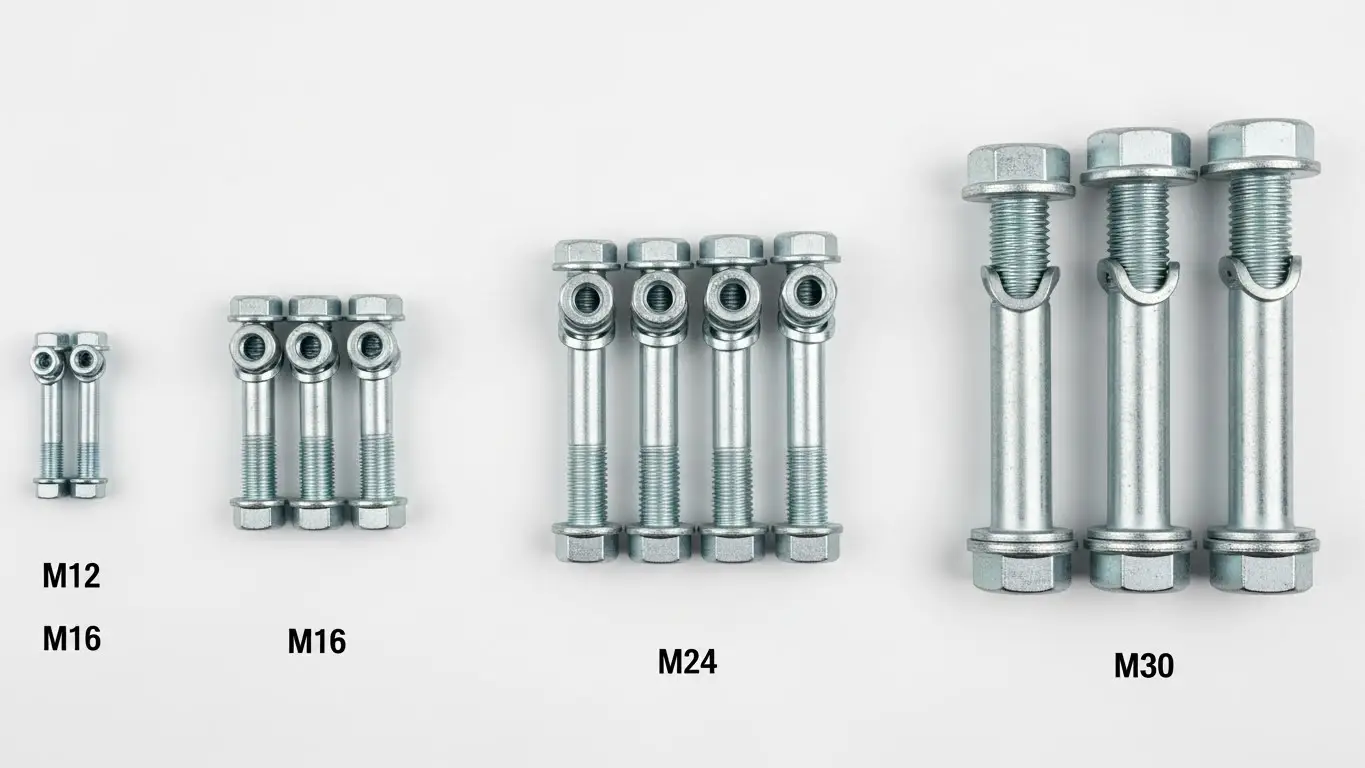
Understanding where the bolts go helps you catch errors in material estimates. Here's the complete breakdown.
Foundation Anchor Bolts: 16-24 Per Tower
These don't count toward the "tower body" total, but you still need to order them.
Each tower leg needs 4-6 anchor bolts embedded in the concrete foundation. Standard configuration:
- Four legs × 4 bolts each = 16 anchor bolts (minimum)
- Four legs × 6 bolts each = 24 anchor bolts (heavy-duty)
Size: M24-M30, Grade 8.8 or ASTM A394 Type 1. Our galvanizing factory applies 86 microns minimum coating thickness on anchor bolts since they're partially buried.
Main Leg Connections: 400-600 Bolts (35-40%)
The tower legs use lap-splice connections every 3-6 meters of height. Each splice joint requires:
- 8-12 bolts for single angle sections
- 16-24 bolts for double angle (back-to-back) sections
On a 30-meter tower with splices at 0m, 6m, 12m, 18m, 24m, and 30m, that's six splice locations × four legs = 24 splice joints. At 12 bolts per joint average, you're at 288 bolts just for leg splices.
Add the base-to-stub connections and cross-bracing attachment points, and you reach 400-600 total for this component.
Horizontal and Diagonal Bracing: 500-800 Bolts (40-45%)
This is your largest bolt category. The tower body uses K-bracing, X-bracing, or combined patterns. Each connection point typically needs:
- Diagonal members: 4-6 bolts per connection (both ends)
- Horizontal members: 3-4 bolts per connection
- Secondary bracing: 2-3 bolts per connection
Count the connection points on your tower drawings, multiply by bolts per connection, and you'll land in this range. Angle towers and dead-end towers sit at the upper end due to doubled bracing in high-stress panels.
Cross-Arm Assemblies: 200-350 Bolts (15-20%)
Cross-arms support the conductor insulators. A 132kV tower typically has:
- One top cross-arm (for top phase conductor)
- One middle cross-arm (for middle phase conductor)
- One bottom cross-arm (for bottom phase conductor)
- Ground wire peak assembly
Each cross-arm assembly requires:
- Main connection to tower body: 12-20 bolts
- Bracing members: 16-24 bolts
- Insulator attachment brackets: 8-12 bolts
Total per arm: 36-56 bolts. Three arms = 108-168 bolts. Add the ground wire assembly (40-60 bolts) and equipment mounting brackets (50-80 bolts), and you're at 200-350 bolts total.
Double circuit towers double the cross-arm bolts since you need six conductor positions instead of three.
Miscellaneous Hardware: 50-100 Bolts (3-5%)
Don't forget these:
- Step bolts for climbing: 20-40 bolts (one every meter of height)
- Anti-climbing device bolts: 8-16 bolts (around 3-meter height)
- Danger sign bolts: 4-8 bolts
- Tower number plate bolts: 4-8 bolts
- Equipment mounting: 10-20 bolts
Bolt Size and Grade Distribution for 132kV Towers
Not all bolts are the same size. Here's the actual distribution from our production records.
Size Distribution by Percentage
| Bolt Size | Percentage of Total | Primary Applications | Typical Length Range |
|---|---|---|---|
| M12 | 5% | Step bolts, light brackets | 40-80mm |
| M16 | 40% | Secondary bracing, cross-arm members | 50-100mm |
| M20 | 35% | Horizontal bracing, diagonal members | 60-120mm |
| M24 | 15% | Main leg splices, critical joints | 70-140mm |
| M30+ | 5% | Heavy-duty connections, foundations | 80-180mm |
For a 1,400-bolt suspension tower, that means:
- 70 × M12 bolts
- 560 × M16 bolts
- 490 × M20 bolts
- 210 × M24 bolts
- 70 × M30+ bolts
Grade Requirements by Application
Foundation anchor bolts:
- Grade 8.8 (DL/T 248-2021) or ASTM A394 Type 1
- Yield strength: 640 MPa minimum
- Always hot-dip galvanized per ASTM A153
Main structural bolts:
- Grade 6.8 (most common in Asian markets)
- Grade 4.8 acceptable for secondary members
- All galvanized to 70-86 microns coating thickness
Special application bolts:
- Step bolts: Grade 8.8 minimum for safety
- Equipment bolts: Stainless steel or weathering steel where specified
We source our tower steel fittings including bolts from ISO-certified suppliers. Every batch gets tested for tensile strength, galvanizing thickness, and thread dimensions before assembly.
How Tower Height Affects Your Bolt Count
Height directly impacts your material requirements. Here's how to calculate it.
Base Height Bolt Count
Standard 132kV towers use these baseline heights:
- 25-30 meters: Base bolt count applies (1,200-2,200 depending on type)
- 30-35 meters: Add first extension section
- 35-40 meters: Add second extension section
- 40-50 meters: Add third extension section (rare, special applications)
Extension Section Impact
Each 3-meter extension section adds approximately:
- Leg extension bolts: 32-48 bolts (8-12 per leg × 4 legs)
- Bracing bolts: 40-60 bolts (additional panels)
- Connection hardware: 8-12 bolts
Total per 3m extension: 80-120 bolts
Quick Calculation Formula
Total Bolts = Base Tower Count + (Extension Height ÷ 3m × 100 bolts)

Example 1: Suspension tower, 28m height (no extensions)
= 1,400 bolts (base count)

Example 2: Suspension tower, 34m height (6m extension)
= 1,400 + (6m ÷ 3m × 100)
= 1,400 + 200
= 1,600 bolts

Example 3: Angle tower, 40m height (10m extension)
= 1,900 + (9m ÷ 3m × 100)
= 1,900 + 300
= 2,200 bolts
This formula gets you within 5% accuracy for material estimation. For final procurement, always verify against actual tower drawings.
Height vs. Bolt Count Reference
| Base Height | Extension | Added Bolts | Suspension Total | Angle Total |
|---|---|---|---|---|
| 25m | 0m | 0 | 1,200 | 1,800 |
| 28m | 0m | 0 | 1,400 | 1,900 |
| 31m | 3m | 100 | 1,500 | 2,000 |
| 34m | 6m | 200 | 1,600 | 2,100 |
| 37m | 9m | 300 | 1,700 | 2,200 |
| 40m | 12m | 400 | 1,800 | 2,300 |
International Standards for 132kV Tower Bolts
Specifications matter. Here's what to reference in your procurement documents.
North American Standards
ASTM A394-08(2024) covers transmission tower bolts with:
- Type 0: Hot-dip zinc-coated, low/medium carbon steel (most common)
- Type 1: Hot-dip zinc-coated, quenched and tempered (high-strength applications)
- Type 3: Bare weathering steel (special applications)
Thread sizes: 1/2", 5/8", 3/4", 7/8", 1" (metric equivalents: M12, M16, M20, M22, M24)
Galvanizing per ASTM A153: Minimum 86 microns (610 g/m²) coating weight
Chinese Standards
DL/T 248-2021 specifies:
- Grades 4.8J, 6.8J, 8.8J, 10.9J
- Thread sizes: M12, M16, M20, M24, M30, M36
- Galvanizing per GB/T 13912-2002: Minimum 70 microns
Material requirements:
- Grade 6.8: 35K or 45# steel
- Grade 8.8: 35K, 45#, or 40Cr steel (quenched and tempered)
Indian Standards
IS 12427:2001 covers mushroom head and hexagon head transmission tower bolts:
- Steel grades: 5.8, 8.8
- Galvanizing per IS 2629
- Dimensional tolerances per IS 1367
European Standards
EN 14399 for structural bolting:
- Property classes 4.6, 5.6, 8.8, 10.9
- Hot-dip galvanizing per EN ISO 1461: 70-85 microns minimum
Most power transmission tower projects we export specify a combination of standards. African projects typically reference British Standards (BS). Southeast Asian projects use a mix of ASTM and Chinese standards. European projects strictly follow EN standards.
Always confirm which standard applies to your project before ordering. Bolt threads aren't interchangeable between standard systems.
Total Weight of Bolts in a 132kV Tower
Weight affects shipping costs and tower design calculations. Here's what the bolt assembly weighs.
Weight by Bolt Size
| Bolt Size | Approximate Unit Weight | Typical Quantity | Total Weight |
|---|---|---|---|
| M12 | 25g | 70 bolts | 1.8 kg |
| M16 | 50g | 560 bolts | 28.0 kg |
| M20 | 90g | 490 bolts | 44.1 kg |
| M24 | 150g | 210 bolts | 31.5 kg |
| M30 | 280g | 70 bolts | 19.6 kg |
| Bolts Subtotal | — | 1,400 bolts | 125 kg |
Add nuts (same weight as bolts) and washers (10% of bolt weight):
- Nuts: 125 kg
- Washers: 12.5 kg
- Total hardware weight: 262.5 kg
For a complete 132kV suspension tower weighing 5,500-7,000 kg, the bolt assembly represents approximately 3.8-4.8% of total weight.
Weight Considerations for Project Planning
Shipping: Bolts ship separately from tower steel. Plan for 0.25-0.35 tons of hardware per tower.
Handling: Bolt packages arrive in boxes of 50-100 bolts by size. A full tower's hardware fills 15-20 boxes weighing 10-20 kg each.
Inventory: Store bolts by size and grade. Mixing different standards creates assembly problems.
Single Circuit vs. Double Circuit Bolt Requirements
Circuit configuration significantly changes your bolt count. Here's the comparison.
| Specification | Single Circuit | Double Circuit | Difference |
|---|---|---|---|
| Base tower body | 800-1,000 bolts | 900-1,150 bolts | +100-150 |
| Cross-arm assemblies | 200-300 bolts | 350-500 bolts | +150-200 |
| Foundation bolts | 16-20 bolts | 20-24 bolts | +4 |
| Suspension total | 1,200-1,500 | 1,500-1,900 | +300-400 |
| Angle total | 1,800-2,200 | 2,100-2,600 | +300-400 |
Why Double Circuit Adds Bolts
Cross-arm complexity: Six conductor positions instead of three means:
- Double the number of insulator brackets
- Wider cross-arm spans requiring more bracing
- Heavier assembly creating higher connection loads
Tower base width: Supporting six conductors requires wider tower bases. Base width increases from 3.5-4.0 meters to 4.5-5.5 meters. The wider geometry adds:
- Extra horizontal bracing members
- Additional diagonal bracing for stability
- More connection points throughout the structure
Foundation requirements: Heavier loads mean 4-6 anchor bolts per leg instead of 4 bolts per leg.
How to Calculate Bolt Requirements for Your 132kV Project
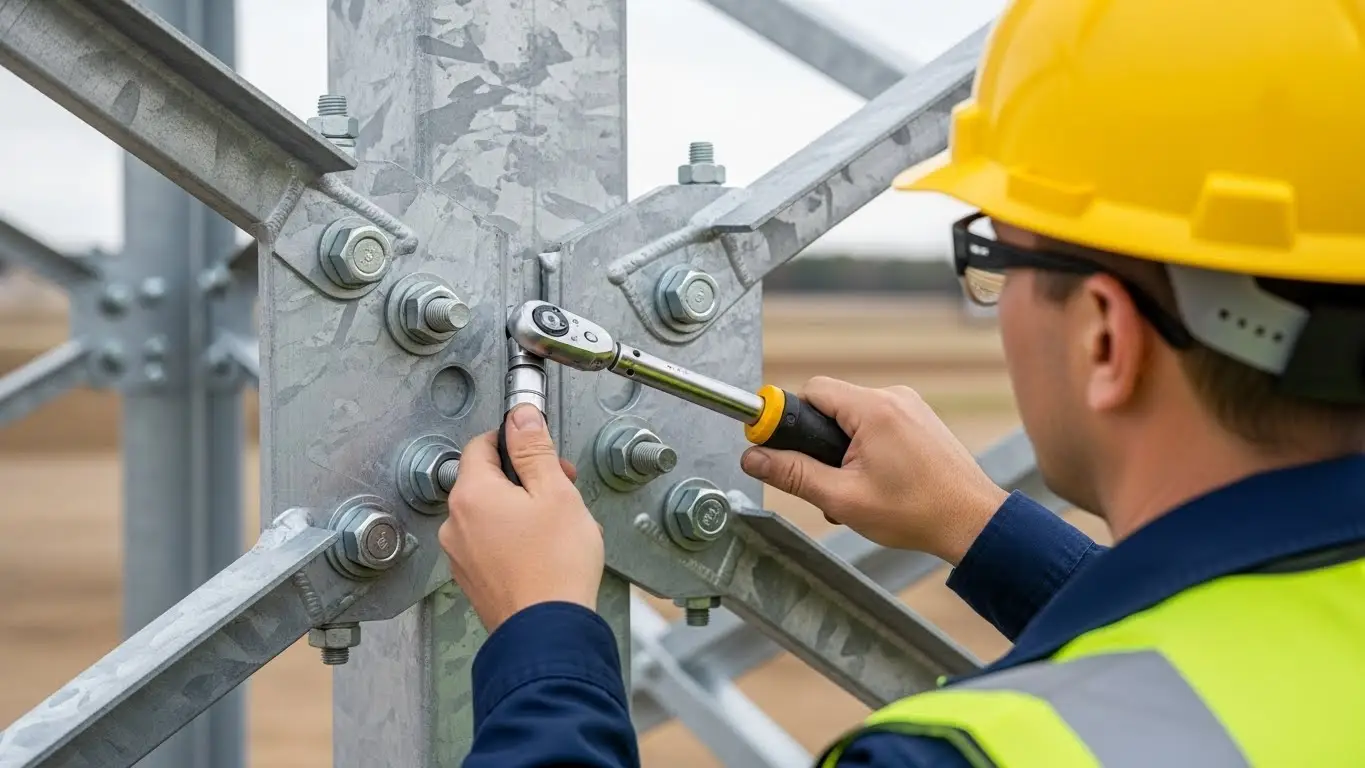
Follow this process to generate accurate material estimates.
Step 1: Identify Your Tower Types
Review your transmission line design. Count:
- Number of suspension towers
- Number of angle towers (note the angle degrees)
- Number of tension towers
- Number of dead-end towers
Example project: 80 km line with towers every 350 meters = 229 total towers
- 210 suspension towers
- 12 small angle towers (2-10°)
- 5 medium angle towers (10-30°)
- 2 dead-end towers
Step 2: Determine Heights and Extensions
Check tower spotting profiles. List:
- Standard height towers (count)
- Towers with 3m extension (count)
- Towers with 6m extension (count)
- Towers with 9m+ extension (count)
Example: Out of 210 suspension towers:
- 170 towers at 28m (standard)
- 30 towers at 31m (3m extension)
- 10 towers at 34m (6m extension)
Step 3: Check Circuit Configuration
Single or double circuit? This affects every tower.
Step 4: Calculate Base Bolt Count
Use these baseline numbers:
| Tower Type | Single Circuit | Double Circuit |
|---|---|---|
| Suspension | 1,400 | 1,700 |
| Small angle (2-10°) | 1,800 | 2,100 |
| Medium angle (10-30°) | 2,000 | 2,300 |
| Large angle (30-60°) | 2,200 | 2,500 |
| Dead-end | 2,300 | 2,600 |
Step 5: Add Extension Bolts
For each tower with extensions:
- 3m extension: +100 bolts
- 6m extension: +200 bolts
- 9m extension: +300 bolts
- 12m extension: +400 bolts
Step 6: Calculate Project Total
Example calculation for our 229-tower project:
Suspension towers (210 total):
- 170 × 1,400 bolts = 238,000
- 30 × 1,500 bolts = 45,000
- 10 × 1,600 bolts = 16,000
- Suspension subtotal: 299,000 bolts
Angle towers (17 total):
- 12 × 1,800 bolts = 21,600
- 5 × 2,000 bolts = 10,000
- Angle subtotal: 31,600 bolts
Dead-end towers (2 total):
- 2 × 2,300 bolts = 4,600
Project total: 335,200 structural bolts
Foundation anchor bolts: 229 towers × 20 bolts = 4,580 anchor bolts
Step 7: Add 15% for Spares and Wastage
Structural bolts: 335,200 × 1.15 = 385,480 (round to 386,000)
Anchor bolts: 4,580 × 1.15 = 5,267 (round to 5,300)
Step 8: Break Down by Size
Apply the standard distribution percentages:
| Size | Percentage | Structural Bolts | Anchor Bolts | Total to Order |
|---|---|---|---|---|
| M12 | 5% | 19,300 | — | 19,300 |
| M16 | 40% | 154,400 | — | 154,400 |
| M20 | 35% | 135,100 | — | 135,100 |
| M24 | 15% | 57,900 | 2,650 | 60,550 |
| M30 | 5% | 19,300 | 2,650 | 21,950 |
| Total | 100% | 386,000 | 5,300 | 391,300 |
This gives you a complete procurement list broken down by size. For our 40,000 tons annual capacity manufacturing facility, this represents about 3.5 tons of hardware—a typical month's bolt consumption for our 132kV transmission tower production line.
Cost and Procurement Considerations
Understanding costs helps you budget accurately. Here's what to expect.
Typical Bolt Costs (2024 Pricing)
Prices vary by order quantity, but these ranges apply for bulk orders:
| Bolt Size | Price Range (USD per bolt) | 1,000-Bolt Price | 10,000-Bolt Price |
|---|---|---|---|
| M12 | $0.40-$0.80 | $0.60 | $0.45 |
| M16 | $0.50-$1.20 | $0.85 | $0.60 |
| M20 | $0.80-$1.80 | $1.30 | $0.95 |
| M24 | $1.50-$3.00 | $2.20 | $1.70 |
| M30 | $2.50-$5.00 | $3.75 | $3.00 |
Total bolt cost per suspension tower: $1,500-$2,800 (depending on specifications)
Total bolt cost per angle tower: $2,200-$4,000
For a 100-tower project, hardware costs range from $150,000 to $400,000. That's 5-8% of total tower steel costs.
Procurement Best Practices
Order in bulk: Negotiate better pricing by ordering for your entire project at once. We manufacture 180 tons of tower steel monthly, and we order six months of bolts at a time to lock in pricing.
Specify galvanizing clearly: Standard hot-dip galvanizing adds 15-20% to bolt costs compared to plain steel. But it's essential. Specify minimum 70 microns coating thickness (ASTM A153 or equivalent).
Verify standards compliance: Request mill certificates showing:
- Chemical composition
- Mechanical properties (tensile strength, yield strength, elongation)
- Galvanizing thickness test results
- Thread dimension verification
Check thread compatibility: ASTM and DIN threads differ. Mixing standards creates field assembly problems. Specify one standard system for your entire project.
Plan for lead times: Standard bolts ship in 2-4 weeks. Custom sizes or special coatings need 6-8 weeks. Order early.
Quality inspection matters: We reject 2-3% of bolt shipments during incoming inspection for:
- Insufficient galvanizing thickness
- Thread damage
- Dimensional variations
- Wrong grade markings
Having backup suppliers prevents project delays.
Maintenance and Replacement Factors
Bolt maintenance extends tower service life. Here's what field crews need to know.
Inspection Requirements
Visual inspection schedule:
- New towers: After 1 year in service
- Normal conditions: Every 3-5 years
- Coastal/industrial areas: Every 2-3 years
- After severe weather events: Within 6 months
What to check:
- Galvanizing condition (white rust is acceptable; red rust is not)
- Bolt loosening (check critical connections with torque wrench)
- Thread damage or shearing
- Missing nuts or washers
Common Replacement Scenarios
Corrosion replacement: Coastal installations lose 5-10 microns of galvanizing per year. After 7-10 years, some bolts need replacement. Priority order:
- Foundation anchor bolts (ground contact accelerates corrosion)
- Lower tower bolts (splash zone from ground moisture)
- Cross-arm bolts (bird dropping acid)
Retrofitting additions: Adding equipment to existing towers (telecom antennas, monitoring equipment) requires 20-50 new mounting bolts per tower.
Storm damage repair: Lightning strikes and high winds create localized failures. Keep spare kits on hand with:
- 50 × M16 bolts
- 50 × M20 bolts
- 30 × M24 bolts
- 100 matching nuts and 200 washers
Recommended Spare Inventory
For a 100-tower transmission line:
| Item | Quantity | Purpose |
|---|---|---|
| M16 structural bolts | 500-1,000 | Most common size |
| M20 structural bolts | 400-800 | Second most common |
| M24 structural bolts | 200-400 | Critical connections |
| M30 anchor bolts | 50-100 | Foundation repairs |
| Nuts (all sizes) | Match bolt quantities | — |
| Washers (all sizes) | 2× bolt quantities | — |
This represents about 3-5% of project total, stored at maintenance depots along the line.
Our substation structure projects require similar spare inventories. We recommend clients order spares at the time of original tower procurement to ensure batch consistency.
Real-World Project Example: 132kV Line in Southeast Asia
Here's how the numbers worked on an actual project our team completed in 2023.
Project details:
- 95 km transmission line
- 272 total towers
- Terrain: Mixed (flat agricultural + 15 river crossings)
- Circuit type: Single circuit
Tower breakdown:
- 240 suspension towers at 28m height
- 18 suspension towers at 34m height (river crossings)
- 8 small angle towers at 30m height
- 4 medium angle towers at 32m height
- 2 dead-end towers at 38m height
Bolt calculation:
- Suspension 28m: 240 × 1,400 = 336,000 bolts
- Suspension 34m: 18 × 1,600 = 28,800 bolts
- Small angle 30m: 8 × 1,900 = 15,200 bolts
- Medium angle 32m: 4 × 2,100 = 8,400 bolts
- Dead-end 38m: 2 × 2,500 = 5,000 bolts
- Total structural: 393,400 bolts
- Foundation anchors: 272 × 20 = 5,440 bolts
- Project total: 398,840 bolts
Order quantity (with 15% spare):
- Structural: 452,410 bolts
- Anchors: 6,256 bolts
- Final order: 458,666 bolts total
Breakdown by size:
- 22,930 × M12 bolts
- 180,964 × M16 bolts
- 158,344 × M20 bolts
- 67,862 × M24 bolts
- 28,566 × M30 bolts
Total hardware weight: 98 tons (bolts, nuts, washers)
Project cost: Tower steel: $2.8M | Hardware: $185,000 (6.6% of steel cost)
The customer's initial estimate was 380,000 bolts based on generic calculations. Our detailed engineering increased the order by 78,666 bolts (21% increase). That prevented a mid-project shortage that would have cost far more than the additional hardware.
Frequently Asked Questions
M16, M20, and M24 bolts represent 90% of all fasteners in a 132kV tower. M16 bolts (40% of total) connect secondary bracing members, M20 bolts (35%) join horizontal and diagonal members, and M24 bolts (15%) secure main leg connections and critical load-bearing joints. The remaining 10% splits between M12 hardware bolts and M30+ heavy-duty connections.
A standard 132kV tower requires 16-24 foundation anchor bolts, with 4-6 bolts per leg depending on tower type and loading. Suspension towers typically use 16-20 anchor bolts (4 per leg), while dead-end and large angle towers use 20-24 anchor bolts (5-6 per leg). These bolts are M24-M30 size, Grade 8.8 or ASTM A394 Type 1, and are counted separately from the tower body structural bolts.
Yes, double circuit 132kV towers require 300-400 more bolts than equivalent single circuit towers. The increase comes from doubled cross-arm assemblies (six conductor positions instead of three), wider tower base requiring additional bracing members, and reinforced foundation connections. A single circuit suspension tower uses 1,200-1,500 bolts, while a double circuit suspension tower needs 1,500-1,900 bolts.
Add approximately 80-120 bolts for every 3 meters of height extension beyond the base tower. The formula is: Total Bolts = Base Tower Count + (Extension Height ÷ 3m × 100 bolts). For example, a 28m suspension tower with 1,400 base bolts extended to 34m (6m extension) needs 1,400 + (6÷3 × 100) = 1,600 bolts total. This accounts for additional leg splices, bracing panels, and connection hardware in the extension sections.
Specify ASTM A394-08(2024) for North American projects, DL/T 248-2021 for Asian markets, or IS 12427:2001 for Indian subcontinent projects. All specifications require hot-dip galvanizing per ASTM A153, ISO 146, or GB/T 13912-2002 with minimum 70-86 microns coating thickness. Always verify which standard applies to your project location before ordering, as thread dimensions and mechanical properties vary between standards and bolts are not interchangeable.
Total bolt assembly costs range from $1,500-$4,000 per tower depending on tower type, height, and bolt specifications. Suspension towers cost $1,500-$2,800 in hardware, angle towers run $2,200-$3,500, and dead-end towers reach $2,800-$4,000. This represents 5-8% of total tower steel cost. For a 100-tower project, budget $150,000-$400,000 for complete bolt assemblies including nuts and washers.
Foundation anchor bolts must be Grade 8.8 (per DL/T 248-2021) or ASTM A394 Type 1 with minimum yield strength of 640 MPa. These bolts experience combined tension, shear, and bending loads from tower base reactions and must withstand higher stresses than tower body bolts. Main structural connections use Grade 6.8 or Type 0 bolts, while secondary bracing may use Grade 4.8 where structural analysis permits lower strength requirements.
Order 10-15% additional bolts beyond calculated requirements to account for installation wastage, coating damage during galvanizing, and future maintenance needs. For a 100-tower project requiring 140,000 structural bolts, order 154,000-161,000 total. Maintain spare inventory at maintenance depots with 500-1,000 M16 bolts, 400-800 M20 bolts, 200-400 M24 bolts, and matching quantities of nuts and washers for field repairs and retrofitting.

Hey, I’m Chunjian Shu
"X.Y. Tower: Reliable, innovative solutions for high-quality towers and electrical equipment with professional service.
