
Lattice & Guyed Towers: The Definitive Guide for Telecom Networks
2025-12-08
Lattice & Guyed Towers are the undisputed backbone of reliable telecommunications infrastructure, providing the height and stability needed for global connectivity. Whether you are expanding a 5G network or setting up rural broadband, choosing the right support structure—self-supporting lattice or wire-supported guyed—determines your project's budget, longevity, and signal quality.
In this guide, we strip away the jargon. We will compare structural integrity, analyze cost efficiencies, and provide the technical "on-the-ground" insights you need to make the right engineering decision.
What Is the Main Difference Between Lattice and Guyed Towers?
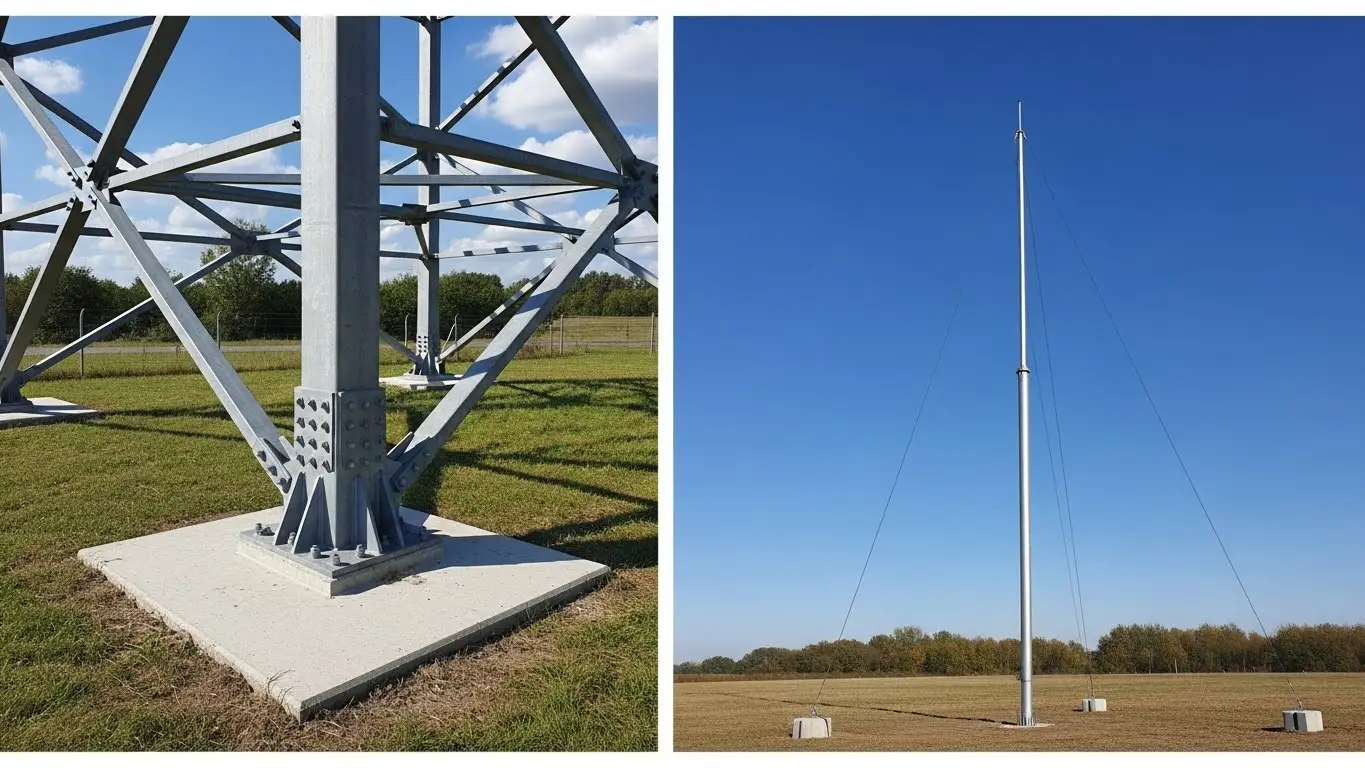
The primary difference lies in their support method and footprint: Lattice towers are self-supporting structures with a triangular or square base requiring less land, while Guyed towers rely on tensioned cables (guy wires) for stability, requiring a much larger land area but using less steel.
The Structural Deep Dive
When I look at site plans, the choice often comes down to one metric: Real Estate vs. Material Cost.
- Self-Supporting Lattice Towers: Think of these as the "heavy lifters" of the telecom world. They use a wide base that tapers as it goes up. Because they don’t need guy wires, they are perfect for urban areas or locations where land is expensive or limited. However, they are heavier. They require more steel to support their own weight against wind loads.
- Guyed Towers: These are the efficient giants. They consist of a slender mast held in place by steel cables anchored to the ground. They are incredibly lightweight compared to lattice towers. If you have a large plot of land in a rural area, a guyed tower is almost always the more cost-effective choice for reaching extreme heights (often exceeding 2,000 feet).
Expert Note: Never underestimate the "Radius of Guy Anchors." I’ve seen projects delayed because the land acquisition team didn't account for the anchor points extending hundreds of feet from the tower base.
Which Tower Type Is Best for Heavy Wind and Ice Loads?
Lattice towers generally offer superior rigidity and torsional stability for heavy antenna loads in high-wind or icy regions, whereas guyed towers are excellent for extreme heights but require rigorous maintenance to manage cable tension during temperature fluctuations.
Weathering the Elements
Stability is not just about standing up; it’s about deflection.
- Lattice Rigidity:For microwave backhaul links, deflection (twisting or swaying) is the enemy. A deviation of just a degree can misalign a focused beam. Lattice towers, specifically 3-legged or 4-legged angular steel designs, provide high torsional stiffness. If you are mounting heavy Remote Radio Units (RRUs) and massive dish antennas, the lattice structure minimizes twist.
- The Guyed Tower Advantage:Don't count guyed towers out. They are aerodynamic. Because the mast is slender, it catches less wind. However, in icy conditions, the guy wires themselves can accumulate ice. This "galloping" effect (wires bouncing in the wind) can stress the mast.
Comparison of Environmental Resilience
| Feature | Lattice Tower (Self-Supporting) | Guyed Tower |
| Wind Resistance | High stiffness; low sway. | Good, but relies on tension. |
| Ice Load | Handles ice weight well on members. | Wires prone to ice buildup. |
| Seismic Activity | Excellent structural damping. | Flexible, moves with ground. |
| Footprint Required | Small (Base only). | Massive (Anchor radius). |
How Do Installation Costs Compare?
Guyed towers are significantly cheaper in terms of material manufacturing and transport, but their installation costs can skyrocket if land acquisition prices are high or if complex foundation work is required for multiple anchor points.
The Economics of Steel vs. Land
In my experience managing site builds, the budget sheet tells two different stories depending on your location.
- The Steel Factor: A 300-foot lattice tower uses exponentially more steel than a 300-foot guyed tower. You are paying for raw tonnage. If steel prices are high, lattice towers hurt the budget.
- The Land Factor: A guyed tower saves you money on steel, but "spends" it on land. You might need a 200-foot radius for your anchors. In a city, that land is unobtainable. In a cornfield, it’s cheap.
Tip: Always factor in the foundation concrete. Lattice towers require one massive central foundation. Guyed towers need a central base plus three (or more) anchor blocks. Sometimes, digging three separate holes in rocky terrain costs more than pouring one big slab.
If you are dealing with unique terrain or specific load requirements, relying on a generic catalog won't work. You often need a tailored approach. Reading a comprehensive custom mast tower manufacture guide can help you understand how manufacturers adjust steel grades and bracing patterns to save costs without sacrificing safety.
Maintenance: Which Tower Requires More Upkeep?
Lattice towers are generally "install and inspect," requiring mostly visual checks and surface treatment, while guyed towers demand frequent, specialized maintenance to retension cables and inspect anchor points for corrosion.
The Long-Term OpEx Reality
Nobody likes Operational Expenditure (OpEx), but it’s inevitable.
- Guyed Tower Maintenance:This is high-touch. Guy wires stretch over time. Temperature changes cause them to slacken or tighten. You need a scheduled regimen (usually every 3-5 years) where a crew measures tension using a dynamometer. If the tension is off, the tower becomes unstable. Furthermore, the anchor points are at ground level—prime targets for rust, vegetation overgrowth, or even vandalism.
- Lattice Tower Maintenance:These are relatively low maintenance. The main concern is galvanization integrity. Are the bolts tight? Is there rust on the joints? However, you don't have to worry about the tower falling over because a cable snapped.
If your maintenance budget is thin, the upfront premium of a lattice tower pays for itself in reduced labor costs over 20 years.
Comparison Summary: Lattice vs. Guyed vs. Monopole
Lattice towers offer heavy loading capacity; Guyed towers offer maximum height efficiency; and Monopoles offer the smallest footprint and best aesthetics for urban zoning compliance.
Choosing the Right Tool
Sometimes, neither a lattice nor a guyed tower is the answer. If you are in a dense suburb, a massive steel skeleton (lattice) or a sprawling wire web (guyed) will get your permit denied instantly.
This is where understanding alternatives is key. For sites requiring a sleek profile and minimal ground space, you should explore monopole telecom towers design benefits. They are aesthetic and occupy barely any ground space, though they cannot reach the heights of a guyed tower or carry the massive loads of a heavy lattice tower.
Quick Selection Cheat Sheet:
- Rural, Height > 300ft, Limited Budget: Go Guyed.
- Urban/Suburban, Height < 200ft, Heavy Load: Go Lattice.
- City Center, Height < 150ft, Strict Zoning: Go Monopole.
What Are the Foundation Requirements?
Lattice towers typically require a single, deep reinforced concrete pad or pier foundation, whereas guyed towers utilize a smaller central pin foundation combined with multiple heavy concrete anchors spread widely apart.
Digging Deep
The foundation is the most critical failure point.
- Lattice Foundations:We often use "mat" foundations or deep piles. The goal is to prevent the tower from tipping over (overturning moment). This requires a significant volume of concrete concentrated in one spot.
- Guy Anchor Points:The central base of a guyed tower supports the downward compression. It doesn't need to resist tipping—the wires do that. However, the anchors must resist uplift. They are trying to be pulled out of the ground. In sandy or swampy soil, installing "deadman" anchors can be an engineering nightmare.
Conclusion: Making the Final Decision
Choosing between Lattice & Guyed Towers is not just a structural decision; it is a business decision.
If you have the land and need the height, the Guyed Tower is your cost-effective champion. It uses physics to save you money on steel. However, if your site is confined, your loads are massive, or you want to minimize long-term maintenance headaches, the Lattice Tower is the robust, set-it-and-forget-it solution.
Evaluate your site geography, calculate your total antenna load, and never compromise on the foundation. The reliability of your network starts from the ground up.

Hey, I’m Chunjian Shu
"X.Y. Tower: Reliable, innovative solutions for high-quality towers and electrical equipment with professional service.
