
How Do Lightweight Monopole Towers Reduce Footprint and Costs?
2025-12-15
Lightweight monopole towers reduce ground footprint by up to 90% compared to traditional lattice structures, often requiring only a 1–3 square meter foundation. By utilizing high-strength tapered steel (Q345/Q460) and slip-joint assembly, these towers cut civil engineering costs by 30% and allow for rapid 1-day installation, making them the standard for cost-effective 5G densification in 2026.
Why This Matters
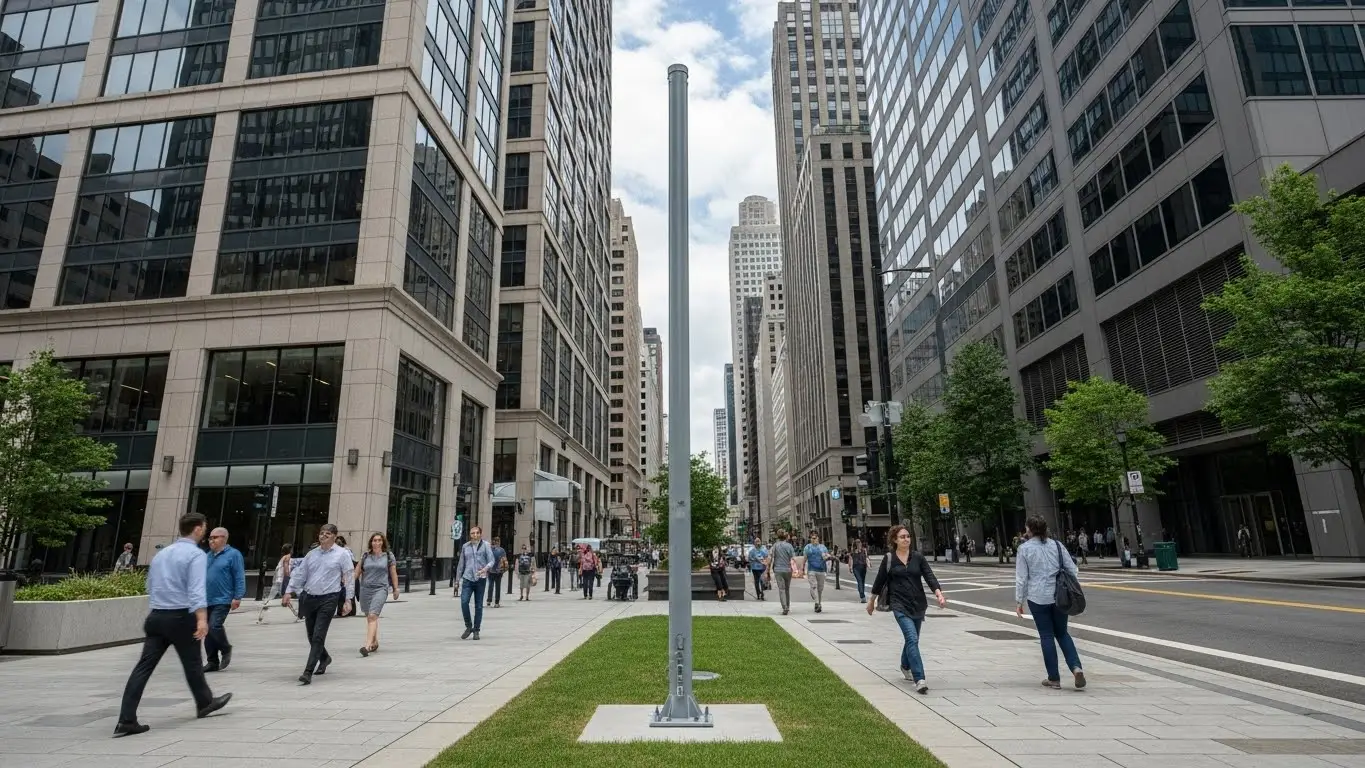
In 2025, the telecommunications industry is facing a dual challenge: the urgent need for 5G network densification and skyrocketing urban real estate costs. Operators need to deploy thousands of new sites to eliminate "dead zones," but traditional sprawling towers are no longer viable in crowded cities.
For project managers and network engineers, shifting to lightweight monopole towers isn't just an aesthetic choice—it is a financial necessity. A tower that requires 100 square meters of land might cost $5,000/month in urban land leases, whereas a monopole fitting into a 5-square-meter roadside strip might cost a fraction of that. If you are planning an urban rollout, understanding the "footprint-to-cost" ratio is critical for your budget.
The "Lightweight" Engineering Secret
How can a single pole replace a massive steel truss tower? The answer lies in High-Strength Steel and Tapered Design.
Unlike lattice towers that use standard angle steel, modern monopoles from manufacturers like XY Tower utilize high-grade steel (typically ASTM A572 Grade 50 or Chinese equivalent Q345/Q460). This material allows for thinner walls without sacrificing structural integrity.
- Tapered Hollow Shafts: The pole is widest at the bottom to handle the moment load and tapers toward the top. This geometry sheds wind load more efficiently than flat lattice faces.
- Slip-Joint Assembly: Instead of bolting thousands of small cross-braces, monopole sections simply slide over one another (friction fit). This eliminates tons of connection plates and bolts, significantly reducing the overall dead weight of the structure.
💡 Learn More: Dive deeper into the engineering behind this in our guide on monopole telecom towers design and benefits.
Monopole vs. Lattice: The Efficiency Comparison
When every square foot of land costs money, the monopole wins. Below is a comparison based on typical 40-meter urban deployment data for 2024.
| Feature | Lightweight Monopole | Lattice Tower |
| Ground Footprint | 1.5 – 3.0 m² (Compact) | 30 – 60 m² (Sprawling) |
| Foundation Type | Single Drilled Caisson | Large Concrete Mat / Pad |
| Installation Time | 1 Day (Stacking) | 3 – 5 Days (Assembly) |
| Visual Impact | Low (Sleek / Camouflage) | High (Industrial Look) |
| Urban Suitability | ✅ Excellent | ❌ Poor |
| Land Lease Cost | Low | High |
For a detailed breakdown of urban site selection, read our monopole vs lattice towers urban comparison.
The Cost Breakdown: Where Do You Save?
While the manufacturing cost per ton of a monopole can be slightly higher than a lattice tower (due to specialized plate bending), the Total Cost of Ownership (TCO) is significantly lower for urban sites.
1. Civil Works Savings (approx. 30%)
A lattice tower requires a massive excavation for a concrete mat foundation to anchor three or four widely spaced legs. A monopole typically uses a deep single-shaft foundation. Less concrete, less excavation, and less labor translate to immediate CAPEX savings.
2. Logistics & Freight
Because lightweight monopoles use slip joints, the sections nest inside each other during shipping (where diameter permits) or stack efficiently on flatbeds. This maximizes shipping container density—a crucial factor if you are importing towers from global manufacturers like XY Tower.
3. Installation Speed = Labor Savings
A seasoned crew can stack a 40m monopole in 6 to 8 hours. A lattice tower of the same height requires assembling hundreds of individual members, taking 3 to 5 days. Cutting crane rental time and crew man-hours by 70% is a massive line-item saving.
Step-by-Step: Rapid Installation Process
The speed of lightweight monopoles comes from their "Plug-and-Play" design.
- Foundation Prep: A single caisson is drilled and poured with an anchor bolt cage.
- Section Delivery: Sections arrive numbered (Base, Mid, Top).
- Ground Assembly: Antennas and climbing ladders are often attached to the top section while it is still on the ground (safer and faster).
- Stacking: The crane lifts the base section onto the anchors. Subsequent sections are lowered onto the joint.
- Jacking/Settling: Gravity or hydraulic jacks ensure the slip joint is tight.
- Final Connections: Cables are run through the inside of the hollow pole (protecting them from weather and theft).
Common Mistakes to Avoid
Even with the best hardware, projects can fail if details are missed.
- ❌ Underestimating Deflection (Sway): Monopoles sway more than lattice towers. If you are using narrow-beam microwave backhaul, ensure the tower is engineered with the correct stiffness (deflection criteria) to prevent signal loss during high winds.
- ❌ Ignoring Soil Tests: Because the entire load sits on a single point, the soil conditions are non-negotiable. A poor geotechnical report can lead to foundation failure.
- ❌ Cheap Galvanization: A tower is an investment for 50 years. Ensure your manufacturer follows ASTM A123 standards for hot-dip galvanization. Thin zinc coating will rust in <10 years, costing thousands in repainting.
Expert Tips for 2026 Deployments
- Go "Stealth": In strict residential zones, lightweight monopoles can be easily disguised as pine trees ("Monopines") or flagpoles. This is often the key to getting zoning approval quickly.
- Future-Proofing: Order monopoles with pre-welded ports for future 5G small cells or IoT sensors. It is cheaper to add brackets during manufacturing than to retrofit them 5 years later.
- Buy Direct: Sourcing directly from certified manufacturers (like XYTOWER) can reduce unit costs by 20-30% compared to buying through local tiered resellers, provided the factory meets ISO and AWS welding standards.
Frequently Asked Questions
While monopoles can be engineered up to 60+ meters, the "lightweight" efficiency sweet spot is between 15 and 45 meters. Beyond this height, the base diameter becomes very large to handle wind loads, and lattice towers may become more steel-efficient.
A high-quality hot-dip galvanized monopole (following ASTM A123) typically has a lifespan of 50 to 70 years in rural or suburban environments, and 30-50 years in harsh coastal/industrial zones before maintenance is needed.
Yes. Despite looking slender, they are engineered to withstand wind speeds of 120 km/h to 160 km/h (and higher with custom design). The tapered round shape naturally lowers wind resistance (drag coefficient) compared to flat steel angles.
Yes, they are the industry standard. The weight of the upper sections creates a tight friction fit that actually gets stronger over time as gravity settles the joint. They have been proven safe in telecom infrastructure for decades.
For a typical 30-40m tower, you usually need a working area of about 3x3 meters for the foundation cap, though the visible pole may only be 1-1.5 meters wide. This is significantly less than the 8x8 meter (or larger) space needed for lattice towers.
Key Takeaways
- 90% Footprint Reduction: Monopoles free up valuable urban land, lowering lease costs.
- Speed is Money: 1-day installation reduces crane rentals and traffic disruption.
- TCO Winner: While steel costs vary, the total project cost is often lower for urban monopoles due to civil and land savings.
- Aesthetic & Zoning: Easier to permit in cities due to sleek, concealable design.
- Quality Matters: Always specify ASTM A123 galvanization for a 50+ year asset lifespan.

Hey, I’m Chunjian Shu
"X.Y. Tower: Reliable, innovative solutions for high-quality towers and electrical equipment with professional service.
