
How Mobile Antenna Towers Improve 4G/5G Coverage
2025-12-14
Mobile antenna towers improve 4G and 5G coverage by elevating antennas to maximize line-of-sight signal propagation and reducing ground-level interference. By lifting transmission equipment—such as Massive MIMO arrays and microwave backhaul dishes—above obstructions like buildings and trees, these towers allow radio waves to travel further and maintain higher signal integrity. Additionally, towers enable network sectorization, where coverage is split into specific zones to handle more users simultaneously without speed degradation. This combination of structural elevation and strategic placement is the physical foundation that supports high-speed data transfer and consistent connectivity across both rural and urban environments.
How Elevation Affects Signal Quality
Why Height Matters for 4G and 5G
The primary function of a tower is simple: height. Radio waves, particularly the higher frequency bands used in 5G, behave much like light—they travel best in straight lines. When an antenna is placed on a high-quality Mobile Antenna Tower, it bypasses physical obstacles that would otherwise absorb or reflect the signal.
- Line of Sight: Elevation clears the "Fresnel Zone" (the football-shaped area between transmitter and receiver), ensuring the signal path isn't choked by terrain.
- Interference Reduction: Lifting antennas away from street-level noise (like electrical interference or moving vehicles) improves the Signal-to-Noise Ratio (SNR), resulting in faster download speeds.
What is the Difference Between 4G and 5G Towers?
While 4G towers focus on broad, wide-area coverage using lower frequencies, 5G towers often utilize dense networks of smaller cells and "Massive MIMO" technology to handle higher data loads.
Expanded Details:
The physical structure of the tower is adapting. A traditional 4G setup typically uses fixed sector antennas. In contrast, 5G infrastructure often requires reinforcing existing towers to support heavier Massive MIMO (Multiple Input, Multiple Output) panels. These advanced panels beam-form signals directly to user devices rather than broadcasting in a wide floodlight pattern. This precision improves coverage efficiency but requires the stable platform that only a rigid lattice or monopole tower can provide.
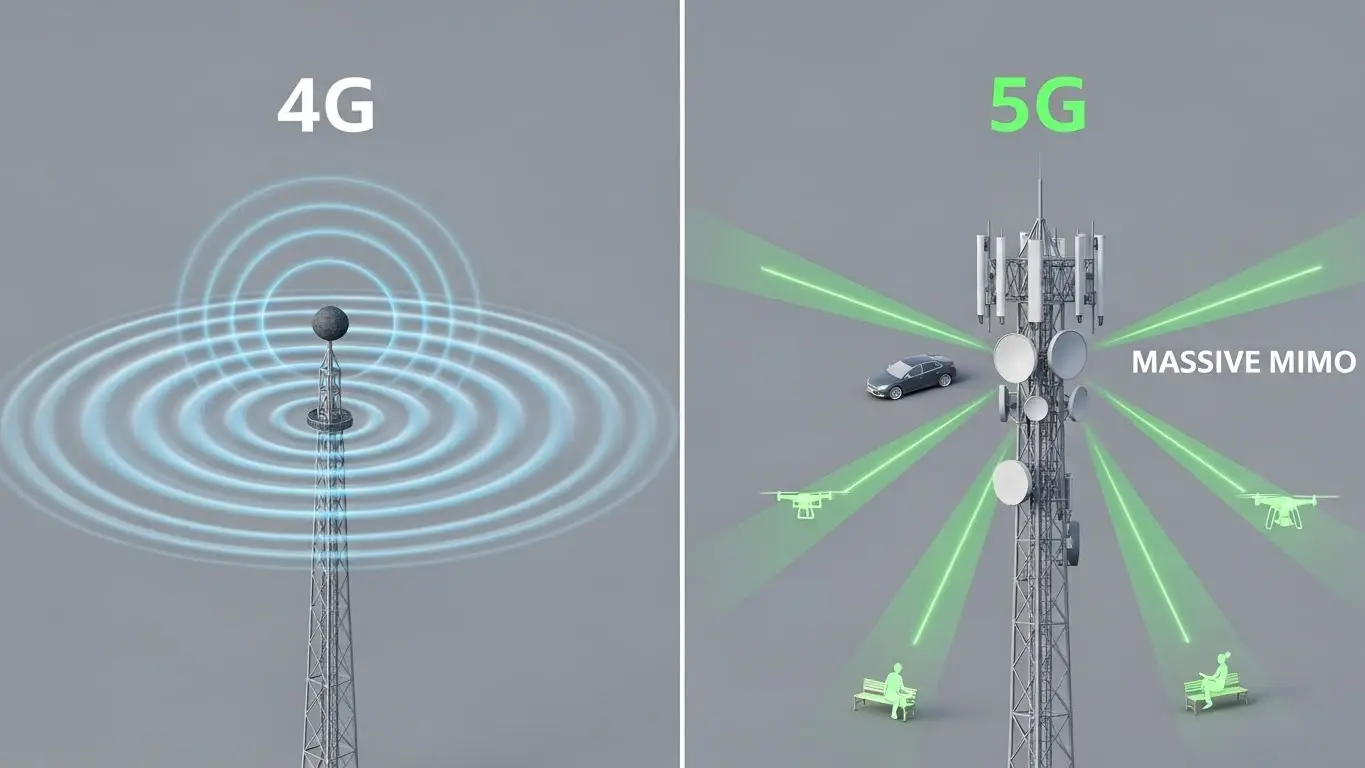
Image Suggestion 1:
- Visual: A side-by-side diagram showing a standard 4G antenna spread versus a 5G beamforming signal pattern.
- Alt Text: Diagram comparing 4G wide beam coverage vs 5G beamforming signal precision on a mobile tower.
Why Do We Need More Towers for 5G Coverage?
We need more towers for 5G because high-frequency 5G waves (mmWave) have shorter wavelengths that cannot travel as far or penetrate walls as well as 4G signals.
Expanded Details:
The trade-off for 5G's incredible speed is its fragility over distance. To maintain a consistent connection, network planners must increase the density of the network. This involves a two-tiered approach:
- Macro Towers: Large lattice towers providing the "umbrella" coverage for low-band 5G.
- Small Cells: Utilizing street furniture and smaller monopoles to fill in coverage gaps in dense urban areas.
Without this increased density, users would experience frequent signal drops when moving behind buildings.
| Feature | 4G LTE Coverage | 5G (mmWave) Coverage |
| Range | Up to 10+ miles (Low band) | Less than 1,500 feet |
| Penetration | High (Passes through walls) | Low (Blocked by glass/trees) |
| Tower Density | Low (Spread out) | High (Dense clusters) |
| Latency | 30-50 ms | < 10 ms |
What Is the Range of a Standard Mobile Tower?
A standard mobile tower can cover anywhere from 1 to 45 miles depending on the terrain, antenna height, and frequency band used.
Expanded Details:
Range is not static; it is determined by the "Link Budget."
- Rural Areas: A tall lattice tower broadcasting low-frequency signals (e.g., 700 MHz) can cover a radius of 20-30 miles because there are fewer obstructions.
- Urban Areas: The same tower might only cover 1-2 miles effectively due to concrete canyons and high user congestion.
- 5G Ultra-Wideband: Coverage may shrink to just a few city blocks, necessitating the installation of more numerous, shorter towers.
[SUGGESTED LINK: Guide to Telecommunication Tower Types]
How Structural Stability Improves Connectivity
It is not just about holding the antenna up; it is about keeping it still.
For microwave backhaul links (the wireless connection connecting the tower to the internet), alignment must be precise. If a tower twists or sways too much during a storm, the link breaks, causing a network outage.
High-quality steel structures, such as those discussed in our guide on Mobile Antenna Towers: Uses and Benefits, are engineered with specific "twist and sway" tolerances. This rigidity ensures that even in high winds, the digital handshake between the tower and your phone remains unbroken.
Image Suggestion 2:
- Visual: A close-up of a steel lattice tower joint or base showing robust bolts and galvanization.
- Alt Text: High-strength galvanized steel connection on a lattice mobile antenna tower ensuring structural stability.
Frequently Asked Questions
No, mobile towers operate within strict safety guidelines set by the FCC and ICNIRP. The radio frequency (RF) energy they emit is non-ionizing, meaning it lacks the energy to damage DNA, similar to FM radio or TV broadcast signals.
Yes, this is called "colocation." Structural engineers design towers to support the equipment of multiple carriers (e.g., AT&T, Verizon, T-Mobile) simultaneously. This reduces the total number of towers needed in a landscape.
Most critical mobile towers are equipped with backup battery systems and diesel generators. This ensures that 4G and 5G coverage remains active for emergency calls even when the local power grid fails.
Heavy rain or snow can cause "rain fade," particularly for high-frequency 5G signals, by absorbing radio energy. However, modern towers use adaptive power controls to boost signal strength during bad weather to compensate.
Key Takeaways
- Elevation is Key: Towers raise antennas to clear obstacles, extending the horizon of the signal.
- Stability Equals Speed: Rigid tower structures prevent swaying that can disrupt sensitive high-speed backhaul connections.
- Density for 5G: The shift to 5G requires a denser network of towers to compensate for shorter signal ranges.
- Colocation: Modern towers are designed to hold heavy loads, allowing multiple carriers to share one structure.
Conclusion
Mobile antenna towers are the silent workhorses of the digital age. By providing the necessary elevation and structural rigidity, they transform invisible radio waves into the reliable 4G and 5G streams we rely on daily. Whether upgrading existing lattice structures or deploying new urban monopoles, investing in quality tower infrastructure is the only way to guarantee seamless coverage.
For expert insights on tower manufacturing and specifications, explore our detailed resource on Mobile Antenna Towers.

Hey, I’m Chunjian Shu
"X.Y. Tower: Reliable, innovative solutions for high-quality towers and electrical equipment with professional service.
