
Why Mobile Base Station Towers Help During Disasters
2025-12-15
Mobile base station towers are the rapid-response "immune system" of a telecommunications network. When hurricanes, earthquakes, or wildfires destroy permanent infrastructure, these self-contained units (like Cells on Wheels) bridge the critical gap in connectivity. They provide immediate, independent cellular and radio coverage, allowing first responders to coordinate rescue operations and enabling victims to contact loved ones, thereby reducing panic and accelerating recovery efforts.
The "Blackout" Problem: Why Permanent Towers Fail
To understand the value of a mobile tower, we must first understand why the main network collapses. Permanent cell towers are vulnerable to three primary failure points during a disaster:
- Power Loss: The most common failure. When the grid goes down, battery backups typically last only 4-8 hours.
- Backhaul Severance: Physical fiber optic cables buried underground or strung on poles are often snapped by flooding or wind, cutting the tower off from the internet.
- Structural Damage: High winds or debris can physically topple the mast or misalign antennas.
How Mobile Towers Function Independently
Unlike their permanent counterparts, mobile towers are designed to operate on a "bring your own infrastructure" model. They do not rely on the local grid or broken cables.
1. Independent Power (The Heart)
Mobile towers are equipped with onboard diesel generators and large battery banks. Modern units often utilize hybrid systems with solar panels to extend fuel life—a critical feature when fuel trucks cannot navigate flooded roads.
2. Alternative Backhaul (The Brain)
If the fiber lines are cut, how does the tower connect to the internet?
- Satellite (VSAT): The tower beams its data up to a satellite, bypassing local ground damage entirely. This is the gold standard for total infrastructure collapse.
- Microwave Relay: The tower uses a dish to "shoot" a signal to a distant, undamaged tower up to 30 miles away, daisy-chaining connectivity back to the core network.
Caption: A Cell on Wheels (COW) utilizing satellite backhaul to bypass damaged ground infrastructure.
The Strategic Benefits in Emergency Response
Empowering First Responders (Command & Control)
In the chaos of search and rescue, police and fire teams often find their standard radios dead spots. Mobile towers can deploy a "private bubble" of Band 14 (FirstNet) connectivity. This allows for:
- Real-time coordination: Dispatchers can track the GPS location of every rescue unit.
- Data sharing: Paramedics can send patient vitals to hospitals before the ambulance arrives.
- Drone uplinks: Rescue drones can stream live aerial video of the disaster zone back to the command center.
For a deeper look at specific response strategies, read our guide on mobile communication towers for emergency response.
Stabilizing the Public (The Psychological Component)
Information is a commodity as valuable as water in a crisis. When a mobile tower restores 4G/5G signal to a shelter:
- Panic Reduction: "Safe" checks to family members stop the spread of rumors and panic.
- Self-Rescue: Victims can access maps, weather alerts, and government relief applications directly from their smartphones.
Hardware Options: COW vs. COLT
Not all disasters require the same equipment. The choice between a heavy-duty trailer and a light truck depends on the terrain and mission duration.
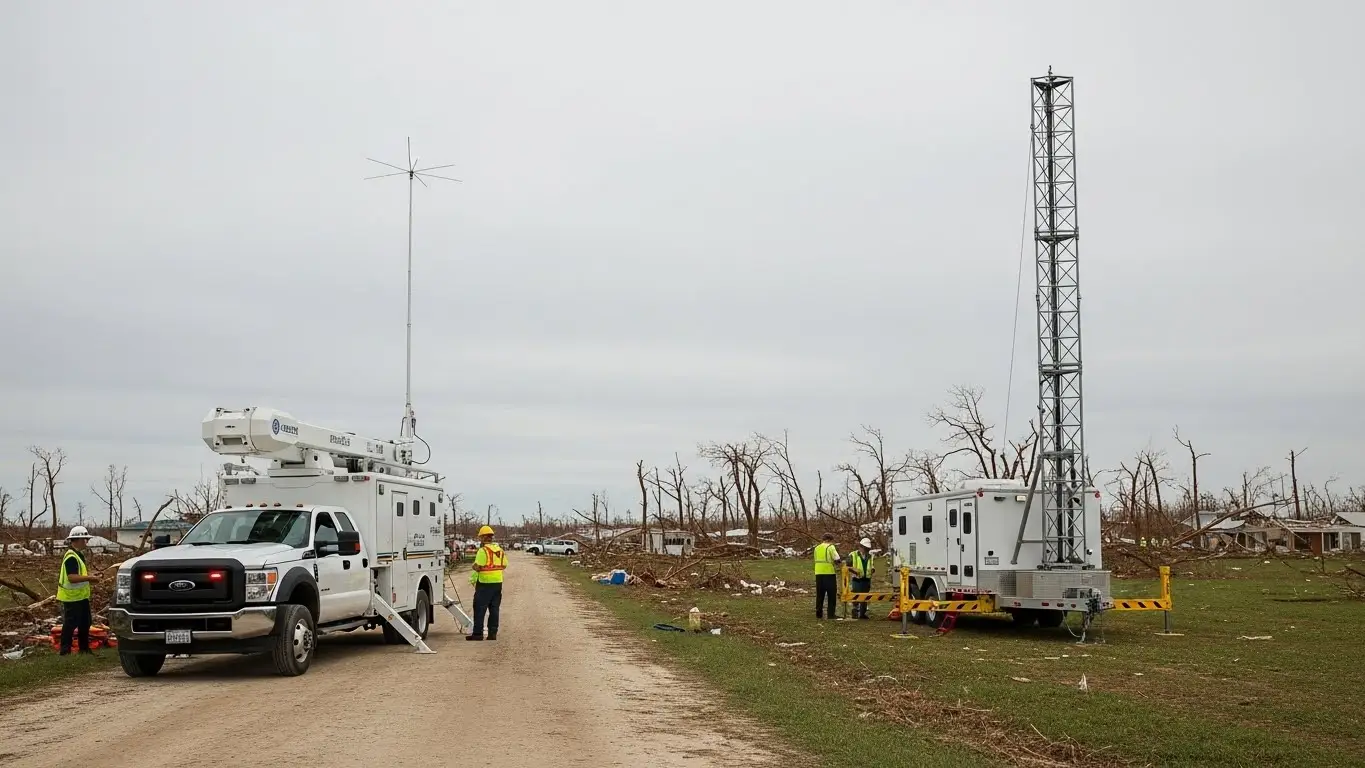
| Feature | COLT (Cell on Light Truck) | COW (Cell on Wheels) |
| Mobility | High: Integrated on a truck chassis. Drive in, park, transmit. | Medium: Trailer-based. Requires towing and unhitching. |
| Setup Time | 15-30 Minutes: Fastest deployment for "Sprint" phase. | 30-60 Minutes: Requires stabilization jacks and grounding. |
| Payload | Light/Medium: Good for immediate coverage bubbles. | Heavy: Can support massive dishes and taller masts (up to 40m). |
| Best Use | Scouting, drive-testing, highly mobile fronts. | Long-term base camps, field hospitals. |
For a detailed breakdown of deployment speed, see our analysis on rapid deployment telecom towers setup time.
Challenges in Deployment
While mobile towers are lifesavers, they are not magic. Successful deployment requires overcoming significant logistical hurdles:
- Site Access: A 10,000-lb COW cannot be towed through 3 feet of floodwater. Specialized "skid" units or air-liftable pods are needed for extreme terrain.
- Fuel Logistics: A generator running 24/7 burns significant fuel. If the tanker truck can't reach the tower, the network dies.
- Spectrum Interference: In a small area like a base camp, too many radios and towers can cause signal "noise," requiring careful frequency planning.
Frequently Asked Questions
A Cell on Light Truck (COLT) can be operational in as little as 15-20 minutes after arriving. Larger trailer-based COWs typically take 45-60 minutes to stabilize and raise. See more on rapid deployment solutions.
Yes. While satellite is used for total isolation, mobile towers prefer to use "Microwave Line-of-Sight" or temporary fiber connections if available, as these offer faster data speeds than satellite.
Range varies by mast height and terrain. A standard 30-meter mobile tower can cover a radius of 5-10 miles (8-16 km) in flat terrain, but this may drop to 1-3 miles in dense urban or mountainous areas.
Generally, no. Most jurisdictions have "Emergency Declarations" that waive zoning and permitting requirements for temporary infrastructure needed to protect life and property.
Indefinitely, as long as it has fuel and maintenance. Some temporary mobile towers remain in place for months or even years while permanent infrastructure is rebuilt.
Key Takeaways
- Independence is Key: Mobile towers succeed because they bring their own power and internet (satellite) connectivity.
- Speed Saves Lives: COLTs can restore vital signal in under 30 minutes, enabling rapid triage and rescue coordination.
- Psychological Aid: restoring public connectivity reduces panic and allows for self-organization among victims.
- Logistics Matter: The effectiveness of a mobile tower is limited only by the ability to refuel it and access the site.
Conclusion
Mobile base station towers are more than just temporary poles; they are the anchors of resilience in a fragile world. By rapidly restoring the flow of information, they transform a disjointed disaster zone into a coordinated recovery effort. Whether through a nimble COLT or a robust COW, these assets ensure that when nature silences our networks, we have the voice to answer back.

Hey, I’m Chunjian Shu
"X.Y. Tower: Reliable, innovative solutions for high-quality towers and electrical equipment with professional service.
