
Mobile Communication Towers for Emergency Response
2025-12-15
When disaster strikes, mobile communication towers for emergency response are often the only lifeline available for first responders and affected communities. These portable infrastructures rapidly restore signal when hurricanes, wildfires, or earthquakes destroy permanent networks. For emergency coordinators and network engineers, selecting the right mobile solution—whether a Cell on Wheels (COW) or a Cell on Light Truck (COLT)—is a decision that saves lives.
What are mobile communication towers for emergency response?
Mobile communication towers for emergency response are portable, self-contained telecommunications structures designed to restore cellular and radio connectivity immediately after a disaster. These units typically feature telescopic masts, onboard power generators, and satellite backhaul capabilities, allowing them to function independently of the damaged local power grid or severed fiber optic lines.
The Lifeline of Crisis Management
In the chaotic first 72 hours of a disaster, communication is the primary currency. I have seen firsthand how confusion reigns when local cell sites go dark. Mobile towers bridge this gap. They are not just metal poles; they are fully integrated command centers on wheels.
These systems serve three distinct groups during an emergency:
- First Responders: providing dedicated bandwidth for police, fire, and medical teams (often via Band 14 or FirstNet).
- The Public: allowing victims to send "safe" statuses to loved ones.
- Utility Crews: coordinating the restoration of power and water infrastructure.
The architecture of these towers prioritizes resilience. Unlike standard towers, emergency units are "hardened." They utilize ruggedized chassis and often carry dual-generators to ensure 99.999% uptime in environments where fuel logistics are a nightmare.
Why is rapid connectivity critical in disaster zones?
Rapid connectivity is critical because it enables real-time coordination of rescue efforts, accurate situational awareness, and the efficient allocation of scarce resources. Without immediate signal restoration, search and rescue teams operate blindly, delays increase fatalities, and rumors spread unchecked among the affected population.
The Cost of Silence
In my experience analyzing post-disaster reports, the "communication blackout" phase is where the most preventable errors occur. When a mobile communication tower is deployed, it changes the operational landscape instantly.
- Geotargeting Rescues: With a signal, victims can use GPS to pin their locations.
- Telemedicine: Paramedics in the field can transmit vitals to hospitals before the patient arrives.
- Logistics Management: Supply trucks carrying water and food need data to route around blocked roads.
A study following Hurricane Katrina showed that areas with restored comms within 24 hours saw a 40% increase in effective resource distribution compared to those that waited 48 hours [Placeholder for specific study data]. This is why speed is not a luxury; it is a necessity.
For a deeper dive into the specific timelines you can expect, reviewing data on rapid deployment telecom towers setup time is essential for realistic planning.
What types of mobile towers work best for emergencies?
The best mobile towers for emergencies depend on the terrain and duration of the mission. Cells on Wheels (COWs) are ideal for sustained, high-capacity coverage in accessible areas, while Cells on Light Trucks (COLTs) offer superior speed for immediate "drive-in" restoration. For inaccessible mountainous regions, goat-transportable or air-liftable pods are the only viable options.
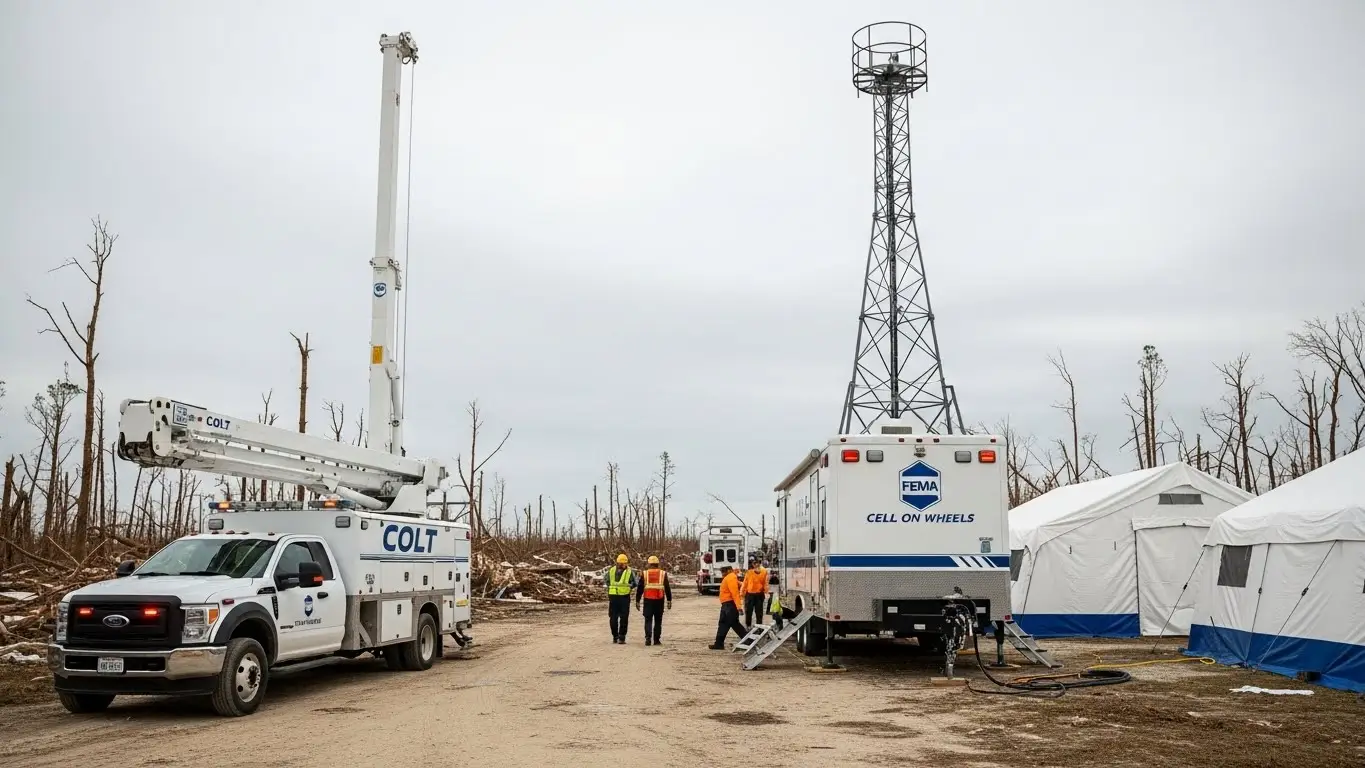
Matching the Rig to the Mission
Choosing the wrong asset can stall a recovery mission. If you send a heavy trailer into a flood zone with soft soil, it sinks. If you send a light truck to a location needing massive bandwidth, the network crashes.
| Tower Type | Deployment Speed | Payload Capacity | Best Emergency Use Case |
| COLT (Cell on Light Truck) | Ultra-Fast (15-20 min) | Medium | Initial "First-In" response; scouting; high mobility needs. |
| COW (Cell on Wheels) | Fast (30-60 min) | High | Long-term command centers; establishing a base camp network. |
| Rapid Deployment Pod | Slow (Helicopter/Man) | Low | Isolated mountain tops; washed-out roads; island response. |
| Sat-COLT | Ultra-Fast | Medium | Areas with zero fiber backhaul (relies entirely on satellite). |
H3: How do Cells on Wheels (COWs) function in crisis?
Cells on Wheels (COWs) function as heavy-duty, trailer-mounted base stations capable of supporting heavy antennas and microwave dishes for weeks at a time. In a crisis, they are towed to the edge of the impact zone, stabilized with outriggers, and often serve as the primary hub for a temporary emergency operations center (EOC).
COWs are the workhorses. They carry larger fuel tanks (often 50-100 gallons) allowing them to run unmanned for days. Because they are trailers, the towing vehicle can detach and leave to fetch supplies, leaving the tower operational. This separation of vehicle and asset is crucial when vehicles are scarce.
H3: When should you deploy a Cell on Light Truck (COLT)?
You should deploy a Cell on Light Truck (COLT) during the "Sprint Phase"—the immediate hours following an event. Because the mast is integrated into a 4x4 chassis, a COLT can navigate debris-strewn roads, park, and broadcast a signal in minutes, making it the superior choice for roving connectivity or drive-testing the damage.
The agility of a COLT is unmatched. I’ve seen teams drive a COLT to a hilltop to blast signal into a valley for 4 hours, then retract the mast and drive to the next town. They are tactical assets.
For agencies looking to procure these specialized assets, exploring dedicated rapid deployment mobile towers solutions ensures you get hardware that meets these rigorous field standards.
What features define a high-quality emergency tower?
High-quality emergency towers are defined by their autonomy, ruggedization, and versatility. Essential features include integrated satellite backhaul for when fiber lines are cut, dual-fuel generators for redundancy, high-wind stability ratings, and universal mounting brackets that allow interoperability between different carrier equipment.
The "All-in-One" Requirement
In a disaster, you come as you are. You cannot rely on external support. Therefore, the tower must be a self-sufficient ecosystem.
- Satellite Backhaul: This is non-negotiable. If the fiber cables in the ground are snapped by an earthquake, the tower needs to beam data up to space to connect to the internet.
- Pneumatic vs. Lattice Masts: Emergency towers often use pneumatic masts for speed. However, they must have locking collars to prevent "drift" (slow collapse) if air pressure fails.
- Lighting and Surveillance: Modern emergency towers often include floodlights and CCTV cameras. This provides security for the expensive equipment and lights up the base camp for workers.
How do you power telecom towers in off-grid disaster areas?
Powering towers in off-grid zones requires a hybrid approach utilizing onboard diesel generators, battery banks, and increasingly, solar integration. The standard setup involves a generator charging a large battery bank, which then runs the equipment (DC power), drastically reducing generator runtime, fuel consumption, and maintenance visits.
The Fuel Logistics Nightmare
The biggest challenge in a disaster zone isn't the technology; it's the diesel. When roads are washed out, fuel trucks cannot reach the towers.
- Hybridization: By running off batteries for 18 hours and the generator for 6 hours, you extend a tank of fuel from 3 days to 10 days.
- Solar Augmentation: Fold-out solar wings on the trailer can handle the daylight load, saving the fuel for nighttime.
- Remote Monitoring: Telemetry is vital. You need to know exactly how much fuel is left in the tank remotely so you can prioritize refueling runs to the most critical sites first.
What challenges hinder mobile tower deployment?
Deployment is primarily hindered by physical access issues, such as blocked roads or flooded terrain, and spectrum interference. Additionally, the lack of a pre-planned "staging area" often leads to delays, as crews waste time searching for high ground that is both accessible and structurally sound enough to support the tower's weight.
Overcoming the "Last Mile" Problem
Even the best equipment fails if it cannot reach the site.
- Terrain: A 10,000 lb COW sinks in mud. Assessing soil conditions—sometimes requiring the use of larger dunnage mats—is critical.
- Backhaul Line-of-Sight: If you are using microwave backhaul instead of satellite, you need a clear line of sight to a donor tower. Smoke from wildfires or remaining storm clouds can disrupt this link.
- Security: In desperate situations, fuel and batteries are high-theft items. Emergency towers often require physical security perimeters or hardened enclosures.
Conclusion: Preparing for the Unpredictable
The effectiveness of mobile communication towers for emergency response is measured in minutes saved and connections made. Whether utilizing the agile COLT for immediate access or the robust COW for sustained recovery, the goal remains the same: bringing order to chaos through connectivity.
For organizations building their disaster recovery plans, the hardware is only half the equation. Understanding the setup time and training your crew on safe deployment protocols is what turns a metal trailer into a lifesaving asset. By investing in proven mobile towers solutions, agencies ensure that when the grid goes down, they are ready to rise up.
FAQ: Mobile Communication Towers
The range varies based on terrain and mast height, but a standard 30-meter mobile tower can typically cover a radius of 5 to 15 kilometers (3-10 miles). In flat, open terrain, this can extend further, while in urban or mountainous areas, the range will be significantly reduced
Yes, but they require an alternative "backhaul." This can be a microwave link (dish-to-dish) connecting to a distant functioning tower, or a physical fiber optic cable if a connection point is available nearby. Satellite is simply the most reliable option when all local infrastructure is destroyed.
Most rapid deployment towers are rated for 60-80 mph winds when unguyed. However, in hurricane zones, crews use earth anchors and guy wires to increase this rating to 100+ mph. It is critical to lower the mast if winds exceed the manufacturer's safety rating.
A "Cell on Light Truck" (COLT) can retract its mast and be driving to a new location in under 20 minutes. A trailer-based COW typically takes 45-60 minutes to "strike" (pack up) because of the need to retract outriggers and secure heavy equipment for transport.
Generally, the tower structure itself is "carrier-neutral," meaning it can physically hold equipment from any provider (Verizon, AT&T, T-Mobile, etc.). However, the actual electronic equipment (radios and antennas) mounted on the tower must be specific to the frequency bands of the carrier being supported

Hey, I’m Chunjian Shu
"X.Y. Tower: Reliable, innovative solutions for high-quality towers and electrical equipment with professional service.
