
Portable Antenna Towers: Load Capacity and Equipment Support
2025-12-14
Portable antenna towers generally feature load capacities ranging from 50 kg (110 lbs) for lightweight pneumatic masts to over 500 kg (1,100 lbs) for heavy-duty lattice cells-on-wheels (COWs). The specific capacity depends entirely on the mast design, material strength (aluminum vs. galvanized steel), and the stabilization method used. While smaller units are perfect for lightweight surveillance cameras or single Wi-Fi radios, robust heavy-duty trailer towers are engineered to support multiple sector antennas, microwave dishes, and even heavy 5G Massive MIMO arrays. Understanding these limits is critical to preventing structural failure, especially when factoring in wind resistance and the Effective Projected Area (EPA) of the mounted equipment.
What Factors Determine Tower Load Capacity?
The "payload" a portable tower can safely carry isn't just about the physical weight of the equipment; it is a calculation of weight plus wind resistance. Several key structural elements dictate the final numbers:
- Mast Type: Telescopic pneumatic masts are lighter but often carry less weight than lattice steel masts, which offer superior rigidity.
- Material Grade: High-tensile steel (like Q355) allows for thinner, lighter tower sections that can still support heavy loads compared to standard aluminum.
- Base Stability: The "footprint" of the trailer and the use of outriggers determine how much weight can be lifted before the center of gravity becomes dangerous.
For a deeper dive into the materials that make these structures possible, check out our guide on Mobile Antenna Towers.
The Role of Guy Wires and Outriggers
Portable towers are not anchored into concrete foundations like permanent structures. Instead, they rely on outriggers (stabilizing legs) and guy wires.
- Unguyed Capacity: This is the weight the tower can hold standing freely. It is usually lower.
- Guyed Capacity: Adding tension cables significantly increases the vertical load capacity and wind resistance, allowing for heavier equipment packages.
How Much Weight Can Different Portable Towers Hold?
Light-duty pneumatic masts typically hold 30–100 lbs, while heavy-duty lattice trailers (COWs) can support 500–1,500+ lbs depending on the height deployment.
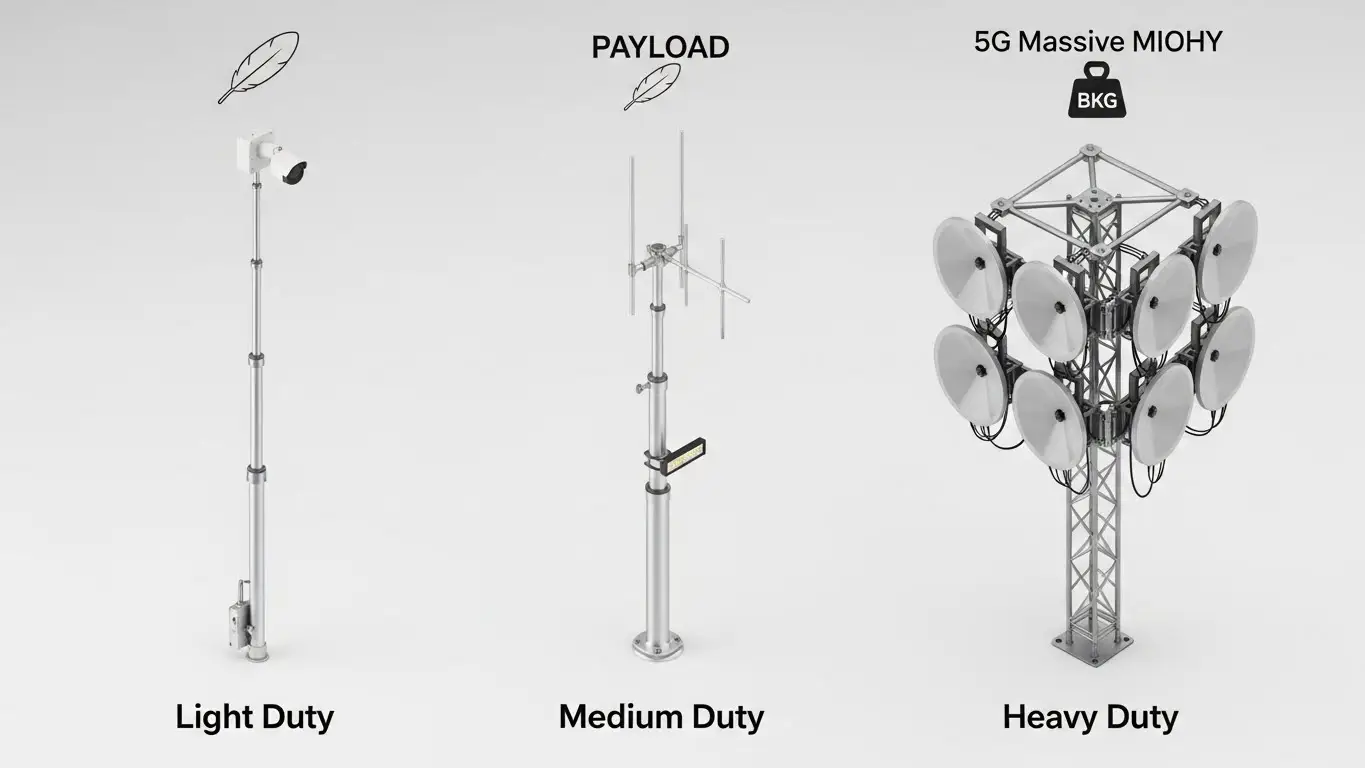
Expanded Details:
When selecting a portable solution, you must match the tower class to your gear. Overloading a mast can burn out the lifting motor (in electric systems) or cause the seals to fail (in pneumatic systems).
| Tower Class | Typical Height | Max Payload (Approx) | Best For |
| Light-Duty (Pneumatic) | 10–30 ft | 30–60 lbs | PTZ Cameras, Single Wi-Fi AP |
| Medium-Duty (Telescopic) | 30–60 ft | 100–300 lbs | Emergency Comms, Lighting |
| Heavy-Duty (Lattice COW) | 60–120 ft | 500–1,500 lbs | 3-Sector Cellular, 5G Arrays |
What Equipment Is Compatible with Portable Towers?
Portable towers support a wide range of equipment, including cellular sector antennas, microwave backhaul dishes, PTZ surveillance cameras, and high-intensity LED floodlights.
Expanded Details:
The versatility of these towers makes them essential for industries ranging from construction to disaster relief. However, the shape of the equipment matters as much as the weight. A flat panel antenna catches more wind than a slim whip antenna.
- Telecommunications: 4G/5G panels and Remote Radio Heads (RRHs). See how these are applied in real-world scenarios in our article on Mobile Antenna Towers: Uses and Benefits.
- Surveillance: Thermal cameras and radar units for border security or event monitoring.
- Lighting: Large LED arrays for night construction or mining operations.
How Does Wind Speed Affect Load Capacity?
Wind speed drastically reduces the safe load capacity; as wind pressure increases, the allowable surface area (EPA) of the equipment must decrease to prevent tipping or buckling.
Expanded Details:
Every portable tower comes with a "Wind Load Chart." This chart tells you that while a tower might hold 500 lbs on a calm day, it might only be safe to hold 200 lbs in 50 mph winds.
- EPA (Effective Projected Area): This is the total surface area of your equipment that faces the wind.
- The Trade-off: If you are deploying in a high-wind zone (like a coastal hurricane relief effort), you must reduce the equipment load or lower the tower height to maintain safety margins.
Are Portable Towers Capable of Supporting 5G Equipment?
Yes, modern heavy-duty portable towers are specifically engineered to support the weight and wind load of heavy 5G Massive MIMO antennas.
Expanded Details:
5G equipment is notoriously heavy and often requires precise alignment. Older portable masts often swayed too much for 5G to work effectively. Newer "Cell on Wheels" (COW) units utilize stiff lattice designs and enhanced stabilization to minimize twist and sway. This ensures that the high-frequency beams stay connected to user devices.
For more on how these structures facilitate next-gen networks, read How Mobile Antenna Towers Improve Coverage.
Frequently Asked Questions
Generally, yes. Retracting a telescopic tower lowers its center of gravity and increases the overlap between sections, making it stiffer and capable of handling higher wind loads or slightly heavier weights.
It depends on the weight. Many heavy-duty COWs (Cell on Wheels) are built on heavy trailers that may require a Commercial Driver's License (CDL) to tow, depending on your local DOT regulations regarding Gross Vehicle Weight Rating (GVWR).
These terms are often used interchangeably. Head Load specifically refers to the weight placed at the very top of the mast. Payload can sometimes include the weight of cables running down the side, which can add up significantly on tall towers.
Deployment time varies by type. A pneumatic mast on a truck can be up in 15 minutes. A large lattice trailer tower usually requires 1–4 hours for leveling, grounding, and antenna installation.
Key Takeaways
- Know Your Weight: Capacities range from 30 lbs (light duty) to over 1,000 lbs (heavy duty).
- Wind Matters: Always calculate the Effective Projected Area (EPA); wind reduces your safe payload capacity.
- Stability is Safety: Use outriggers and guy wires to maximize load capacity and minimize sway.
- 5G Ready: Heavy-duty lattice portable towers are required for modern, heavy 5G equipment.
Conclusion
Portable antenna towers are indispensable tools for temporary connectivity, but they must be respected. Ignoring load capacity charts or wind ratings can lead to catastrophic equipment damage or safety hazards. By choosing the right tower class for your specific equipment—whether it's a light camera or a heavy 5G array—you ensure a safe, reliable deployment every time.
To explore the best structural solutions for your telecommunications needs, visit our main page on Mobile Antenna Towers.

Hey, I’m Chunjian Shu
"X.Y. Tower: Reliable, innovative solutions for high-quality towers and electrical equipment with professional service.
