
Where Can I Get Portable Telecom Towers in the Philippines?
2025-12-10
You can acquire portable telecom towers in the Philippines through two main channels: direct purchasing from specialized manufacturers in China (for 30-40% cost savings) or buying from local industrial equipment distributors in Metro Manila (for immediate stock). Given the Philippines' proximity to major manufacturing hubs, importing directly is often the preferred route for construction companies and LGUs, with shipping times as short as 7–10 days to the Port of Manila or Cebu.
Option 1: Importing Directly (The Cost-Smart Choice)
For most projects in the Philippines, "local" suppliers are simply resellers who add a markup to imported units. Because the Philippines is geographically close to the manufacturing base, you can cut out the middleman easily.
Why Import from China?
- Speed: Unlike shipping to South America (which takes 45+ days, as seen in our Brazil delivery guide), sea freight from China to Manila is incredibly fast—often less than a week.
- Cost: You avoid the 30-50% warehouse markup charged by local dealers in Quezon City or Pasig.
- Customization: You can order units specifically reinforced for Typhoon Belt winds, rather than accepting standard generic stock.
Pro Tip: When choosing a supplier, ensure they are adedicated tower manufacturer for export, not just a general trading company. This ensures you get proper Mill Test Certificates for the steel.
Option 2: Local Distributors (The "Need it Now" Choice)
If you have a customized emergency situation (e.g., disaster relief in Bicol after a storm) and cannot wait for customs clearance, local distributors are your best bet.
- Where to look: Industrial suppliers in the Valenzuela and Parañaque warehouse districts often stock standard pneumatic masts.
- Trade-off: Selection is limited. You likely won't find heavy-duty lattice COW (Cell on Wheels) units on the shelf; you will mostly find lighter aluminum masts.
The "Typhoon Test": Specs You Must Require
The Philippines has some of the harshest wind conditions on Earth. A standard mobile tower designed for Europe or the US might buckle in a Cagayan typhoon.
Check the Wind Rating (NSCP 2015)
The National Structural Code of the Philippines (NSCP) divides the country into wind zones. Your tower must match the zone:
- Zone 1 (Bicol, Samar, Leyte): Must withstand 250+ kph winds.
- Metro Manila / Cebu: Typically 200-240 kph.
- Mindanao: Historically lower, but modern standards suggest 150+ kph.
Ensure your manufacturer uses high-tensile steel grades like Q355B (equivalent to ASTM A572 Gr50) to handle these loads without adding excessive weight.
Logistics: Shipping to Remote Islands
The Philippines is an archipelago. Getting the tower to Manila is easy; getting it to a mountain site in Palawan is the hard part.
Why "Modular" is Non-Negotiable
Avoid fully welded trailers if you are deploying to remote islands. Choose a knock-down (modular) design.
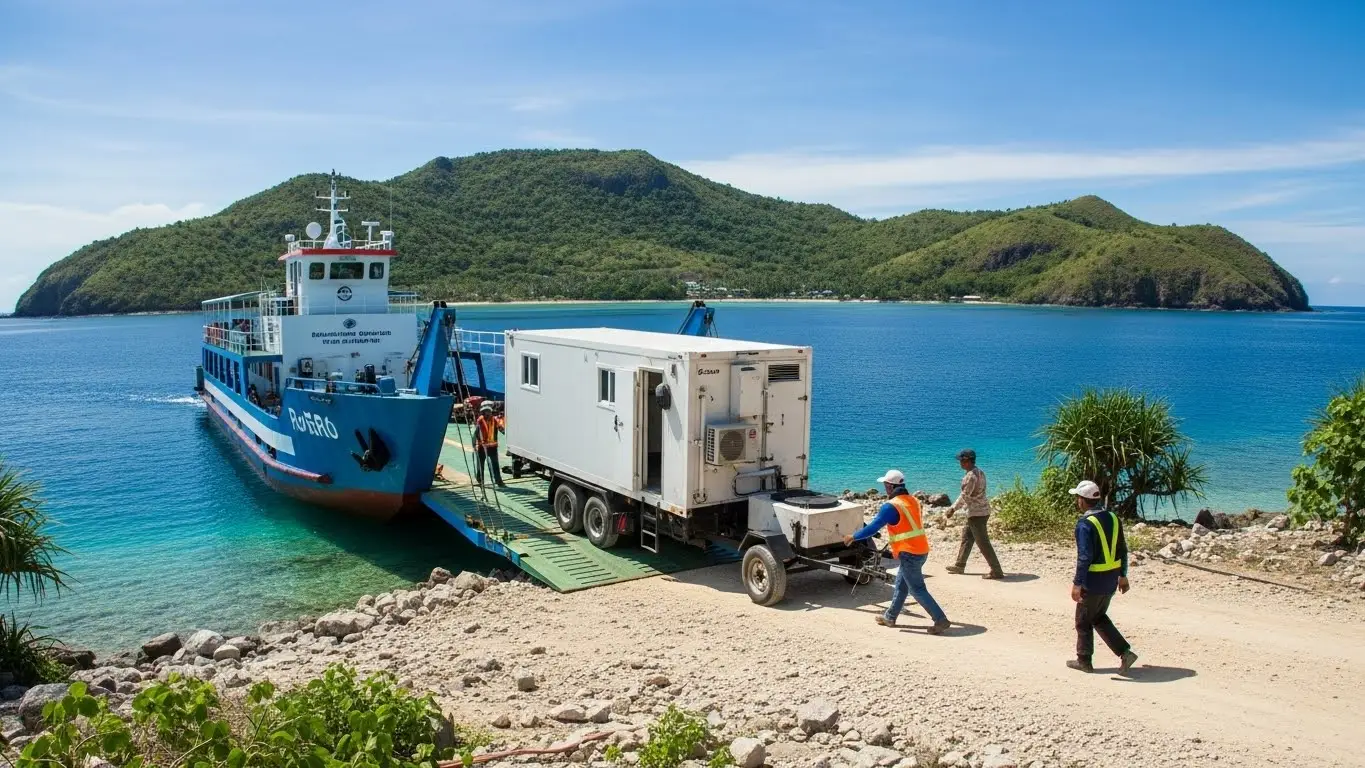
- Shipping: A modular tower packs into a standard container or small crate. This fits on the RoRo (Roll-on/Roll-off) ferries that connect the islands.
- Handling: It can be offloaded by a small forklift or manual labor, whereas a massive unitary trailer requires a specialized crane at the port.
- Learn more: How to Install a Modular Mobile Tower Step-by-Step
Maintenance in the Tropics
The Philippine climate—hot, humid, and salty—is aggressive on metal.
- Galvanization: Demand Hot-Dip Galvanization to ASTM A123 standards. Do not accept "painted" steel; it will rust within 6 months in the humid air.
- Drainage: Ensure the tower design has proper weep holes to prevent water accumulation during monsoon season, as discussed in our extreme weather maintenance guide.
Frequently Asked Questions
To own the steel structure, generally no. However, to operate the radio equipment (transmitters/links) attached to it, you need permits from the National Telecommunications Commission (NTC).
Under the ACFTA (ASEAN-China Free Trade Area), steel towers (HS Code 7308.20) often enjoy 0% or reduced import duties if accompanied by a "Form E" Certificate of Origin. Always verify with your broker.
Yes. While we don't have local crews in every barangay, we provide remote supervision similar to our support model in Egypt. Your local contractor handles the labor; we guide the engineering via video call.
Fabrication typically takes 15–20 days. Shipping to Manila takes 7–10 days. Total lead time is roughly 4 weeks, which is very fast compared to global standards.
Key Takeaways
- Import Direct: Importing from China is faster and cheaper for PH buyers than sourcing from the West or local resellers.
- Typhoon Proofing: Ensure the design meets NSCP wind load standards (250 kph for Zone 1).
- Form E is Key: Use the free trade agreement to minimize import duties.
- Go Modular: Essential for inter-island transport via RoRo ferries.
Conclusion
Sourcing a portable telecom tower in the Philippines is a balance of speed, cost, and structural safety. For most projects, importing a typhoon-rated, modular unit directly from a manufacturer offers the best value and resilience against the local climate.
Need a quote for a typhoon-resistant mobile tower? Contact XYTOWER today for a design that meets Philippine structural codes.

Hey, I’m Chunjian Shu
"X.Y. Tower: Reliable, innovative solutions for high-quality towers and electrical equipment with professional service.
