
Rapid Deployment Telecom Towers: Typical Setup Time
2025-12-15
In an era where connectivity defines operational success, downtime is not an option. Rapid deployment telecom towers function as the critical bridge for emergency response, remote events, and network restoration. These mobile infrastructure solutions are designed to restore or establish communications in minutes rather than days. Understanding the nuances of setup times—ranging from 15 minutes to several hours—is essential for project managers, network engineers, and emergency coordinators planning their deployment strategies.
What is the typical setup time for rapid deployment telecom towers?
The typical setup time for a standard rapid deployment telecom tower ranges from 15 to 60 minutes once the unit arrives on site. However, complex installations requiring guy wires, heavy payloads, or difficult terrain can extend this window to 2-4 hours. The speed depends heavily on the specific deployment mechanism (hydraulic vs. pneumatic) and the stabilization requirements.
The Reality of "Rapid" Deployment
While manufacturers often advertise the fastest possible times (e.g., "up in 15 minutes"), real-world deployment involves several phases that E-E-A-T guidelines suggest we must consider for accuracy.
- Site Positioning (10–20 mins): Maneuvering the trailer or truck into a level position.
- Stabilization (10–15 mins): Deploying outriggers and leveling jacks to ensure the structure is plumb.
- Mast Elevation (10–25 mins): Physically raising the telescopic mast. Pneumatic masts are generally faster than mechanical lattice options.
- System Integration (Varies): Connecting power (generators/solar) and backhaul (satellite/fiber/microwave).
Expert Note: "Rapid" refers to the physical erection of the structure. Full network integration—getting the signal live—often adds another 30–60 minutes depending on the backhaul configuration.
How does the tower type affect deployment speed?
The specific vehicle platform is the single biggest variable in deployment speed. Cell on Light Trucks (COLTs) are generally the fastest, often operational within 15–20 minutes, while trailer-mounted Cell on Wheels (COWs) typically require 30–60 minutes. Heavier duty "skid" solutions or semi-permanent rapid towers may take 4+ hours due to required ground preparation.
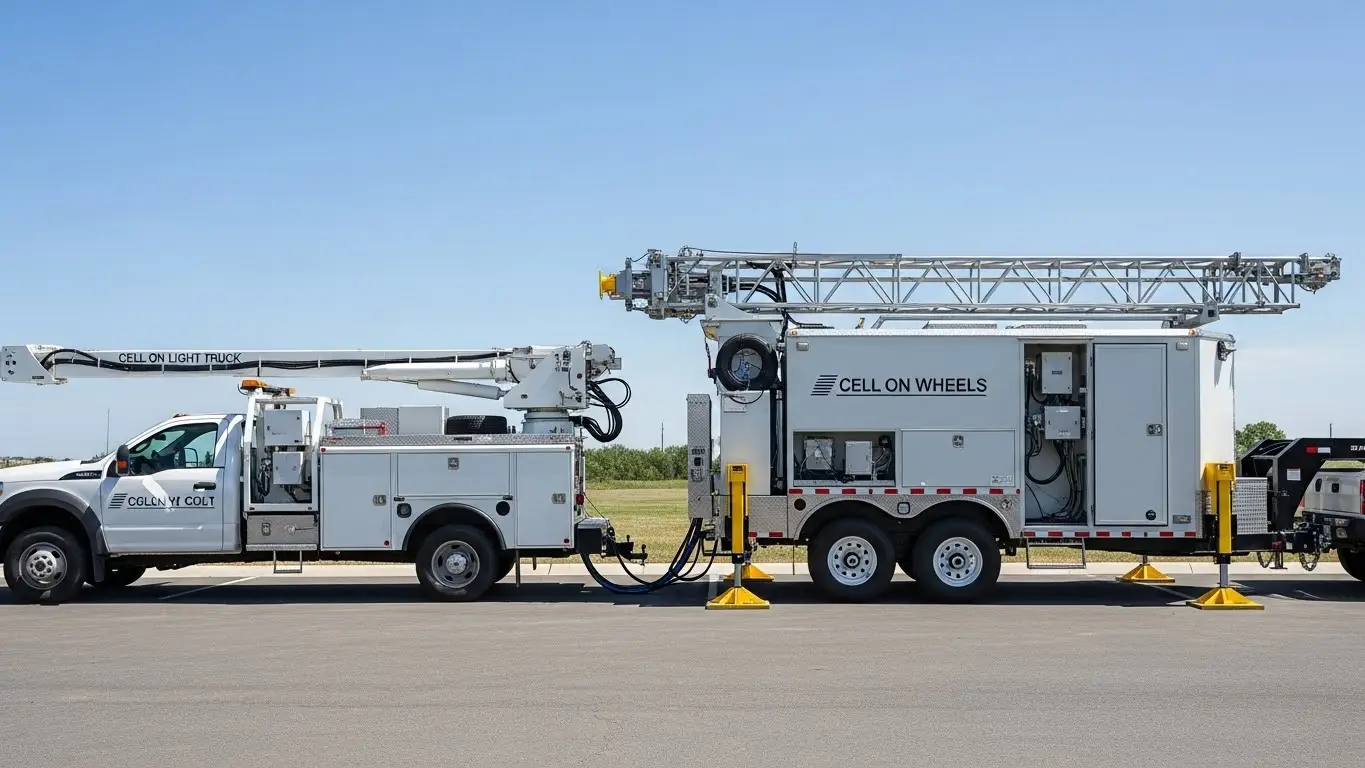
Deployment Speed Comparison by Type
To help you plan, we have broken down the typical time-to-active for the most common rapid deployment solutions.
| Tower Type | Typical Height | Setup Time | Best Use Case |
| COLT (Cell on Light Truck) | 10m – 18m | 15 – 25 mins | Urban events, short-term restoration, high mobility needs. |
| COW (Cell on Wheels) | 20m – 40m | 30 – 90 mins | Disaster recovery, rural coverage, medium-term projects. |
| Portable Mast (Tripod) | 5m – 15m | 20 – 45 mins | Tactical military use, very remote access (carried by hand/ATV). |
| Skid-Mounted Tower | 15m – 30m | 2 – 6 hours | Semi-permanent sites (mining/construction) requiring earth anchors. |
H3: How long does it take to set up a Cell on Wheels (COW)?
A standard trailer-mounted Cell on Wheels (COW) usually takes between 30 and 60 minutes to deploy fully. This includes unhitching the trailer, extending the outriggers for stability, grounding the unit, and raising the mast. If the height requires guy wires for wind stability, add 45–90 minutes to the process.
COWs are the workhorses of the industry. They offer a balance between height and mobility. The setup time is heavily influenced by the guying requirement.
- Unguyed (Self-Supporting): If the COW is heavy enough and the mast is designed to be self-supporting at lower heights, setup is fast.
- Guyed: For maximum height (e.g., 30m+) or high-wind environments, technicians must drive ground anchors and tension steel cables. This manual labor significantly increases setup time but provides essential safety.
H3: Is a Cell on Light Truck (COLT) faster to deploy?
Yes, a COLT is significantly faster, often deploying in under 20 minutes. Because the mast is integrated directly into the chassis of a driven vehicle, there is no unhitching process. The vehicle simply parks, engages its hydraulic stabilizers, and raises the antenna, making it the preferred solution for "drive-test" scenarios and immediate emergency comms.
COLTs sacrifice some height and payload capacity compared to large COWs, but they win on agility. In a multi-site scenario where a team needs to test coverage at five different locations in one day, a COLT is the only viable option.
What environmental factors slow down the installation process?
Wind speed, soil conditions, and overhead obstructions are the primary environmental factors that delay setup. Deployments must often pause if wind speeds exceed 20 mph (32 km/h) during the raising phase. Additionally, soft or uneven ground requires additional time for cribbing (placing pads under outriggers) to prevent the tower from tipping.
The Impact of Site Conditions
Experienced field crews know that the "perfect parking lot" deployment is rare. Here is what causes delays in the field:
- Soil Integrity: If the ground is muddy or sandy, standard outrigger pads may sink. Crews must spend time laying down larger Dunnage or timber mats to distribute the load.
- Grade (Slope): Most rapid towers can only self-level on slopes up to 5–7 degrees. Steeper terrain requires manual digging or blocking to create a level surface before the equipment can even be deployed.
- Overhead Hazards: Power lines are a fatal risk. If lines are detected, the entire rig must be repositioned, which involves packing up and moving the truck/trailer—a massive time sink.
Step-by-Step: How are mobile towers installed safely?
Safe installation follows a strict sequence: Site Survey, Stabilization, Grounding, and Elevation. Ignoring this order risks catastrophic structural failure. The crew first verifies overhead clearance, then extends outriggers to lock the base, connects electrical grounding to protect equipment, and finally raises the mast in stages while monitoring vertical alignment.
The "4-S" Installation Protocol
For those managing a deployment, ensure your teams follow this workflow to maintain efficiency and safety.
- Survey:
- Walk the 360-degree perimeter.
- Look up for power lines.
- Check ground firmness.
- Stabilize:
- Extend all outriggers fully.
- Use bubble levels to ensure the trailer/truck is perfectly flat.
- Tip: Never raise the mast until the wheels are off the ground and the weight is entirely on the outriggers.
- Secure (Grounding):
- Drive copper ground rods into the earth.
- Bond the tower chassis to the ground rod to prevent static buildup and lightning damage.
- Structure (Elevation):
- Unlock the travel locks.
- Raise the mast slowly. If pneumatic, watch air pressure gauges. If mechanical, listen for cable tension.
- Stop at 50% height to double-check stability before going to full extension.
For organizations seeking specialized hardware to streamline this process, Rapid Deployment Mobile Towers Solutions offer engineered designs that prioritize both speed and stability, reducing the friction in these critical steps.
Safety: What are the critical checks before deployment?
Before any deployment begins, operators must verify that wind speeds are within safe limits (typically under 45 mph for erection), that there is no risk of lightning, and that the "fall zone" is clear of personnel. Overhead high-voltage lines must be at least 1.5 times the mast height away from the deployment point to prevent arcing or accidental contact.
The "Go/No-Go" Safety Checklist
Every deployment should begin with a briefed checklist. If any of these are "No," the deployment halts.
- [ ] Overhead Clearance: Is the sky clear of power lines within a radius equal to the tower height + 20 feet?
- [ ] Wind Speed: Is the sustained wind below the manufacturer's rating for deployment (usually lower than the rating for a guyed static tower)?
- [ ] Ground Stability: Can the ground support the point-load of the outriggers (often thousands of pounds per square foot)?
- [ ] Mechanical Integrity: Are the lifting cables/hydraulics free of fraying or leaks?
Why Experience Matters
In my analysis of field reports, the most common cause of deployment failure isn't equipment breakage—it's human error regarding the center of gravity. Rapid deployment towers have a high center of gravity. Moving a trailer with the mast even partially extended is strictly forbidden and is the leading cause of rollovers. Always fully retract and lock the mast before moving the unit even a few feet.
FAQ: Rapid Deployment Telecom Towers
Generally, temporary mobile towers (COWs/COLTs) utilized for emergencies or short-term events (under 30-90 days) are often exempt from standard zoning and building permits, though this varies strictly by local municipality and requires a "Temporary Use Permit" in some urban zones.
Most unguyed mobile towers are rated for 60–80 mph winds. However, when properly guyed and anchored, high-end rapid deployment solutions can survive winds exceeding 100 mph. Always check the TIA-222 revision rating of the specific tower.
They are usually self-contained. Most units come with an onboard diesel or propane generator (5kW–20kW) and a battery bank. Many modern solutions are now integrating solar panels to reduce fuel consumption and noise.
Payload capacity varies significantly. A light-duty pneumatic mast might hold 30–50 kg (enough for a radio and small antenna), while a heavy-duty lattice COW can support 250–500 kg of heavy Remote Radio Heads (RRHs) and microwave dishes.
While they can remain on site for years, they are not cost-effective for permanent use compared to a ground-based lattice tower or monopole. They are best for temporary gaps, disaster recovery, or interim solutions while a permanent tower is being built.

Hey, I’m Chunjian Shu
"X.Y. Tower: Reliable, innovative solutions for high-quality towers and electrical equipment with professional service.
