
Telecom Monopole Towers Explained: When to Choose Them
2025-12-15
Telecom monopole towers are single-pole, self-supporting structures designed for areas where space is limited and aesthetics are a priority. Typically ranging from 50 to 150 feet in height, they are the ideal choice for urban and suburban deployments where zoning regulations are strict or land availability is scarce. Unlike sprawling lattice towers or guyed masts, a monopole requires a minimal ground footprint—often just a few square feet for the foundation—making it the go-to solution for maximizing connectivity in densely populated environments without creating a visual eyesore.
What Is a Telecom Monopole Tower?
A monopole tower is essentially a large, tapered steel tube. It is constructed by stacking hollow steel sections that slip-fit onto one another (a process called "slip-jointing") or are bolted together via flanges.
Because of this streamlined design, they are the most popular tower type for modern wireless communication, including 5G rollouts and cellular base stations. They are manufactured using high-strength steel and are hot-dip galvanized to resist corrosion, ensuring a lifespan of 30+ years even in harsh weather.
Key Design Features
- Small Footprint: Requires significantly less land than lattice or guyed towers.
- Aesthetics: Sleek, single-pole design is less intrusive.
- Versatility: Can be camouflaged as trees (monopines), flagpoles, or light standards.
For a detailed engineering breakdown, read our guide on monopole telecom towers design and benefits.
When Should You Choose a Monopole Over a Lattice Tower?
You should choose a monopole when ground space is expensive or restricted, and when community zoning laws demand a structure that blends into the background.
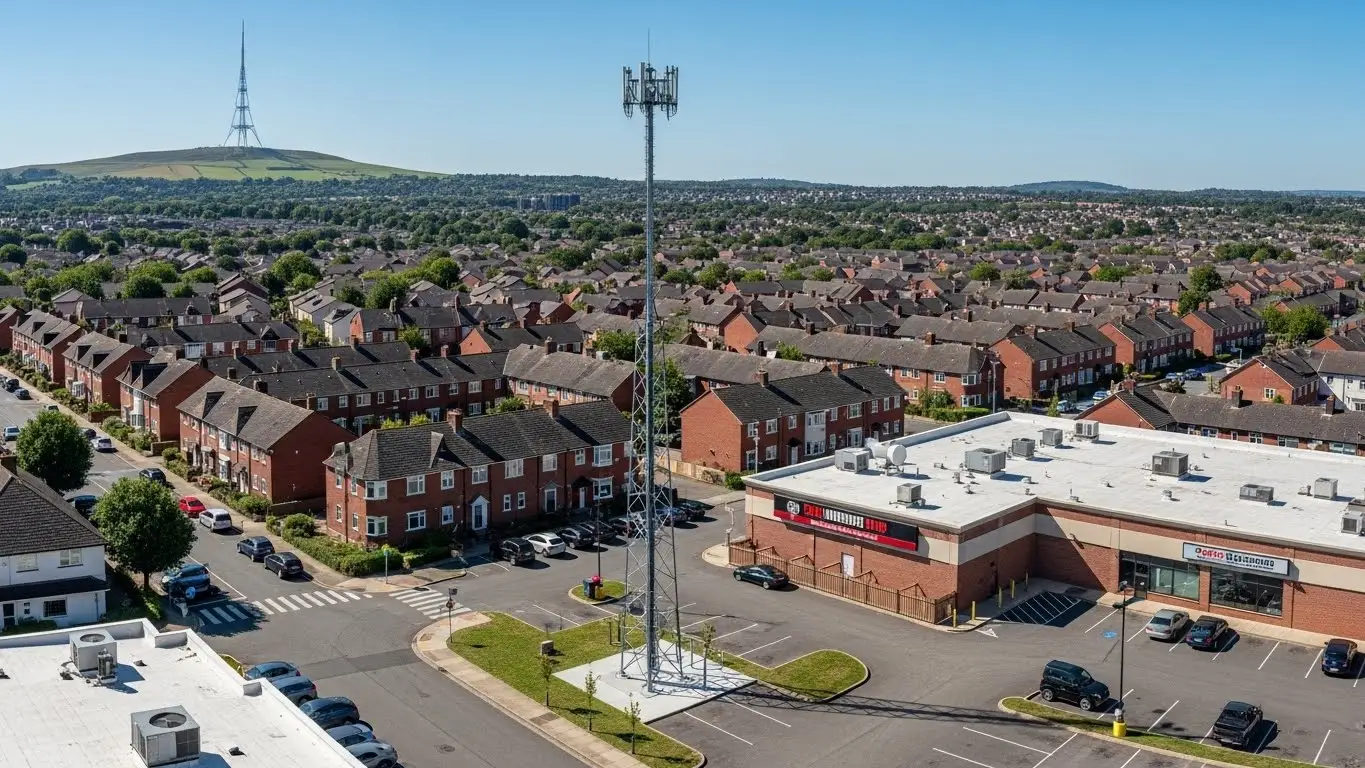
While lattice towers (the three- or four-legged structures) are generally cheaper to manufacture for great heights, they require a much larger base. Monopoles are the superior choice in three specific scenarios:
- Urban/Suburban Sites: If you are building in a city center or a residential neighborhood, a lattice tower is often prohibited by zoning laws due to its industrial appearance.
- Small Leased Areas: If you are leasing a 10x10 foot plot in a parking lot, a monopole is often the only structure that will fit.
- Speed of Installation: Because they consist of fewer sections, monopoles can often be erected faster than assembling a lattice tower piece-by-piece.
Comparison: Monopole vs. Self-Supporting Lattice
| Feature | Monopole Tower | Lattice Tower |
| Footprint | Small (Approx. 4-10 ft diameter base) | Medium (Approx. 15-30 ft width base) |
| Height Capacity | Typically maxes out around 200 ft | Can exceed 300+ ft easily |
| Load Capacity | Moderate (fewer antennas) | High (many antennas/heavy dishes) |
| Wind Load | Deflects (sways) more | Rigid (less sway) |
| Installation Time | Fast (Sections stack quickly) | Slower (Many bolts and members) |
How Tall Can a Monopole Tower Be?
Most standard telecom monopoles range between 50 and 150 feet, though engineered designs can reach up to 200 feet.
While it is physically possible to build them taller, it becomes exponentially more expensive. As a monopole gets taller, the diameter of the base must get significantly wider to prevent the tower from snapping in the wind. Beyond 200 feet, the amount of steel required usually makes a lattice tower or guyed mast a much more cost-effective option.
Engineering Note: Height is also limited by the "sway" or deflection. Because it is a single pole, a monopole moves more in the wind than a rigid lattice tower. If you are mounting highly sensitive microwave dishes that require pinpoint alignment, engineers must oversize the monopole to make it stiffer.
How Much Does a Monopole Tower Cost Compared to Others?
Monopoles are generally more expensive per foot of height than lattice or guyed towers due to the higher cost of manufacturing tapered steel tubes.
However, the total project cost often balances out. Here is why:
- Lower Foundation Costs: You are pouring a foundation for a single point, not three or four legs.
- Lower Land Costs: You lease less land from the property owner.
- Faster Erection: You save on crane time and labor hours during installation.
So, while the steel itself costs more, the overall project in an urban environment is often cheaper—or simply the only viable option—with a monopole.
Can Monopoles Be Expanded or Upgraded?
Yes, existing monopoles can often be reinforced or extended, but it requires careful structural analysis.
If you need to add more tenants (carriers) to an existing pole, engineers can "retrofit" the tower. This usually involves:
- Extension: Bolting a new section to the top (if the base can handle the leverage).
- Reinforcement: Welding flat steel plates or channels to the sides of the existing pole to stiffen it against wind loads.
However, monopoles are less flexible than lattice towers in this regard. A lattice tower offers hundreds of connection points for new beams; a monopole only offers the outer surface of the tube.
Frequently Asked Questions
A monopole is a free-standing single pole, whereas a guyed tower is a thin mast supported by tensioned steel cables (guy wires) anchored to the ground. Guyed towers are cheaper and taller but require a massive amount of land for the anchors.
Yes, they are designed to strict TIA-222 standards. While they are designed to sway slightly to shed wind load, they are engineered to withstand hurricane-force winds and ice loads specific to their location.
Foundation depth varies by soil type and tower height, but typical monopole caisson foundations are drilled 20 to 40 feet deep into the ground and filled with reinforced concrete.
Absolutely. Monopoles are ideal for 5G because they can be placed closer to population centers where 5G density is needed. They can easily support the weight of modern massive MIMO antennas.
A slip joint is a method of assembly where the upper section of the tower is slightly narrower than the lower section, allowing it to slide inside for a snug friction fit, eliminating the need for bolted flange connections at every joint.
Key Takeaways
- Best for Urban Areas: Choose monopoles when space is tight and looks matter.
- Small Footprint: They require significantly less ground area than lattice towers.
- Height Limit: Most effective up to 150-180 feet; beyond that, lattice towers are more efficient.
- Fast Install: Slip-joint sections allow for rapid erection, saving on labor costs.
Conclusion
Telecom monopole towers are the backbone of modern urban connectivity. While they may cost more per pound of steel than other structures, their ability to fit into small spaces and blend into the environment makes them indispensable for 5G expansion. If you are planning a site in a populated area with strict zoning, the monopole is likely your best—and often only—choice.
Ready to optimize your network infrastructure? Explore our specialized monopole telecom towers design and benefits to find the perfect fit for your next project.

Hey, I’m Chunjian Shu
"X.Y. Tower: Reliable, innovative solutions for high-quality towers and electrical equipment with professional service.
