
Do Telecom Towers Meet ISO 9001 and Safety Compliance Standards?
2025-12-16
Yes, reputable telecom tower manufacturers strictly adhere to ISO 9001 for quality management and specific structural safety standards like TIA-222-H (USA) or Eurocode 3 (Europe). While ISO 9001 ensures consistent manufacturing processes—like verifying steel grades and welding protocols—structural safety standards dictate the tower's ability to withstand wind, ice, and seismic loads. For a tower to be compliant, it must pass both the "Process Audit" (ISO) and the "Design Stress Analysis" (TIA/EN).
The Difference Between "Quality" and "Safety"
In the telecom infrastructure world, buyers often conflate "Quality" with "Safety," but they are governed by different rulebooks.
- ISO 9001 (The Process): This certifies that the factory has a consistent system in place. It answers: "Did you build the tower exactly how the drawings said you would, every single time?"
- TIA-222 / Eurocode (The Design): This certifies the engineering math. It answers: "Will the tower actually stand up in a 160 km/h hurricane?"
A factory can be ISO 9001 certified and still build a tower that collapses if the engineering design was flawed. That is why you need both.
Phase 1: ISO 9001 in Tower Manufacturing
ISO 9001 is not just paperwork; in a steel tower factory, it controls three critical physical steps:
1. Material Traceability (Clause 8.5.2)
When raw steel arrives, ISO 9001 mandates that every batch is tagged with a "Heat Number." This connects the angle bar in your tower back to the original foundry's steel grades materials report.
- Why it matters: If a tower leg cracks 5 years later, the manufacturer can trace exactly which batch of steel was used and recall other towers built from that same defective batch.
2. Welding Quality Control (ISO 3834)
Welding is the most common point of failure. Compliance requires:
- WPS (Welding Procedure Specifications): The "recipe" for the weld (voltage, speed, wire type).
- CWI (Certified Welding Inspectors): Independent checks using Ultrasonic or Magnetic Particle testing to find invisible cracks.
3. Calibration of Tools
The torque wrenches used to tighten bolts and the micrometers used to measure hot-dip galvanizing thickness must be calibrated regularly. ISO 9001 auditors verify these calibration logs.
Phase 2: Structural Safety Standards (The Design)
Once the manufacturing quality is assured, the design must meet regional safety codes.
TIA-222-H (North America / Global)
The Telecommunications Industry Association (TIA) standard is the global benchmark.
- Wind Loading: Calculates pressure based on "Ultimate Wind Speed" (e.g., 3-second gust).
- Ice Loading: Accounts for the weight of radial ice accumulation.
- Seismic: Mandates spectral response analysis for earthquake zones.
Eurocode 3 Part 3-1 (Europe)
Specifically EN 1993-3-1, which covers "Towers, Masts and Chimneys." It is notoriously strict on steel fatigue and buckling analysis.
Note: Sourcing from China? Ensure your supplier designs to GB 50135 but can convert drawings to TIA or Eurocode standards. Most top-tier exporters, like XYTOWER, use software (like MSTower or PLS-TOWER) that supports multiple global codes.
Phase 3: Occupational Safety (ISO 45001)
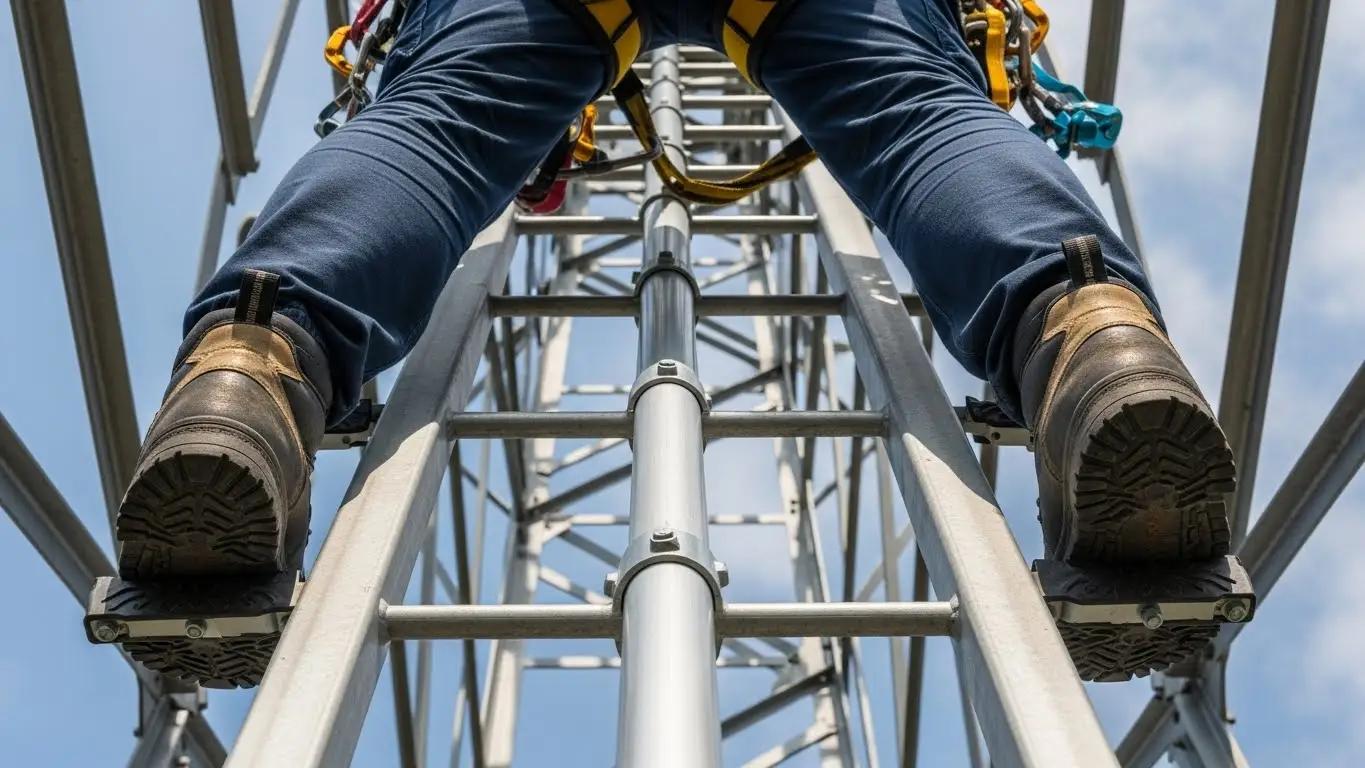
Safety isn't just about the tower standing up; it's about the people building and climbing it.
- Manufacturing Safety: ISO 45001 ensures factory workers are protected from zinc fumes during the galvanizing process and arc flash during welding.
- Climbing Safety Features: The tower design itself must include safety features like:
- Anti-Fall Rail Systems: Integrated into the ladder.
- Rest Platforms: Required every 9-15 meters depending on local labor laws.
- Step Bolt Strength: Bolts must withstand high shear loads in case a climber falls.
The Compliance Checklist for Buyers
Before signing a contract, request these four documents to verify compliance:
| Document | Standard | What it Proves |
| Mill Test Certificate (MTC) | ASTM / GB | The steel chemistry matches the required steel grades. |
| ISO 9001 Certificate | ISO | The factory has a valid Quality Management System. |
| WPS & PQR | AWS / ISO | Welders are qualified and procedures are tested. |
| Galvanizing Report | ASTM A123 | Zinc thickness is sufficient for corrosion protection. |
Frequently Asked Questions
No. ISO 9001 guarantees the process was followed. To guarantee corrosion resistance, you need to specify ASTM A123 or ISO 1461 for the hot-dip galvanizing, and verify the zinc thickness report.
Yes. Steel is a universal material. As long as the manufacturer uses the correct steel grade equivalencies (e.g., Q355B instead of A572 Gr50) and follows the TIA design loads, the tower is fully compliant.
ISO 9001 focuses on Quality (Customer Satisfaction). ISO 14001 focuses on Environment (Waste Management). Many telecom operators now require suppliers to have both to meet corporate sustainability goals
Yes. Step bolts must meet specific tensile strength requirements (often ASTM A449) and geometry standards to ensure a climber's boot won't slip. They are considered "Critical Safety Items."
According to TIA-222-H, towers should undergo a maintenance inspection every 3 years and a structural inspection after any severe wind or seismic event.
Key Takeaways
- Two-Part Compliance: You need ISO 9001 for manufacturing consistency and TIA/Eurocode for structural design safety.
- Traceability is Key: ISO 9001 ensures every steel member can be traced back to the mill, essential for long-term liability.
- Don't Ignore Welding: Certified Welding Inspectors (CWI) and ISO 3834 compliance are your best defense against structural failure.
- Verify Documentation: Always ask for the MTC, WPS, and Galvanizing Reports before final payment.
Conclusion
Compliance is not a sticker you put on a tower; it is the rigorous documentation of every weld, bolt, and zinc bath. By ensuring your manufacturer adheres to ISO 9001 for process control and TIA/Eurocode for design integrity, you mitigate the risk of catastrophic failure. Don't just ask "Is it certified?"; ask "Show me the trace logs."
Ready to source compliant infrastructure? Explore our guide on steel grades for mobile towers to understand the materials that form the backbone of a safe tower.

Hey, I’m Chunjian Shu
"X.Y. Tower: Reliable, innovative solutions for high-quality towers and electrical equipment with professional service.
