
Using Temporary Mobile Towers for Disaster Recovery
2025-12-15
Temporary mobile towers for disaster recovery act as critical infrastructure bridges that rapidly restore telecommunications when permanent networks fail due to hurricanes, earthquakes, or wildfires. By deploying self-contained units like Cells on Wheels (COWs) or Cells on Light Trucks (COLTs), emergency coordinators can re-establish cellular and radio signals within 30 to 60 minutes of arrival. These mobile assets provide essential connectivity for first responders to coordinate rescue efforts and for affected communities to contact loved ones, operating independently of the local power grid through onboard generators and satellite backhaul.
How Do Mobile Towers Support Emergency Response?
When a disaster strikes, the "golden hour"—the first 60 minutes after the event—is crucial. Permanent towers often fail due to power outages or physical damage, creating a "blackout zone" that hampers rescue operations.
Mobile towers solve this by bringing the network to the user. They function as temporary base stations that can be towed or driven directly into the disaster zone. Once stabilized, they extend a telescopic mast equipped with antennas and microwave dishes, creating an immediate coverage bubble.
Key capabilities include:
- Interoperability: Supporting multiple frequencies (LTE, 5G, Land Mobile Radio) so police, fire, and medical teams can talk to each other.
- Grid Independence: Utilizing onboard diesel generators and battery banks to run for days without external power.
- Backhaul Flexibility: Connecting to the core network via satellite (VSAT) when fiber lines are severed.
For a deeper dive into the specific hardware used in these scenarios, explore our guide on rapid deployment mobile towers solutions.
Types of Disaster Recovery Towers: COWs vs. COLTs
Choosing the right equipment depends on the terrain and the duration of the deployment.
Cell on Wheels (COW)
A COW is a portable base station mounted on a trailer. It typically features a lattice or pneumatic mast that can reach heights of 20 to 40 meters.
- Best for: Long-term recovery (weeks to months) and high-capacity needs.
- Pros: Higher payload capacity for heavy equipment; stable in high winds when guyed.
- Cons: Requires a towing vehicle; slower to set up than a COLT.
Cell on Light Truck (COLT)
A COLT is a vehicle (usually a heavy-duty chassis) with the mast integrated directly onto the truck bed.
- Best for: "First-in" response, scouting, and highly mobile operations.
- Pros: Extremely fast setup; can drive over debris to reach difficult sites.
- Cons: Lower mast height; limited fuel storage compared to large trailer units.
To understand how these units function in real-world crises, read our analysis on mobile communication towers for emergency response.
How Fast Can Mobile Towers Be Deployed?
Most mobile towers can be operational within 30 to 60 minutes of arriving at the site.
However, "deployment" refers to the physical setup—stabilizing the vehicle, grounding the electrical system, and raising the mast. Full network integration (getting the signal live) can take longer depending on the backhaul connection type.
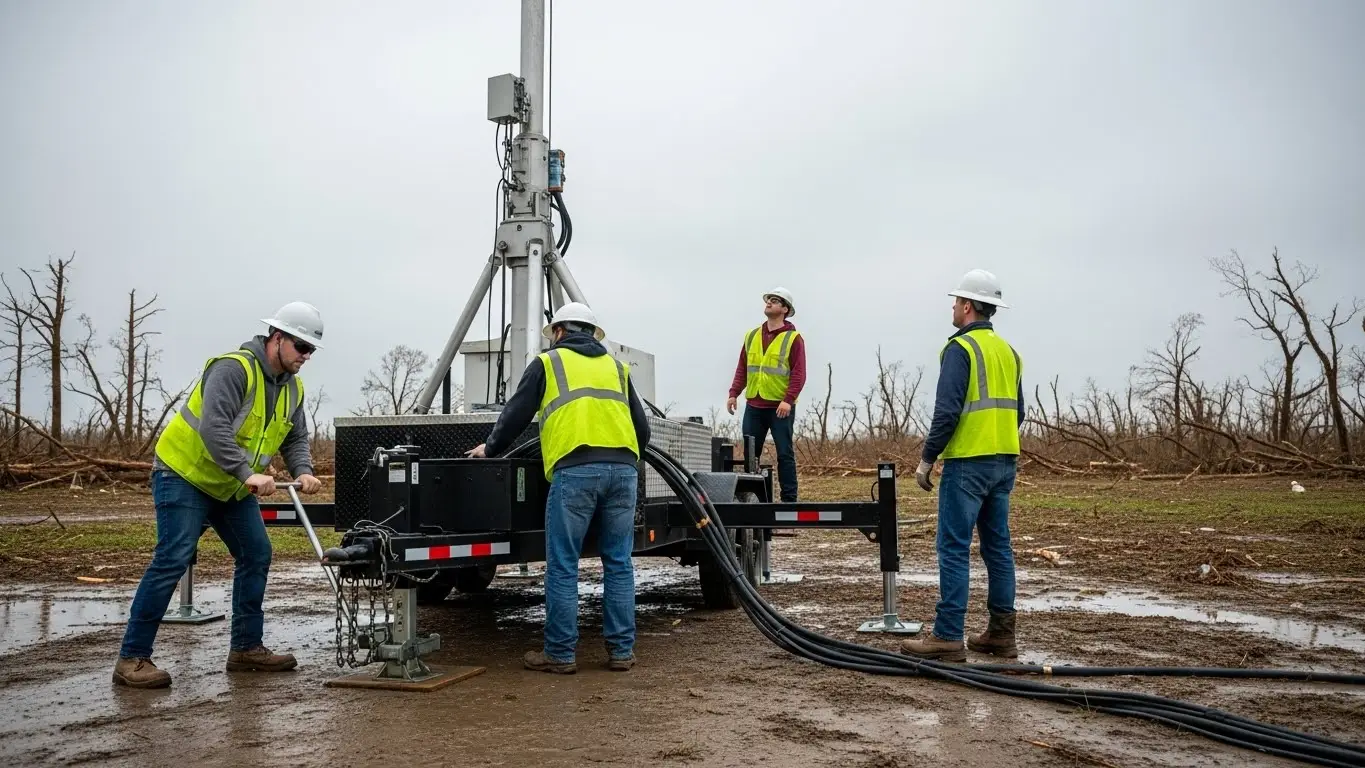
Typical Setup Timeline:
- Arrival & Stabilization (15 mins): Leveling the trailer with outriggers.
- Mast Elevation (15-20 mins): Pneumatic or mechanical raising of the antenna.
- Signal Integration (15-30 mins): Aligning satellite dishes or microwave links.
Note: Complex terrain or severe weather can extend these times. For a detailed breakdown of timelines, check out our data on rapid deployment telecom towers setup time.
What Are the Challenges of Deploying in Disaster Zones?
While powerful, mobile towers face significant logistical hurdles in a disaster zone.
1. Access and Terrain
Flooded roads or debris often block heavy trailers (COWs). In these cases, smaller, air-liftable "goat" units or COLTs with off-road capabilities are required.
2. Fuel Logistics
Generators require diesel. If the disaster disrupts fuel supply chains, the tower will go dark once its tank runs dry. Modern units use hybrid power systems (Solar + Battery + Generator) to extend runtime.
3. Backhaul Connectivity
A tower is useless if it cannot connect to the internet (backhaul). If fiber lines are cut, technicians must rely on satellite links, which have lower bandwidth and higher latency, potentially slowing down data speeds.
| Feature | COW (Trailer) | COLT (Truck) | Portable Mast (Tripod) |
| Setup Speed | 45-90 mins | 15-30 mins | 20-40 mins |
| Height | High (up to 40m) | Medium (10-20m) | Low (6-15m) |
| Mobility | Low (needs towing) | High (self-driven) | Very High (man-portable) |
| Power | Large onboard gen | Vehicle engine/gen | Battery packs |
People Also Ask
Do mobile towers work without electricity?
Yes, mobile towers are designed to work without grid electricity. They are equipped with onboard power sources, typically diesel or propane generators, which charge a battery bank. This hybrid system ensures continuous operation even when the local power lines are down.
What is the range of a temporary mobile tower?
A temporary mobile tower typically covers a radius of 3 to 10 miles (5-16 km). The exact range depends heavily on the height of the mast and the terrain. In flat, open areas, the signal travels further, whereas in mountainous or urban disaster zones, obstructions will reduce the effective coverage area.
Can mobile towers withstand hurricane winds?
High-quality mobile towers are rated to withstand winds of 60-80 mph when unguyed. However, for safety during hurricane-force winds (100+ mph), the mast must be retracted or heavily secured with guy wires and ground anchors to prevent tipping or structural failure.
Frequently Asked Questions
In declared emergency situations, local governments often waive standard zoning permits to expedite recovery. However, for non-emergency temporary use, standard permits are usually required.
For inaccessible regions, specialized "skid-mounted" towers can be airlifted by helicopter or loaded onto C-130 transport aircraft.
Yes, modern mobile towers are "technology agnostic." They can support 4G LTE, 5G, and private radio networks depending on the equipment installed on the mast.
A standard diesel generator on a COW consumes about 0.5 to 1.0 gallons per hour. Hybrid units with solar support can significantly reduce this consumption.temporary mobile towers disaster recovery
Key Takeaways
- Immediate Connectivity: Mobile towers restore critical comms for first responders within an hour of arrival.
- Versatile Options: Choose COLTs for speed and mobility, or COWs for stability and long-term coverage.
- Grid Independence: Onboard generators and satellite links allow operation in total blackouts.
- Logistics Matter: Successful deployment requires planning for fuel delivery and site access.
Conclusion
Temporary mobile towers are the unsung heroes of disaster recovery, turning chaos into coordination. By understanding the differences between COWs and COLTs and planning for logistical challenges, emergency managers can ensure that when the worst happens, the line remains open.

Hey, I’m Chunjian Shu
"X.Y. Tower: Reliable, innovative solutions for high-quality towers and electrical equipment with professional service.
