
Top 10 Transmission Tower Manufacturers Worldwide (2026 Guide)
2026-01-19
Transmission towers play a critical role in global power infrastructure, supporting the safe and efficient delivery of electricity across long distances. As demand for grid expansion, renewable energy integration, and cross-border power projects continues to rise, selecting a reliable transmission tower manufacturer has become increasingly important for utilities, EPC contractors, and energy developers.
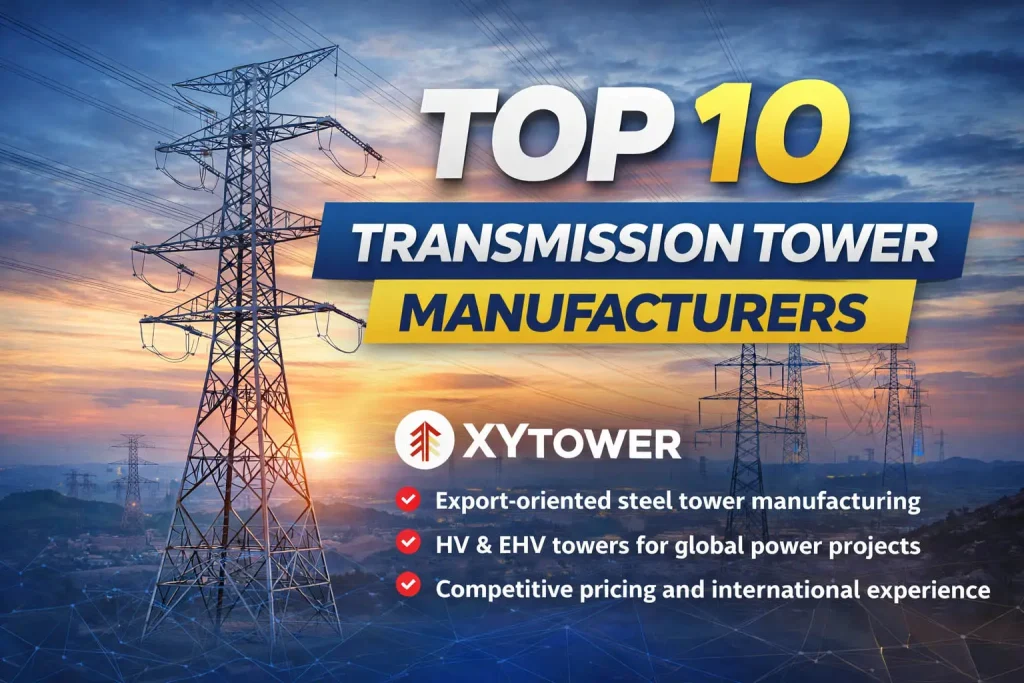
This guide highlights the Top 10 Transmission Tower Manufacturers worldwide, based on manufacturing capability, engineering expertise, international project experience, and compliance with global standards.
1. Larsen & Toubro (L&T) – India
Larsen & Toubro is one of the world’s most established engineering and infrastructure companies. Its power transmission division manufactures lattice transmission towers, substation structures, and customized steel frameworks for high-voltage lines.
Key strengths:
- Extensive experience in extra-high-voltage (EHV) projects
- Integrated design, fabrication, and EPC services
- Strong presence across Asia, the Middle East, and Africa
Website: https://www.larsentoubro.com
2. Tata Projects – India
Tata Projects, part of the Tata Group, is a major supplier of transmission towers for national grid and cross-country power projects.
Key strengths:
- Backed by a globally trusted industrial group
- High-quality fabrication and strict QA/QC systems
- Proven capability in large-scale utility projects
Website: https://www.tataprojects.com
3. Kalpataru Power Transmission Ltd. – India
Kalpataru Power Transmission specializes in power transmission and distribution infrastructure, with decades of experience supplying steel towers worldwide.
Key strengths:
- Expertise in high-voltage and ultra-high-voltage towers
- Strong export footprint in over 50 countries
- End-to-end project execution capability
Website: https://www.kalpatarupower.com
4. Valmont Structures – United States
Valmont Structures is a global leader in engineered steel structures for power, telecom, and transportation infrastructure.
Key strengths:
- Advanced structural analysis and wind-load optimization
- Compliance with ANSI, ASCE, and IEC standards
- Strong reputation in North America and Europe
Website: https://www.valmont.com
5. Skipper Limited – India
Skipper Limited is one of the largest manufacturers of transmission towers in India, exporting to multiple continents.
Key strengths:
- High-volume manufacturing capacity
- Competitive cost structure for utility-scale projects
- Experience in diverse geographic and climate conditions
Website: https://www.skipperlimited.com
6. ZTT Group – China
ZTT Group (Zhongtian Technology) provides transmission towers as part of its broader power and telecom infrastructure portfolio.
Key strengths:
- Vertically integrated steel and power infrastructure manufacturing
- International certifications and export compliance
- Strong presence in Asia, Europe, and Africa
Website: https://en.zttcable.com
7. KEC International – India
KEC International, part of the RPG Group, is a global EPC player with strong in-house manufacturing for transmission towers.
Key strengths:
- Experience in cross-border and long-span transmission lines
- Strong engineering and logistics management
- Projects delivered in over 100 countries
Website: https://www.kecrpg.com
8. Siemens Energy (Structural Solutions) – Germany
Siemens Energy contributes to power transmission infrastructure through engineering-driven structural solutions and grid modernization projects.
Key strengths:
- Strong integration with smart grid and renewable energy systems
- Advanced engineering and compliance with EU standards
- Focus on long-term grid reliability
Website: https://www.siemens-energy.com
9. Power China (Transmission Structures Division) – China
Power China supports large-scale national and international power projects, including transmission tower fabrication and installation.
Key strengths:
- Experience in ultra-high-voltage transmission projects
- Strong government-backed infrastructure capability
- Large overseas project portfolio
Website: https://www.powerchina.cn
10. XYTower – Global
XYTower is a professional transmission tower manufacturer specializing in the design and fabrication of steel lattice towers for power transmission and distribution networks. The company supplies towers for high-voltage and extra-high-voltage lines, serving utilities, EPC contractors, and energy developers worldwide.
XYTower focuses on export-oriented manufacturing, offering flexible customization based on line voltage, terrain conditions, and national grid standards.
Key strengths:
- Custom-designed transmission towers for HV and EHV projects
- Compliance with international structural and galvanizing standards
- Strong export experience across Asia, Africa, the Middle East, and Latin America
- Competitive pricing for large-scale and long-distance transmission lines
Website: (可替换为 XYTower 官方网址)
How to Choose a Transmission Tower Manufacturer
When evaluating transmission tower manufacturers, decision-makers should consider:
- Structural design standards (IEC, ANSI, ASCE, or EN)
- Wind load, seismic resistance, and corrosion protection
- Manufacturing capacity and delivery timelines
- Experience with similar voltage levels and terrains
- Technical documentation and after-sales engineering support
Final Thoughts
As global power demand grows and renewable energy projects expand, transmission towers remain a foundational element of reliable electricity networks. Manufacturers such as L&T, Valmont, Kalpataru, and XYTower demonstrate how engineering expertise, manufacturing scale, and international project experience contribute to long-term grid stability.
Choosing the right transmission tower manufacturer is not just about cost—it is about structural safety, regulatory compliance, and decades of dependable performance.
Transmission Tower vs Telecom Tower: Key Differences Explained
Although transmission towers and telecom towers may appear similar at first glance, they serve very different purposes and are designed according to distinct engineering standards. Understanding these differences is essential when planning power grid projects or telecommunications infrastructure.
1. Primary Function
Transmission Tower
Transmission towers are used to support high-voltage or extra-high-voltage power lines that transmit electricity from power plants to substations over long distances. Their primary role is to ensure safe electrical clearance and mechanical stability under continuous load.
Telecom Tower
Telecom towers support antennas, microwave dishes, and communication equipment used for mobile networks, broadcasting, and wireless data transmission. They are designed to provide optimal signal coverage rather than carry electrical current.
2. Voltage vs Signal Load
Transmission Tower
- Carries live electrical conductors
- Designed for specific voltage levels (66kV to 800kV and above)
- Requires strict electrical clearance and insulation standards
Telecom Tower
- Does not carry electrical power
- Supports radio frequency and microwave signals
- Focuses on antenna positioning and signal stability
3. Structural Design and Load Characteristics
Transmission Tower
Transmission towers are typically lattice steel structures engineered to withstand:
- Heavy conductor weight
- Long-span tension forces
- Wind and ice loading
- Thermal expansion of power lines
These towers are often taller and heavier, with wide bases for mechanical stability.
Telecom Tower
Telecom towers are designed to handle:
- Antenna and equipment load
- Wind-induced vibration
- Multi-operator equipment mounting
They are commonly built as lattice towers, monopoles, or rooftop structures, with more emphasis on flexibility and modularity.
4. Standards and Compliance
Transmission Tower
- IEC, ANSI, ASCE, EN standards
- Utility and national grid specifications
- Stringent safety and electrical clearance regulations
Telecom Tower
- TIA, ISO, and local telecom authority standards
- RF exposure and structural safety requirements
- Often governed by telecom regulators rather than utilities
5. Typical Height and Span
Transmission Tower
- Height typically ranges from 20 to over 80 meters
- Designed for long spans between towers
- Often installed in rural, mountainous, or cross-country routes
Telecom Tower
- Height generally ranges from 15 to 60 meters
- Designed for coverage optimization rather than long spans
- Frequently installed in urban and suburban areas
6. Installation Environment
Transmission Tower
- Power corridors, open fields, deserts, mountains
- Requires right-of-way approval and long-term land access
- Built for decades-long operation
Telecom Tower
- Cities, highways, rooftops, remote villages
- Smaller land footprint
- Designed for easier upgrades and equipment replacement
7. Service Life and Maintenance
Transmission Tower
- Designed for long service life, often exceeding 40 years
- Minimal structural modification after installation
- Maintenance focuses on corrosion protection and insulator replacement
Telecom Tower
- More frequent equipment upgrades
- Structural life may be long, but mounted devices change often
- Maintenance focuses on mounting systems and antenna alignment
8. Cost Structure
Transmission Tower
- Higher material and fabrication cost per unit
- Significant engineering and foundation investment
- Cost efficiency achieved over long-distance transmission lines
Telecom Tower
- Lower structural cost per tower
- Higher cost related to electronic equipment
- Cost driven by coverage density and network capacity
Summary Comparison Table
| Aspect | Transmission Tower | Telecom Tower |
|---|---|---|
| Main Purpose | Power transmission | Wireless communication |
| Load Type | Electrical conductors | Antennas and RF equipment |
| Voltage / Signal | High voltage (HV/EHV) | RF and microwave |
| Standards | IEC, ANSI, EN | TIA, ISO |
| Typical Height | 20–80+ meters | 15–60 meters |
| Installation Area | Power corridors, rural | Urban, suburban |
| Service Life | 40+ years | Long structure, frequent upgrades |

Hey, I’m Chunjian Shu
"X.Y. Tower: Reliable, innovative solutions for high-quality towers and electrical equipment with professional service.
