
Angle Steel Towers: Designing for the Line, Not Just the Drawing
2026-07-29
A “straight” transmission line is reasonably readily interpretable from the surface. The conductors go in a tower then come out in almost the same direction, for the next span.
It is no longer in balance at an angle tower.
The line rotates and the conductor tension stresses in two directions and the pulling sideways force must travel through the tower and its foundation. Hence, implying an angle tower is never to be chosen based on the voltage or its height aspect.
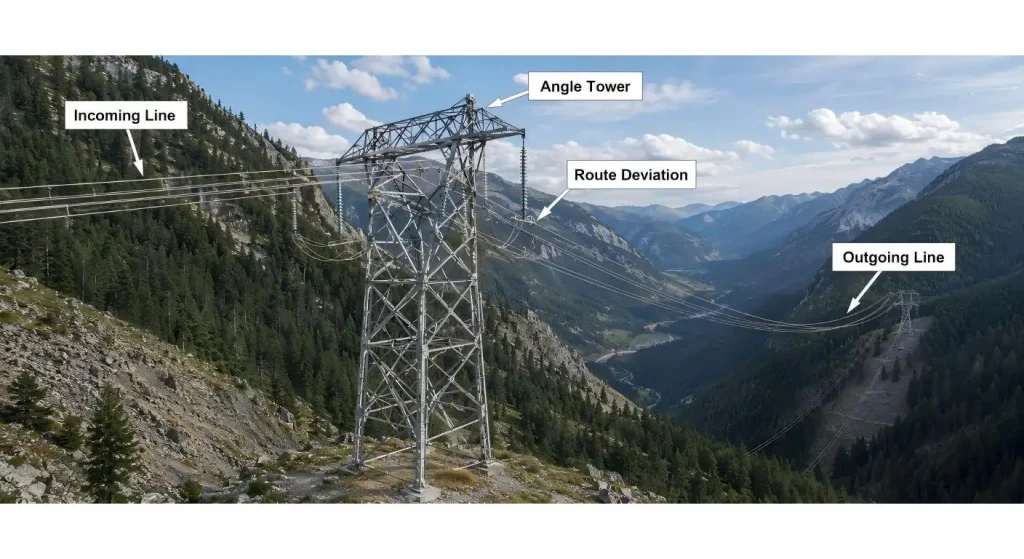
This is an explanation of the Job of “Angle Tower.”
It's a name that can be confusing.
What defines an angle tower is what happens on the route: It helps to change the direction of the line. The structure itself can be constructed as a lattice tower consisting of angle sections, tubular members or other acceptable system.
It is also possible to use a tension tower at a route deviation as the conductor attachments and more robust structural design are designed for higher longitudinal and transverse forces. The approved scope of angles and loading duty, however, must be from the approved tower family (not from the product name).
A Small Turn Can Create a Real Side Load is a type of side load composed of many tiny turns
Maybe, a small road can choose up to the paper, a route deviation is not that harmful. In the load model it will alter the direction of all conductor tension forces.
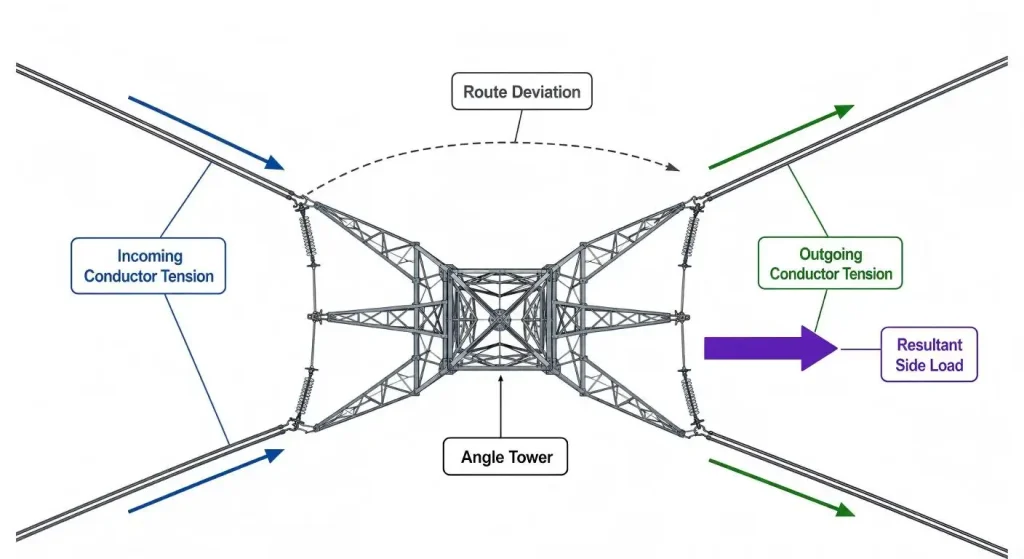
There is more to it than just a plan angle! The tower reaction may be influenced by conductor type, design tension, surrounding spans, height difference of the towers, wind, ice conditions and broken-wire conditions.
This is the reason it is stated on the spotting schedule of actual line angle and tower class being used at each turning point. One of several positions can be considered an angle tower and it's risky to designate them so and decide how these are interpreted on their own during the fabricating process.
| Project Input | Information to Confirm | Why It Matters |
| Route deviation | Incoming and outgoing line direction | Establishes the transverse conductor force |
| Tower duty | Light angle, heavy angle, tension or terminal duty | Prevents use outside the approved tower family |
| Conductor system | Conductor, earth wire, OPGW and design tension | Defines attachment and tower-head loads |
| Span geometry | Adjacent spans and elevation differences | Identifies unequal and uplift loading |
| Environmental loads | Wind, ice, temperature and special events | Sets the governing structural load cases |
| Electrical layout | Insulator type, jumper arrangement and clearances | Controls tower-head and cross-arm geometry |
| Foundation data | Soil conditions, slope and approved reactions | Determines footing type and foundation size |
| Construction plan | Stringing method, temporary loads and access | Supports safe erection and conductor installation |
Don't Pick the Tower based on the Angle Only
A 15' turn on a short sheltered turn is not necessarily equal to a 15' turn beside a long valley turn.
Later in the ruling span one side may be larger than the other. The ground can drop off precipitously after the tower. If a crossing span is used there could be added construction or containment requirements. Even the earth-wire and optical ground wire (OGW) configuration will affect the loading at the tower head.
Therefore it is important to review the loading basis for the project before reaching a tower design solution. Reliability-based methods for loading and strength criteria of overhead lines are given in IEC 60826:2017 but local climatic information and project data are still needed.
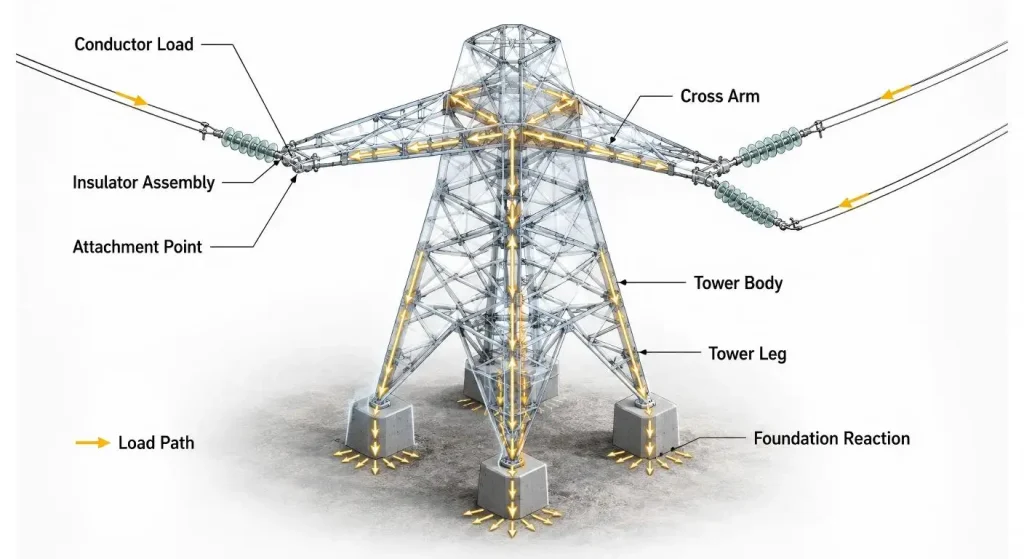
Follow – Load through the cross arms
Though it is only visible at the conductors, the force extends through the insulator sets, attachment plates, cross arms, tower body, tower legs and foundations.
This load path should be readily apparent from the drawings.
The orientation of an insulator needs to be compatible with the geometry of the line and electrical clearance requirements. There must be sufficient strength at the attachment points, albeit without any particular eccentricity or interfering bolt access. Cross arm bracing shall not leave a heavily-loaded connection functioning as a unit out there for the sole purpose of supporting the side pull.
At the same time, there isn't any sound for electrical or structure teams to communicate at the start. Cross-arm dimensions and phase spacing and the tower-head loading may change with an increase in the length of an insulator or with a change in the jumper arrangement.
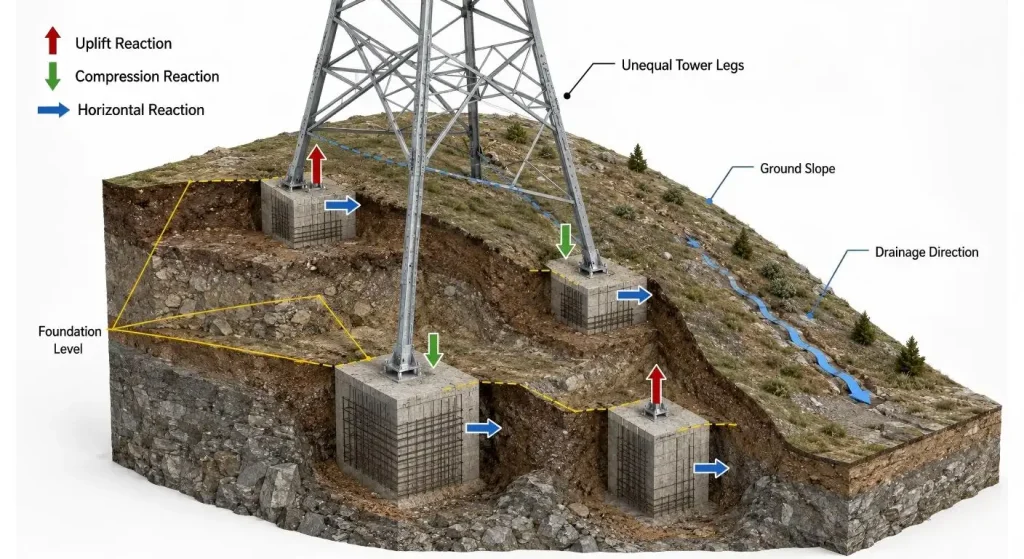
In the end, it's the Foundation who has the most valuable one
The varying tower legs in angle towers can lead to unequal reactions. Different foundations can uplift more or compress or key laterally more than others.
When on level ground, it can result in an excessive foundation size. A hillside does not make the steel tower any more difficult; unlevel legs, excavation for the foundation, drainage, access issues all can pose challenges to the civil work in combination.
The designer of the foundation must have the reactions for each load case, for which it must be designed. Estimation of the base loads should not be done based on the weight of the tower; copying the reactions of a nearby suspension tower should not be done.
If a specific voltage class is being used, a guideline could be used to help spark the conversation, such as the company's 66kV transmission tower range, but route geometry and geotechnical conditions are the deciding factors on what tower and foundation to use.
Consider Stringing Prior to the Tower Wiring at the Site.
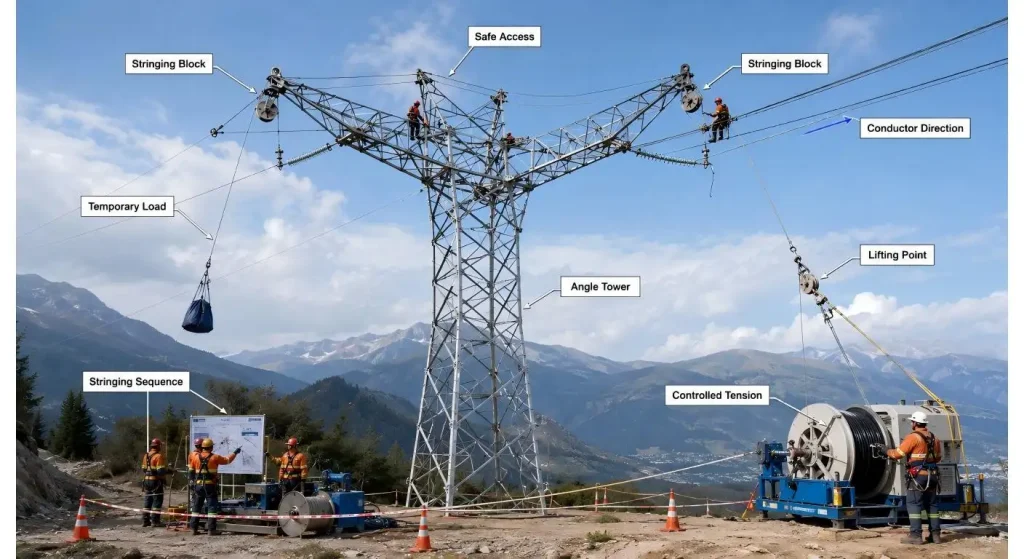
Angle Towers are active working points while installing conductors.
The stringing plan could certainly involve temporary connections to lifting points, runs as well as temporary conductor handling and load balancing sequences. A combination that is successful for the completed line in conditions may require further tests during the erection and stringing of the line.
Safe access to insulator attachment points, jumpers and earth-wire fittings and future maintenance sites are also required for the crews. Responsible requirements should be shown in the plans and accessories, instead of being improvised post erecting.
The planned transmission line construction should therefore be reviewed, as the tower details are still open for coordination, with regard to the construction method planned for the transmission line.
Request a PSR with the Supplier
A great angle tower quote ought to present more than only the height of the tower, weight of the steel and delivery schedule.
The supplier will be given the following information: route angle, conductor specification, span data, tower function, load, body and leg extensions, insulator data and the accessories required, foundation interface.
Inquire about (unspoken) premises. Inquire about the presence of an existing approved family member or new design specific to the project for the quoted tower. Similarly confirm that drawings, calculations, material certificates, trial assembly/instruction documents, galvanizing reports and packing documents will be provided.
These questions are not for the purpose of filling in paper only. They will show you if the offer is for the actual line position or "just" the "similar" looking tower outline.
Conclusion
An Angle Tower is the area where a transmission route has a direction change and so will the structural load path change.
Choosing the right tower based just on the deviation angle is not possible from the right tower. Conductor tension, span geometry, climate, clearances, foundations and stringing and maintenance access must also be considered in the project.
The early confirmation of those inputs results in an easier design, quote, manufacturing, and erection of the tower. The route corner is frequently the first place where unstated assumptions can be easily identified when they are expressed ambiguously.
FAQs
Q1. What is a tower of Angle steel?
A lattice structure made primarily out of steel angle members, plates and bolts. It is assembled in modules for its factory fabrication, transport and assembly in the field.
Q2. Are all the angle steel towers applied at an angle with the route?
Not so, “angle steel” refers to the structural member, and “angle tower” refers to the function of the tower. Angles steel construction can be used in suspension towers, tension towers and terminal towers.
Q3. What are the details required in a tower quote?
Deliver tower, voltage, circuit schematic, route angle, loads, heights, extensions, conductor data, coating requirements, number and delivery point. A Tower Schedule and Drawings enhance the accuracy of quoting.
Q4. What is the reason for trial assembly?
Member fit and connection details and bolt hole alignment are checked during trial assembly prior to shipment. Work particularly well with new or custom tower families.
Q5. So should it be tower weight alone that is the comparison point?
No. Review the weight with the design basis, the change of steel grade, load case, connection and galvanizing and fabrication scope. The figure on the weight does not indicate a suitability.

Hey, I’m Chunjian Shu
"X.Y. Tower: Reliable, innovative solutions for high-quality towers and electrical equipment with professional service.
