
Angle Steel Tower: Design It From the Route, Not the Catalogue
2026-07-28
An angle steel tower does not actually start from the starting point of a workshop in the process of fabrication. It starts at a specified point on a transmission path.
At this time the line can be level, cross a slope, head to a substation or cross a river. Those conditions determine the actions that the tower should take. While height and steel weight may be a visible aspect of the job, they aren't the only important ones.
The most important question to ask for utilities, EPC contractors and tower buyers is not “Which standard tower do you sell?” “What information must be hardened prior to allowing this tower to be fabricated?”
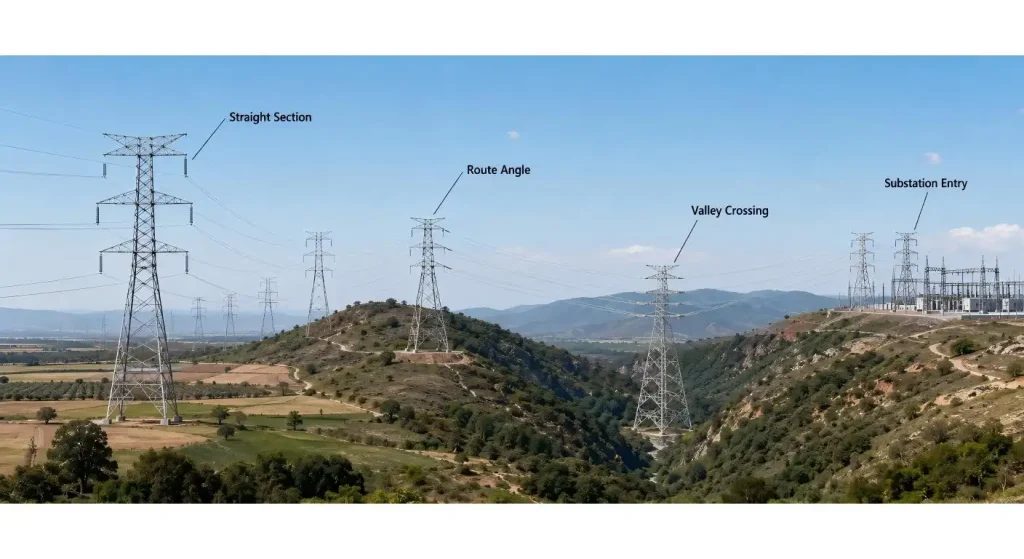
Assign responsibilities to Each Tower
Two similar tower shapes can be acting as a support to two quite different forces.
Conductors are usually strung on a straight part of a line by a suspension tower. An angle or tension tower should also take care of a horizontal pull when changing a route. Heavy unbalanced longitudinal load may be applied to a terminal tower due to the presence of only one side of the conductors.
That's why the position function should be determined by the tower schedule prior to the approval of detailed drawings. When considering a transmission line steel tower for purchase, buyers need to check with the vendor the route angle, circuit arrangement, type and cross-sectional area of conductor and earth-wire, span conditions, as well as attachment loads (including voltage, but not only), in order to make a comparison.
Freeze Tower position first, then the position of the Steel
Changes in the route late in the structure, when they are in use, are costly.
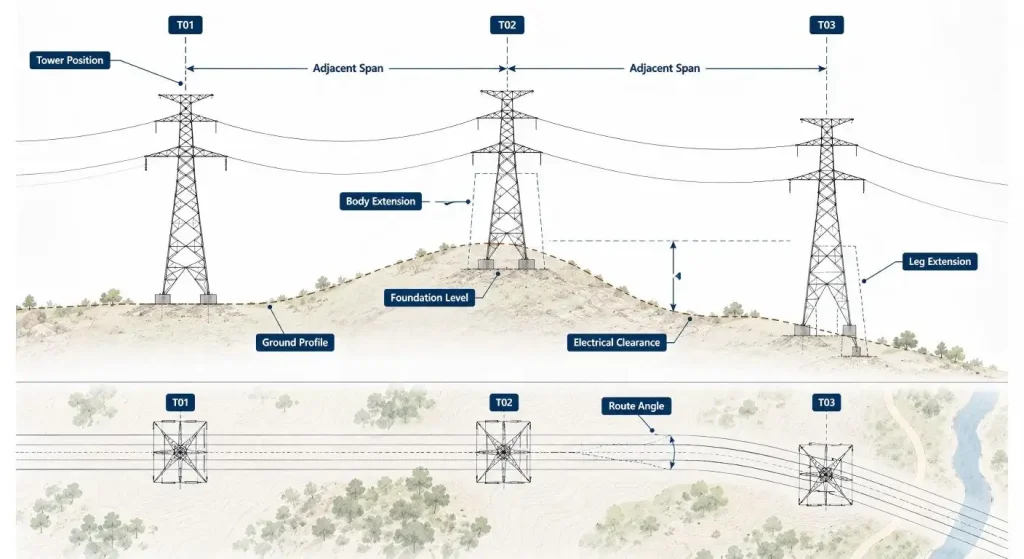
If the line angle is revised, the cross arm geometry and the force in members, foundation reactions and even the type of tower family may change. Any body extension added after detailing may impact the member lengths, number of bolts, climbing set up and packing list. The improper matchup of the scope of extensions and those that have been surveyed will result in either an unnecessary excavation or an awkward level for the foundation.
The outlay is straightforward – just validate the spotting data, review the profile, establish electrical clearance, approve the foundation concept and then hand off the tower to final detailing.
Unless project circumstances are unique, a tower design solution should be presented for discussion or a modification, rather than simply customised from what has been presented on the drawing board with a few assumptions remaining.
| Required Input | Project Information to Provide | Engineering Use |
| Tower position | Tower number and route coordinates | Connects the structure to the correct line location |
| Tower function | Suspension, angle, tension, terminal or crossing | Defines the main structural load pattern |
| Route geometry | Incoming and outgoing line angle | Determines horizontal load and cross-arm arrangement |
| Span data | Adjacent, wind and weight spans | Supports conductor-load calculation |
| Electrical arrangement | Voltage, circuits, conductor and earth-wire layout | Defines clearances and attachment geometry |
| Terrain adjustment | Body extension and individual leg extensions | Matches the tower to the surveyed ground |
| Environmental basis | Wind, ice, temperature, seismic and corrosion conditions | Establishes loading and protection requirements |
| Site logistics | Road limits, unloading and erection method | Guides member length, bundling and delivery planning |
The Tower will be designed as a Bolted Site Kit
Angle steel tower is manufactured in parts, but assessed as a completed structure in the country.
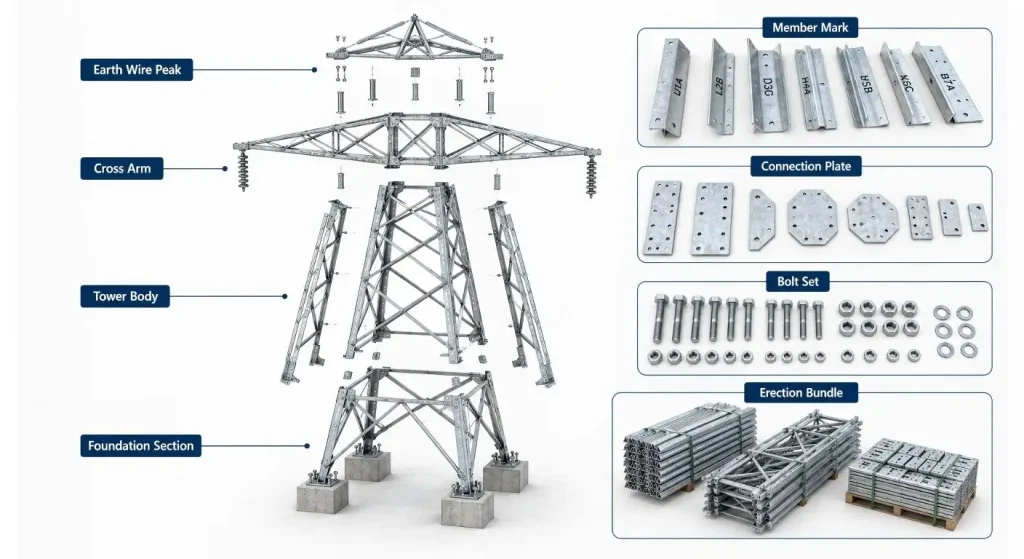
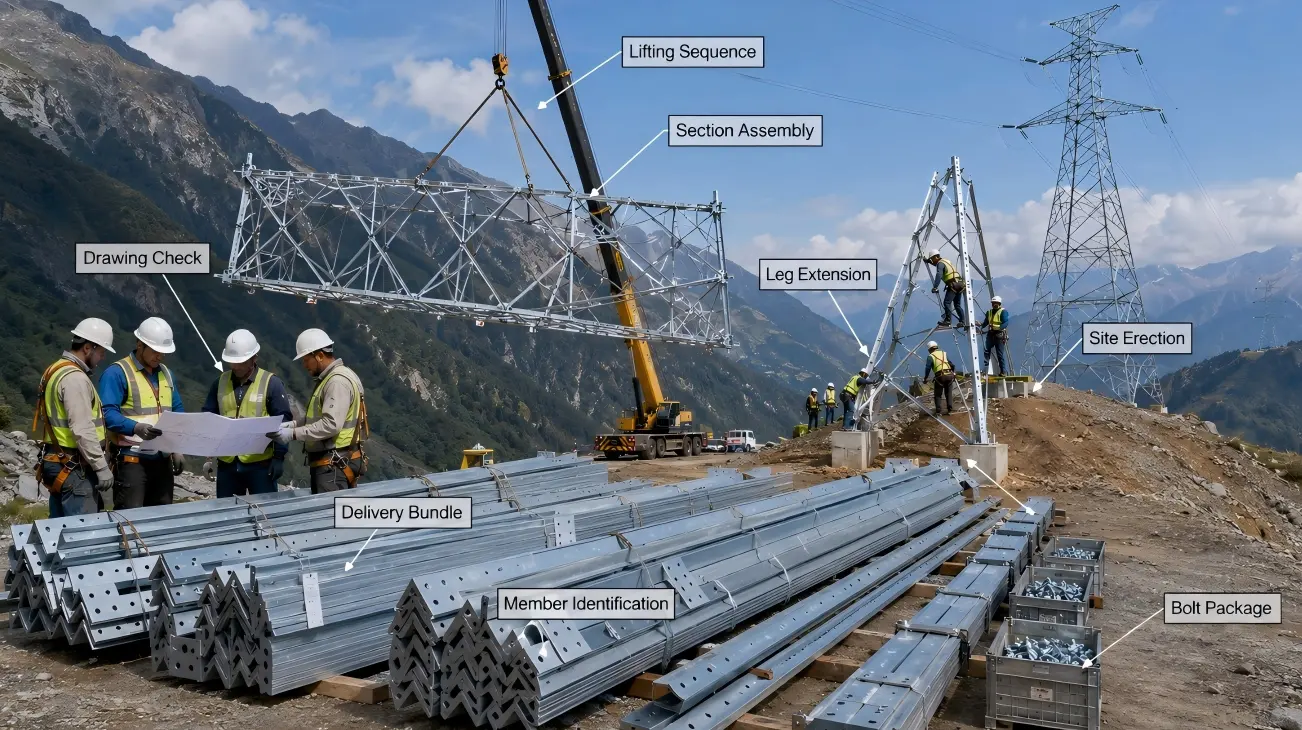
The placement of holes and the direction of the members and connections in and around the holes will dictate if the erection team will be able to maximize the tower without having to force members into place. When crews are working on a far away ridge and don't have a lot of lifting equipment, a little drawing mistake can quickly translate to a whole lot of delays.
Marks used by the member, should be legible after galvanizing. Bundles should be erected in accordance with the planned erection sequence, rather than by matching parts by size of steel only. Bolts and step bolt, plates and small fittings must be clearly identified as these are often the first things to get lost on site.
Information on a typical 66 kV strain tower is only helpful for a turning position once the project has verified the actual load case, and the specification. However, don't be misled by a similar appearance: two strain towers can not be used interchangeably.
Be aware that there is no point in looking for defects after galvanizing
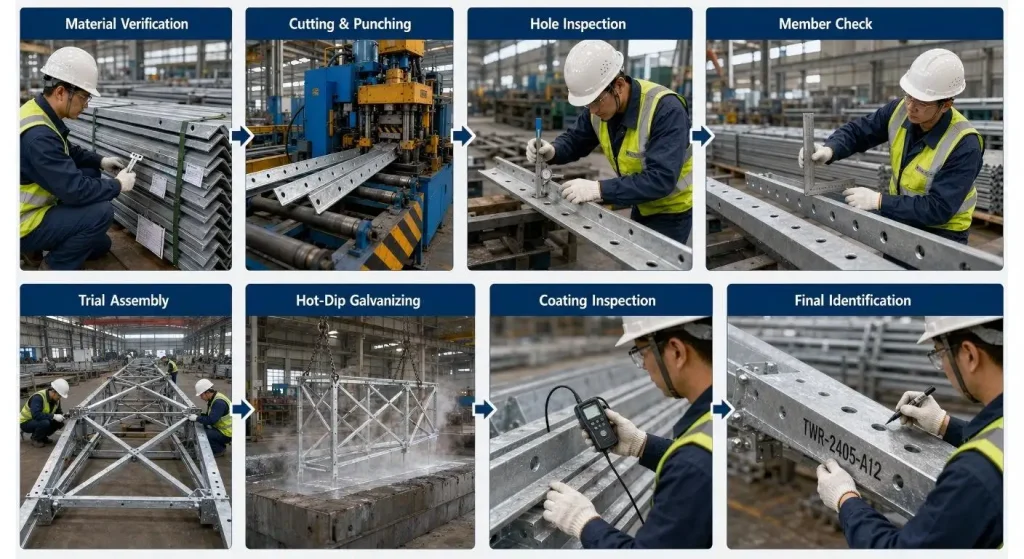
Good galvanizing will take care of a wrong hole, twisted member or poor fit.
It is recommended to have a material certificate, cutting accuracy and hole diameter, member length, member welding detail checking prior to surface treatment. A trial assembly is particularly useful for new Tower families, for heavy angle tower sections and for those sections with lots of connections. These are going to cost less on the factory floor, than next to an open foundation.
After that, hot-dip galvanizing should be considered as a controlled process and requirements for a common coating and inspection should be agreed. ISO 1461:2022 is applicable to hot dip galvanized coatings on fabricated iron and steel articles and to the general properties and test methods of these coatings. File specification for the project must still be established, as well as an acceptance condition, a repair technique and any special exposure conditions.
Allow the Loading Basis to play a role in the amount of steel tonnage
More weight does NOT mean more stability! It might be just taking some assumptions and not making it explicit.
Wind conditions, ice (if applicable), broken wire or unbalanced load cases, construction loads, reliability level and local seismic requirements should be included in the design basis.
The loading and strength requirements for overhead lines are available in IEC 60826:2017 and there is still a need to include country-specific climatic data and project requirements.Chinese design is based on GB 50545 and refers to the advanced concept of reliability design in IEC 60826, taking the stricter requirement between the two to implement.
It's here that the proficient buyer slows the project down for a while. Before you can design, question and an unanswered load can result in tonnes of unnecessary steel—or a significant deficiency in structural capacity.
Carefully choose the plan delivery method that will not affect the erection
Tower package is not completed at the exit from the galvanizing plant.
The supplier is expected to be aware of the limitations in the container(s), the conditions of the inland roads, how they are to be unloaded, how long they can stay in storage and how they are to be erected. On long sizes weight control is more determined by the members' control of the transport. If the bundle planning occurs incorrectly, work crews may end up opening many different packages to finish one section of the tower.
The same identification system should be used in the drawings, packing lists and/or member marks. Any missing or damaged components should be clearly identified and have a replacement plan.
While the different Available high-voltage steel transmission tower configurations at high voltage can begin a technical discussion, the actual delivery plan needs to correspond and take into account the site sequence of the project.
Conclusion
Not only using the angle steel tower height and voltage as the criteria to select the most reliable angle steel tower. It is engineered from a specific route point of establishment, an outlined structural responsibility and a viable site erection plan.
You should give the tower schedule, route angles, loading criteria, conductor data, extensions, foundation reactions, standards to be followed and requirements for both coating and delivery before asking for a final quotation. With complete input, it's more predictable in the fabrication process and more easily accelerated in site assembly and more meaningful for commercial comparison.
FAQs
Q1. The angle steel tower is what?
It consists of lattice structure constructed primarily from steel angle, plates and bolts. It is user-friendly and can be assembled in the field because of being fabricated as modules in the factory.
Q2. Does each angle steel tower have route angle?
No because angle steel is the name of the structural member, angle tower is the name of the function of the tower. Angle steel construction can be used for theory towers, suspension towers and terminal towers.
Q3. What data is required for a quotation for a tower?
Incorporate tower function, voltage, circuit arrangement, route angle, loads, height, extensions, conductor data and coating requirements, quantity and delivery locations. With a tower schedule and drawings, quoting accuracy is improved.
Q4. What are the value of trial assembly?
Trial assembly verifies proper fit of members, connections and alignment of bolt holes prior to shipment. Especialmente conveniente para familias de torres nuevas o personalizadas.
Q5. Should the ballast weight of towers be the primary comparison?
NO, weight should be checked in conjunction with the design basis, steel grade, load cases, connections, galvanizing and work scope of the steel fabrication. A weight figure, alone, isn't an indicator of suitability.

Hey, I’m Chunjian Shu
"X.Y. Tower: Reliable, innovative solutions for high-quality towers and electrical equipment with professional service.
