
Cell Site Tower Planning: From Coverage Needs to Structural Design
2026-09-17
A cell site tower only has a single task: to ensure that antennas and other related equipment are safely maintained in the correct location for the radio network. However, there are many more factors to consider when deciding on a structure than just the height of the tower.
The ultimate solution depends on coverage targets, direction of the antenna, equipment weight, exposure to wind, available land and future upgrades. Even if an antenna needs the same elevation for an open rural site or a constrained urban site, a tower that is good for the rural site might not be appropriate for the urban site.
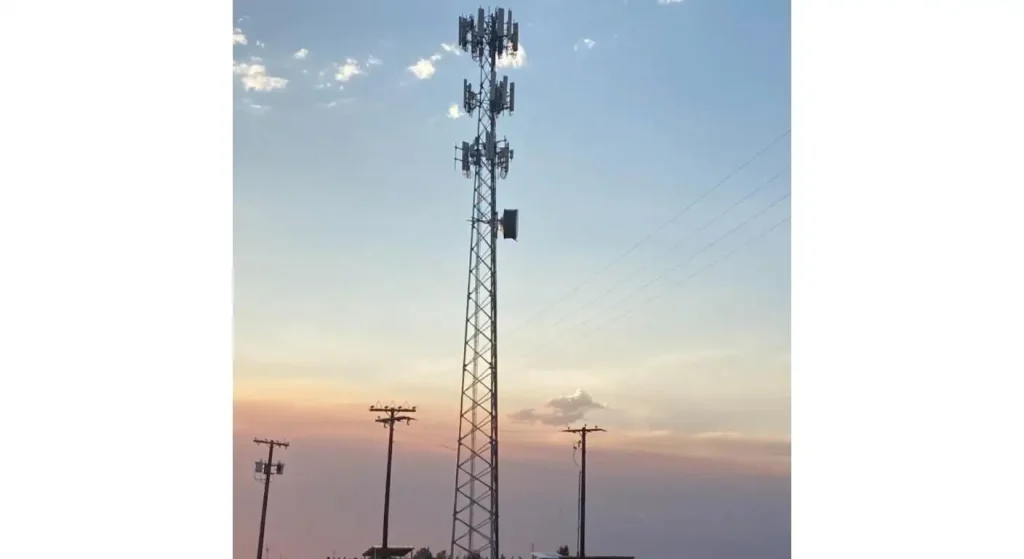
So, What is In a Cell Site?
The tower is just one component of the overall cell site. Panel antennas, microwave dishes, remote radio units, feeders, fiber cables, equipment cabinets, power systems, grounding and lightning protection, fencing and access facilities are also typical elements of a typical site.
The tower provides antenna elevation, alignment, and provides equipment and environmental loads to the foundation. Radio-frequency planning, frequency band, antenna characteristics, terrain and surrounding buildings – NOT tower height – determine network coverage.
XY Tower's mobile communication towers are used to support antennas and associated equipment used for cellular voice and data communication networks.
Broadly summarize the Coverage Objective
Prior to picking a structure, the network team ought to specify what the site needs to accomplish. The macro site for a rural area might include a large low density area. In an urban location, capacity may need to be added in a smaller coverage area or fill a certain hole in coverage.
Target Antenna centerline, Azimuth, Down tilt and Sector arrangement are done in Radio planning. Microwave backhaul can be used and may add extra dishes at various elevations and orientations.
These are translated to structural inputs. The tower designer should be aware of the location of the equipment and the amount of projected wind area created by the equipment or if the mounting frame has loads away from the tower face. Just a simple list of equipment weights is not enough.
What Kind of Cell Site Tower for the Site?
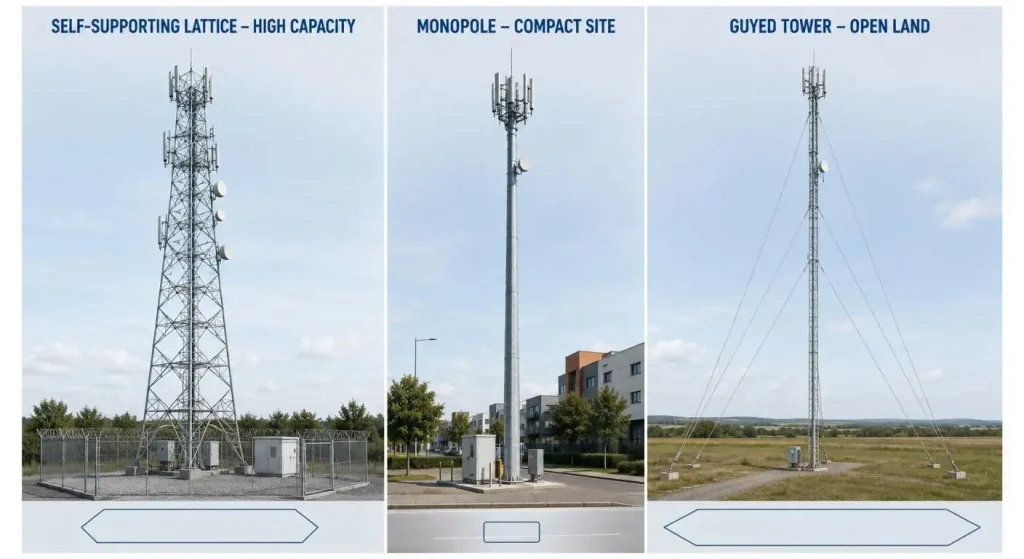
Self-supporting lattice towers are free standing and can be used for several levels of antennas. Their base and foundation typically require more area than a monopole and they are well suited for sites with a large amount of loading requirements.
Monopoles can be smaller in size and less visually obtrusive and are therefore suitable for urban and suburban applications. These have a height and loading capacity that is dependent on the diameter of the shaft, the thickness of the wall and the design of the foundation.
A guyed cell tower is a tower that is anchored with cables. It offers an economical height in open country, but will take up a lot more space for the guy-wire system.
There are more factors to consider than the tower price. Soil, access, visual restrictions, installation equipment, and service life are all considerations when it comes to land boundaries.
So What about Antenna Loads?
Dead load, wind load and sometimes ice load, due to telecom equipment. Typically, wind forces are applied to the projected area of antennas, dishes, mounts, ladders, cables and to the tower itself.Dead load, wind load, construction‑and‑maintenance load and sometimes ice load shall be considered for telecom equipment. Typically, wind forces are applied to the projected area of antennas, dishes, mounts, ladders, cables and to the tower itself. For Chinese‑standard projects, wind‑vibration coefficient, partial safety factors and load‑combination factors shall comply with YD/T 5131.
The position of the equipment also plays a factor. The amount of structure required depends on the size of the microwave dish atop the tower and may require more than heavier equipment lower on the tower. There is the potential for introducing torsion in offset mounts caused by the load not being through the center of the tower.
The engineering schedule should thus define the dimensions, weight, projected area of each item, its elevation of mounting, azimuth and stand-off distance. Additionally, design wind speed, terrain exposure, topography and governing standard of the structure should be indicated.
| Equipment Data | Required Entry | Engineering Purpose |
| Equipment type | Panel antenna, RRU or dish | Identifies loading category |
| Installation elevation | Height above ground | Determines structural demand |
| Dimensions | Height, width and depth | Calculates projected wind area |
| Mounting direction | Azimuth and sector | Establishes load orientation |
| Stand-off distance | Distance from tower face | Evaluates torsional effect |
| Future status | Existing or reserved | Defines expansion capacity |
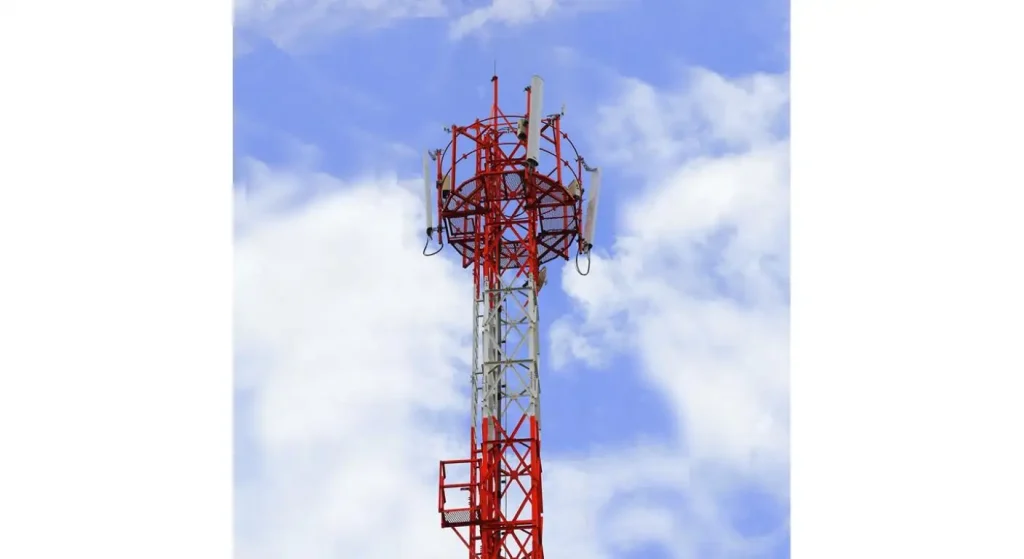
What's the need for Reserved Capacity?
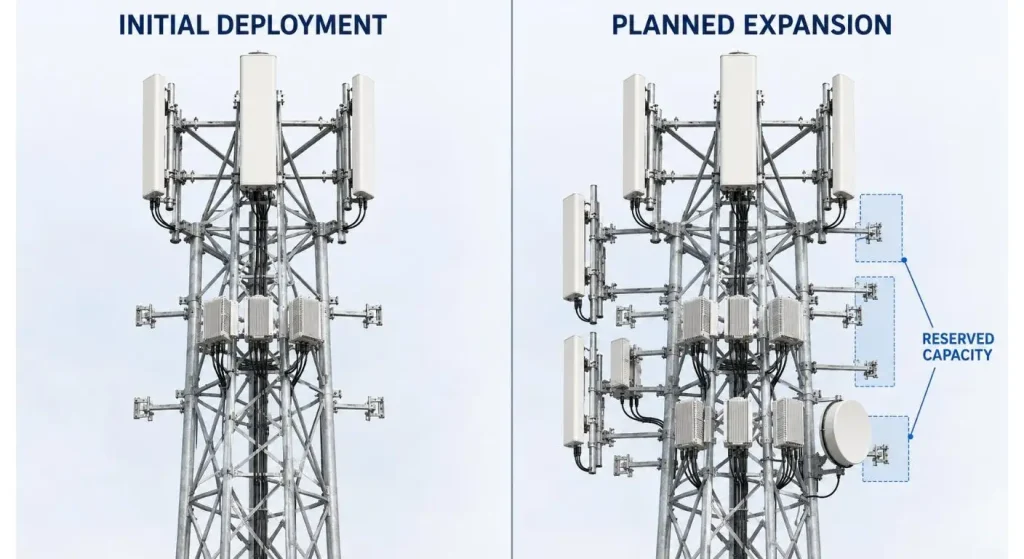
Cell sites change throughout the life of the cell service offering. Operators can add new frequency bands, switch out antennas for larger ones, deploy more remote radio units or even implement microwave links for an additional layer in the network.
If the tower is to be used for first installation only, reinforcement or equipment removal might be necessary in subsequent installations. Alternatively, if you request more spare capacity than is feasible, the original structure could be unnecessarily heavy.
A reserved-load schedule is a practical one that determines future antenna zones and establishes reasonable equipment limits. XY Tower's telecom steel towers are customizable to the loading and network expansion plans.
What are the Site Conditions and their effects on the Structure?
The size of the foundation depends on the soil capacity, the type and method of construction may be altered due to the slope and groundwater.For projects following Chinese standards, foundation shall perform verification for sliding resistance, overturning stability and uplift resistance; buoyancy effect caused by groundwater shall also be taken into account. There also needs to be sufficient working area for excavation, lifting equipment and tower set up.
Coastal air, industrial pollution and high humidity are risk factors for corrosion. Hot dip galvanizing will provide protection for structural steel; coating requirements and connections should be designed for the actual environment.For Chinese‑code projects, hot‑dip galvanizing shall comply with GB/T 13912‑2020, specifying minimum average & local coating thickness for steel members and special coating requirements for bolts, nuts and washers. Site corrosivity category (C1‑C5) shall be defined.
Different challenges are presented with remote locations. The parts might have to be hauled down a small street, or lifted by a smaller crane. Modular tower sections and clearly marked members can make it easier to erect the tower if large cranes are not available.
What needs to be Co-ordinated prior to installation?
All structural drawings, foundation design, antenna layouts and equipment schedules should be the same approved revision. Material changes in tower loading can be caused by the addition of or by small changes in the location of a microwave dish or by the addition of a mounting frame.
The strength of the foundation should not be less than that required for the erection. The position, level and orientation of anchor bolts or embedded components should be checked. Tower sections, bolts, platform, ladders and mounts should also be checked prior to lift against the packing list.
Professional telecommunication tower installation involves coordinating the site evaluation, foundation preparation, tower assembly and installation of antennas in accordance with a construction and safety plan agreed upon.
What are the criteria to look for in a Tower supplier for a cell site?
For domestic Chinese projects, commonly‑used steel grades for telecommunication towers include Q235B and Q355B. Steel members deployed in cold‑climate regions shall satisfy required low‑temperature V‑notch impact‑toughness performance.The customers should check the capability of the structural design, the relevant telecom experience, the traceability of the materials, the welding quality or the trial-assembly procedures of the bolted-connection.
The supplier needs to specify his design assumptions and equipment capacity clearly. The expression of “high wind resistance” is not sufficient, the proposal should include the wind criteria of force, tower configuration and antenna-loading basis.
It is also crucial to have documentation. Calculation reports, fabrication drawings, material certificates, galvanizing inspection records, bolt certificates and erection drawings and packing lists are all important documents that allow the owner to confirm that the delivered structure is the same as in their approved design.
XY Tower's telecommunication tower services include custom-designed, fabricated, installed and maintained cellular, Internet and broadcasting towers.
Conclusion
The best way to choose a cell site tower is to start with the objective of the network, and then establish a disciplined structural and site coordination. The orientation of the antennae, the projected wind area, available property, soil conditions and future equipment should all be specified prior to the finalization of the tower.
A well-planned structure today offers the necessary antenna support needed today and there is control for adding future network changes. Site layout and equipment schedule can be submitted to XY Tower for technical evaluation.
FAQ
Q1. Is there a correlation between height of a cell site tower and quality of coverage?
No, while height can be a factor for improving line of sight, so can frequency, antenna pattern, downtilt, terrain and building and transmit power.
Q2. Which tower type should be used for an Urban Cell Site?
Monopoles are typically selected in situations where the space is limited and visual constraints exist. For greater equipment loads and/or expansion needs, a self-supporting lattice tower may be more desirable.
Q3. What type of information is required to design a cell tower?
Give tower heights, antenna/dish specifications, mounting elevations, azimuths, wind and ice conditions, site coordinates, and soil data and future capacity requirements.
Q4. Is it possible that multiple operators operate on the same tower?
Yes, provided the structure, mounts, foundation and site layout is designed for the total load of the equipment. The reserved loading is not assumed.
Q5. Why is it that cell towers are hot dip galvanized?
The galvanizing helps to prevent corrosion of the steel in the atmosphere and minimises the maintenance requirements over the lifetime of the steel. For Chinese‑standard projects, coating specification shall comply with GB/T 13912‑2020 and match the site corrosivity category.

Hey, I’m Chunjian Shu
"X.Y. Tower: Reliable, innovative solutions for high-quality towers and electrical equipment with professional service.
