
How to Plan Transmission Line Steel Towers for an Entire Power Route
2026-09-16
Though a transmission line might have hundreds of towers, they do not have to be all the same. A tower can be used to carry conductors across a straight plain, a tower could be used to run the line around an obstacle, and the next tower could be on a steep mountainside.
For this reason, the transmission tower planning process should start with a complete transmission line, rather than a single tower. The goal is to create a working tower family that can deal with variations in loads and site without excessive and expensive changes in the family.
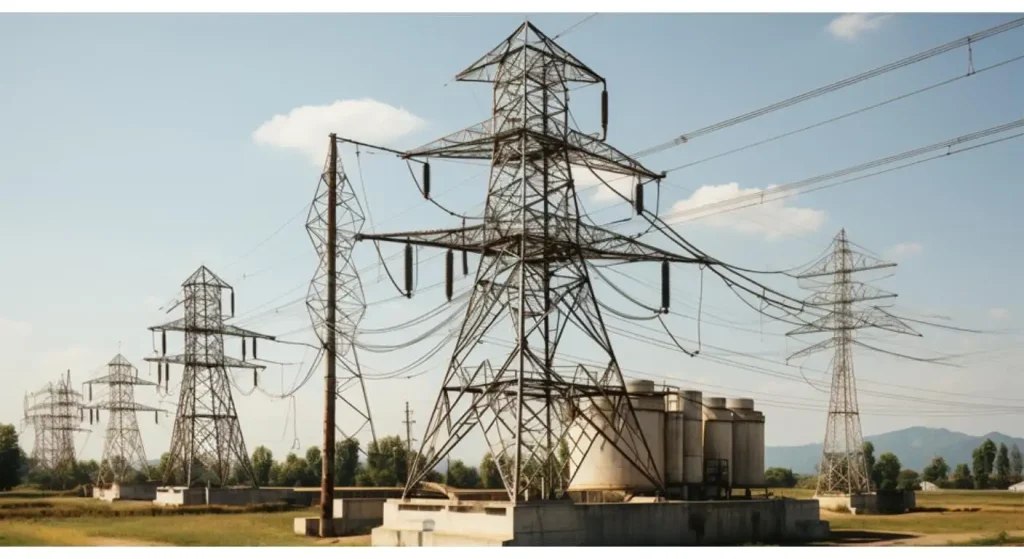
Transmission Line Steel Tower – What is it?
A tower for transmission lines that is used to keep the conductors, earth wires and insulators at the proper height and electrical clearances. Galvanized lattice towers constructed from angle steel members, connection plates and bolts are most commonly used on most long-distance lines.
The open lattice structure not only has a high load capacity but also exhibits relatively low wind resistance. Its members can be prefabricated and delivered in bundles which is beneficial for remote sites with limited access.
XY Tower provides a range of transmission line steel towers that meet the unique requirements of various power grid, renewable-energy and industrial transmission projects.
Why are there several types of towers for one line?
Loads vary throughout a line of transmission. A tower on a straight section is primarily in charge of supporting conductor weight and transverse wind load. On a route deviation, the structure is required to withstand unbalanced longitudinal tension.
A terminal tower can be called upon to support the entire conductor tension on one side. Special structures can also be needed at crossing roads, highway crossings, substations and places where the positions of the phases need to be changed.
If a heavy tower is used on each position, there will be a greater amount of steel and foundation used. The use of a light standard tower at each location would be considered to be an unacceptable risk to the structure. A good tower company allocates capacity where it's needed.
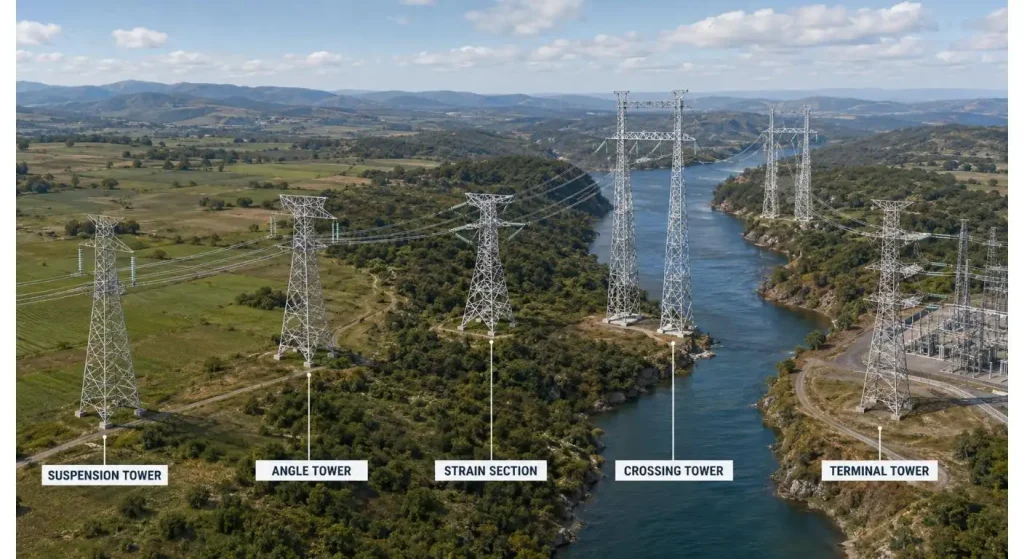
The Suspension Tower is used in :
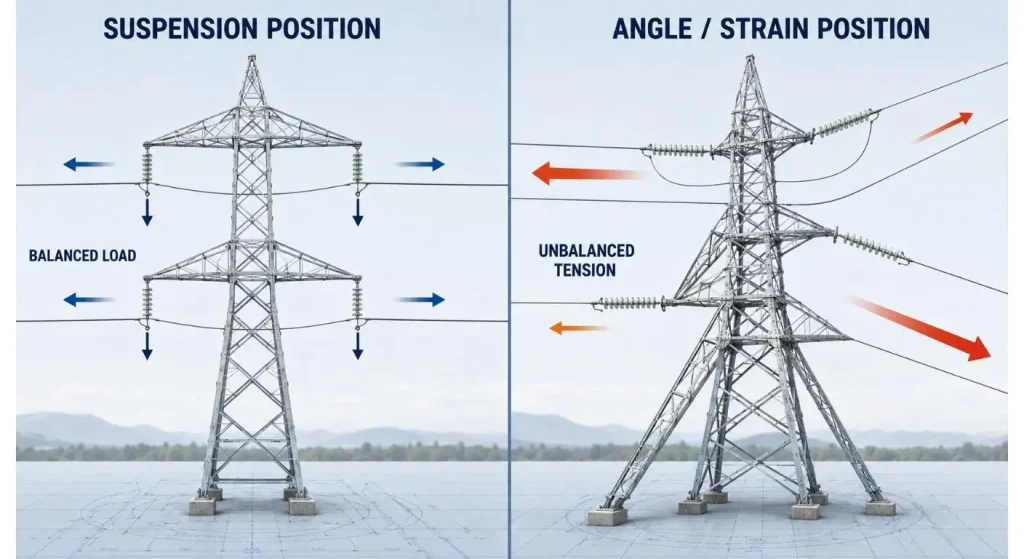
Suspension towers are typically found on straight or almost straight courses. Conductors are suspended from strings of suspension insulators, which give some freedom of movement to the conductor due to temperature and wind.
Longitudinal loads under normal operating conditions are usually lower than tension/terminal structures which makes these towers potentially lighter. For Chinese‑code designs, suspension towers shall also check longitudinal loads from conductor‑breakage and earth‑wire‑breakage load combinations. Typically, the straight-line section of a route accounts for the highest percentage of the route, and optimizing the suspension tower can, therefore, lead to substantial savings throughout the project.
But it is imperative that it has a clearly defined line angle, wind span and weight span. The position of a suspension tower should not be elevated to a more difficult position simply because it is available at the site.
When are Angle, Strain and Tension Towers required?
Conductor tension will result in a horizontal force at the tower when the direction of the route changes. The bigger the angle of the deviation, the higher the load, which is generally unbalanced, that needs to be sustained.In Chinese transmission projects, straight line strain towers are also adopted for mechanical sectioning of long distance lines without route deflection.
This is achieved in a strain tower by means of using tension insulator assemblies and a more robust structure to control these forces. It can also segment a long line into mechanically independent segments, thereby reducing damage caused by conductor damage or cascading.
Tension and dead-end towers are installed under particularly critical conditions, such as for important direction changes, line terminations and approaches to substations. Usually they're heavier, due to their more powerful members and links, so their positions must be chosen carefully.
What would be the effect of terrain on the tower configuration?
Tower spotting is used to locate towers on the route surveyed. Elevation, clearance, span length, slope, and access roads and foundation conditions are factors engineers consider.
On flat terrain, a few of the standard body heights may suffice to encompass the majority of locations. There are a lot more variations on mountainous terrain. Body extensions or the use of independently adjustable legs are used for unequal ground elevations around one tower.
A high-low leg tower can be used to minimize the need for extensive excavation on the hillside by modifying the tower to fit the hillside. This could help to reduce environmental disturbance and foundation work, however each leg condition should be designed in conjunction with survey and geotechnical information.For Chinese‑standard projects, foundation sliding resistance and overturning stability shall be verified based on geotechnical investigation data.
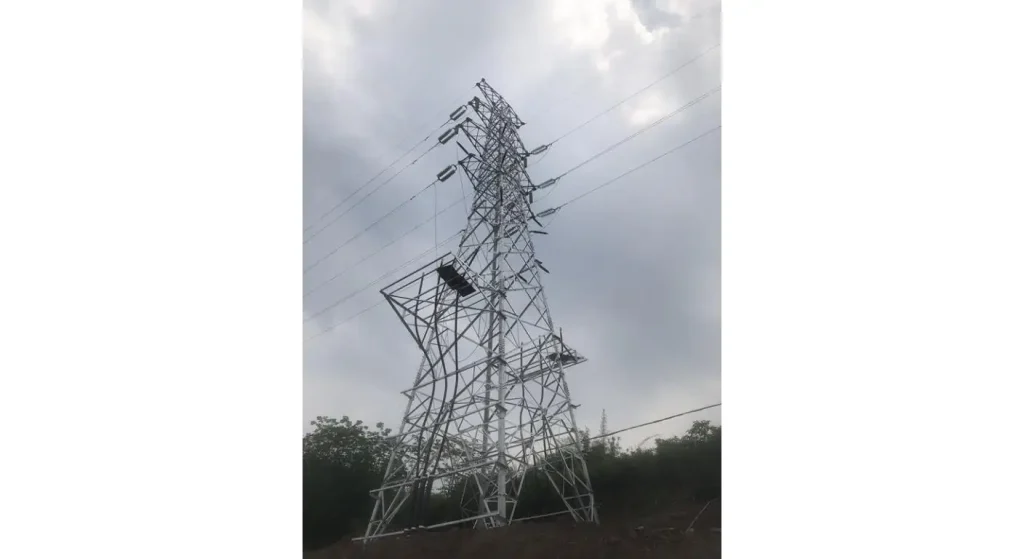
What is the Strength of Each Tower?
Voltage is significant because it influences: electrical clearances, insulation and conductor layout, but is not, by itself, an indicator of structural capacity.
Each type of tower should have a loading envelope that specifies the wind span, weight span, line angle and environmental conditions for each type of tower. Size of the conductors, earth wires, OPGW, wind speed, ice thickness and broken-wire cases must also be located.
Two towers of the same voltage level can thus be very different in weight and dimensions. When comparing designs, the buyer is to use the same load criteria and not just the voltage and height.
Why Standardization of Tower-Family is Important?
Excessive tower variations will prolong engineering hours, prototype needs and fabrication setup and may contribute to mixing of components in the field. Inadequate types of variation may lead to overweight structures, or towers which are being overloaded.
Controlled standardization is the practical solution. Where engineering allows, common body panels, leg extensions, bolt size and connection details can be provided. It is also important that a consistent naming and part-marking convention is used for tower types.
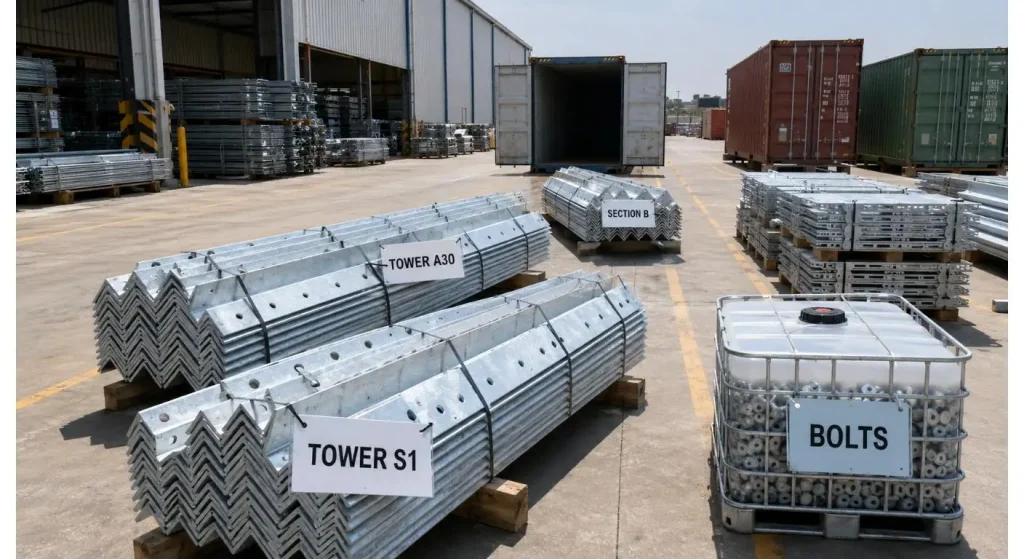
This way, larger production runs can be achieved and replacement parts are more easily identified. It also enhances packing efficiency as it allows to pack the components according to tower number and erected order.
What is the Best Packaging for Towers for Route Based Installation?
During field erection following Chinese specifications, final tightening torque values shall be strictly implemented for grade‑4.8 and grade‑8.8 bolts.Delivery to the tower must correspond not only to the sequence in which it is produced in the factory, but also the sequence in which it is built. All packages must have robust part identification in accordance with approved bill of materials and erection drawings.
Materials for early built sections need to be readily available without unloading materials for later sections of the route. Packing lists are particularly important for small connection plates, bolts and accessories, as they can render an otherwise complete erection team useless if not present.
Galvanized surface must be kept intact from unnecessary abrasion during bundling, container loading and multiple handling on site. In case of projects carried out remotely, additionally, spare parts and selected critical members may be supplied as per agreed spares plan.
What Do Buyers need to confirm before ordering?
Please verify the tower schedule, quantity, body and leg extensions, type of steel, design standard, galvanizing requirement and bolts & accessories before sending a purchase order.For Chinese domestic projects: common steel grades include Q235B, Q355B and Q420B. Steel members in cold regions shall satisfy specified low‑temperature V‑notch impact‑toughness requirements. Hot‑dip galvanizing shall comply with GB/T 13912‑2020, including minimum coating thickness for steel parts and special coating requirements for bolts, nuts and washers. Corrosivity category (C1‑C5) shall be defined according to site environment.
It is imperative that the supplier is also provided with route-loading information, approved tower outlines and required documentation. Design responsibilities must be defined, for example: the buyer can supply an existing design, ask for confirmation or ask for a completely new tower family.
Technical ability needs to be considered in conjunction with manufacturing capacity. XY Tower's transmission line services include lattice towers, steel poles and transmission line components of various voltage and terrain specifications.
| Tower Schedule Field | Example Entry | Project Use |
| Tower code | S1, A30, DT | Identifies tower function |
| Route position | AP-026 | Links tower to survey location |
| Body height | +3 m extension | Maintains ground clearance |
| Leg combination | +1 / 0 / −1 / +2 m | Adapts to local slope |
| Loading class | Wind and weight span class | Confirms structural capacity |
| Delivery section | Package Section B | Controls site delivery order |
Conclusion
The steel tower for a transmission line should be chosen as a component of an overall route-wide system. Suspension towers are used for efficiency on normal sections and strain, tension, terminal and terrain adapted towers are used for protection of critical towers.
Optimized tower schedule means optimised structure and standardization. Early tower functions definition of loading limits and delivery sequences can help utilities and EPCs to avoid unnecessary steel usage, foundation jobs and site delays.
The route profile and loading criteria and tower schedule can be submitted to the XY Tower contact page for technical review by project teams.
FAQ
Q1. Which of the following is the most common type of transmission line tower?
Suspension towers tend to be the most numerous as a lot of the transmission route is straight or at a low angle. This percentage will vary with terrain and route geometry.
Q2. Do all towers in a voltage line have the same features?
The height, leg extension and load capacity of towers on one line may be different although they carry the same voltage.
Q3. What's the difference between suspension and tension towers?
A suspension tower is primarily used for conductors on the normal straight‑route sections. Larger longitudinal forces are resisted by tension/strain towers, which can be deployed for route direction changes, line mechanical sectioning (including straight‑line segment without deflection), or line terminations.
Q4. Are steel towers suitable for mounting in mountainous areas?
Yes. High-low legs and customized extensions on the body of the tower enable the structure to conform to the ground profile and to maintain the necessary conductor clearance.
Q5. What information do you need to obtain if you wanted to place an order for transmission towers?
The following information should be provided by the buyers: Tower schedule, line loads, conductor data, environmental conditions, drawings, steel and galvanizing requirements, quantities and delivery sequence.

Hey, I’m Chunjian Shu
"X.Y. Tower: Reliable, innovative solutions for high-quality towers and electrical equipment with professional service.
