
Steel Tower Engineering: From Design Inputs to Site-Ready Structures
2026-09-15
A transmission tower is not a standalone design. It is a component of a comprehensive line system that includes conductor tension, electrical clearance, span length, terrain and weather.
The good engineering of a steel tower will transform these factors into a safe, cost-efficient and easy-to-fabricate structure. It also links a number of teams, such as the line designers, structural engineers, fabricators, foundation engineers and erection contractors. Even a structurally sound tower can cause delays and unpredicted costs at the project site when these interfaces are not well managed.
What's On offer at Steel Tower Engineering?
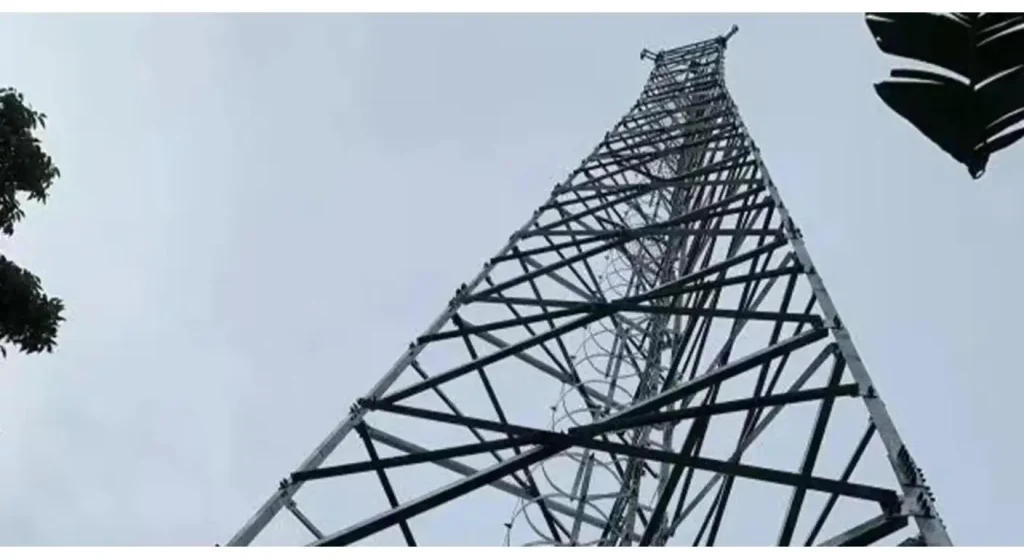
Steel tower engineering is not only a matter of calculation of structures. It usually consists of examining line data, the setting of design criteria, the selection of tower geometry, the analysis of loads, the sizing of members, and the design of connections and the preparation of fabrication drawings.
Considerations should also include foundation, galvanizing, transport restrictions and trial assembly and field erection. Thus a successful design does not necessarily mean that the tower is of lightest weight. It is a structure that can be provided with certainty and can be put in place under project conditions.
XY Tower offers special tower design services for customized transmission, substation and other supporting structure towers.
Why can't Engineering be done without Line Data?
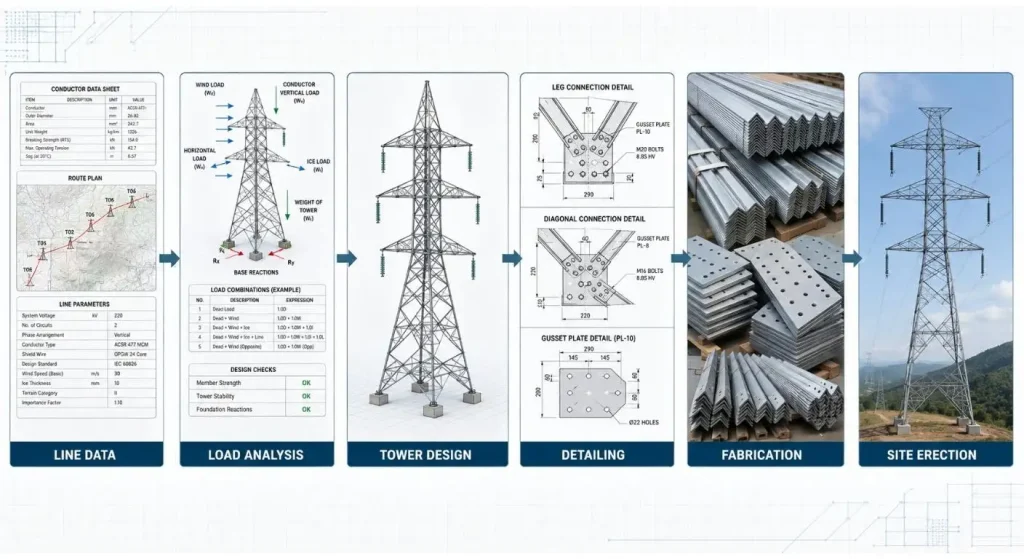
The electrical system performs geometry control of towers before starting structural analysis. The basic height and cross-arm configuration is defined by the voltage level, the conductor layout, the length of the insulators and the minimum clearances.
Then some mechanical inputs are added. These are such things as conductor weight, wind load, ice load, tension, span length, line angle and the possible broken-wire conditions. But basic wind speed is not sufficient since the project standard needs to be known which is used by the designer to convert it into loads on the tower, conductors and insulators.
When input data are not fully complete, it may result in the use of conservative assumptions. This might help to preserve the calculation safety, but could also be detrimental towards tower weight, foundation reactions and project cost. A formal design-input schedule allows the engineering team to look at the design and identify any gaps in the input data prior to carrying out detailed calculations.
How to translate the design loads to a tower structure?
`The analysis is reiterated as the member sizes and tower geometry are optimized. This work can be done more quickly with engineering software, but the results may need to be reviewed by a professional. Sometimes force patterns are unusual due to a problem with the modelling or geometry and not necessarily a problem with the thickness of the steel.
What makes the right Tower Family?
There is not one single tower that can be used to transmit a program but a family of towers.Suspension towers are used for relatively straight sections of route; straight line strain towers are applied for line sectioning without route deflection; angle or strain towers are used when the route needs to deviate from a straight course and terminal towers are used to resist high longitudinal loads.
For instance, a lighter suspension tower can be utilized for regular tangents, and a reinforced strain tower has to be utilized at key direction changes.
The intended line angles, span range, weight span and special loading capacity of each type of tower should be indicated on the tower schedule. This helps to avoid the use of unnecessarily heavy towers along routes and prevents the installation of a low duty tower at a high load position.
Typical body extensions/leg extensions for change of terrain can be worked on. Unifying members and connections for all towers can also make the fabrication process easier, as well as packaging and stocking on-site.
Why Detailing is so important as Structural Analysis?
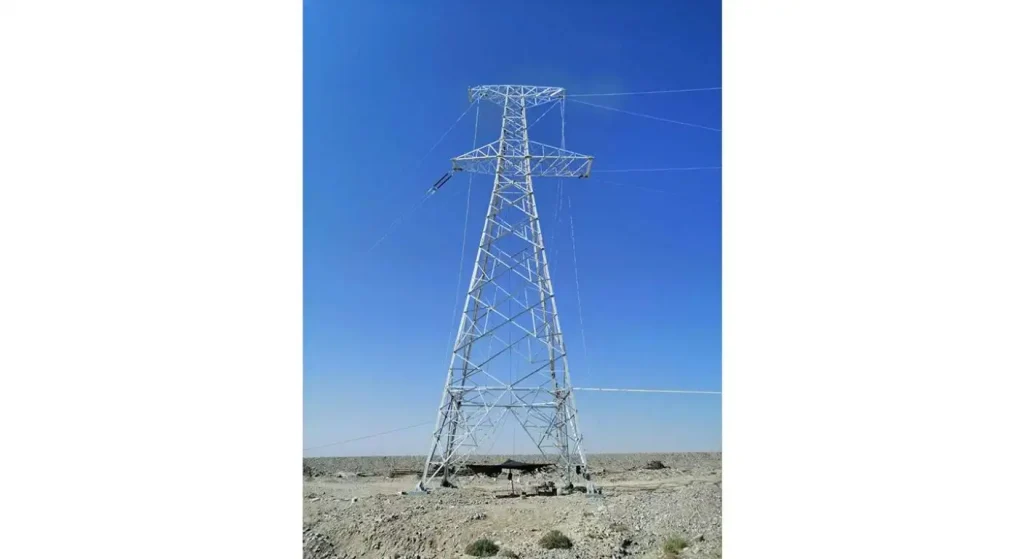
Detailing is the difference between being able to produce and assemble the tower that structural calculations indicate is required for strength.
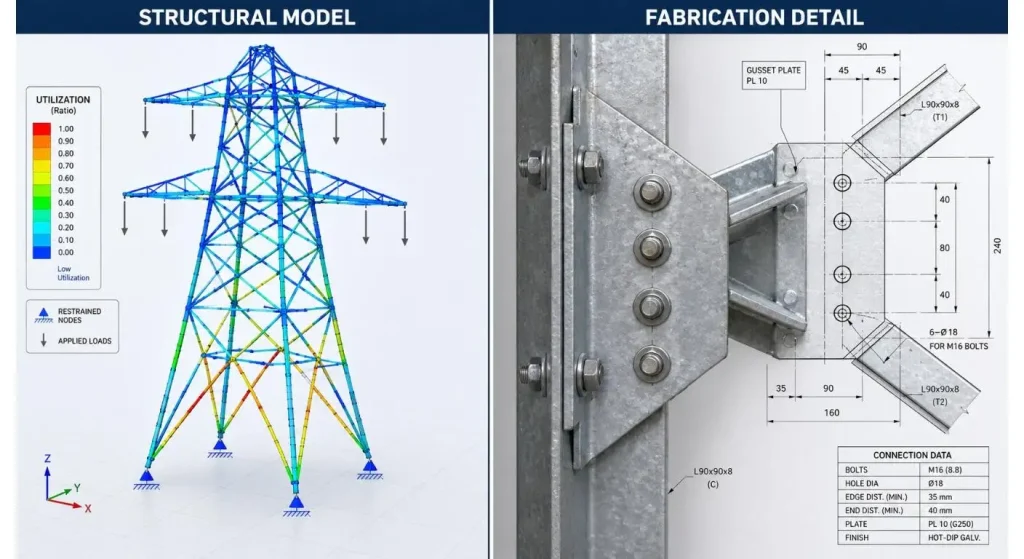
The connection plates must have a sufficient edge distance, bolt spacing and installation space. Members should be avoided at joints and hole pattern should be the same in all connecting members. Details should also facilitate consistent hot dip galvanizing, drainage and venting.
The dimensions of the members should be decided before considering the ability of the available manufacturing equipment and size of steel. A theoretically efficient section is of little value if the section is not readily available or if special manufacturing has to be done for a small volume.
Important deliverables are clear part marks, erection drawings and bills of material. They relate the analytical model to the factory and enable the site team members to recognize their respective places.
How to Engineer and Manufacturing Work Together?
Design and fabrication should not be separated as two distinct phases and one time handover. Production team can identify any areas that could cause a problem in the production of the fabrications, such as inaccessible bolts, conflicting members or difficult galvanizing details that may not be obvious in the structural model.
Prototype assembly: It is a physical verification prior to the mass production. It verifies geometry, hole alignment, orientation of members and fit of connections overall. Any changes made should be sent back to the controlled drawings and material lists so that the design which has been agreed upon can be followed through production.
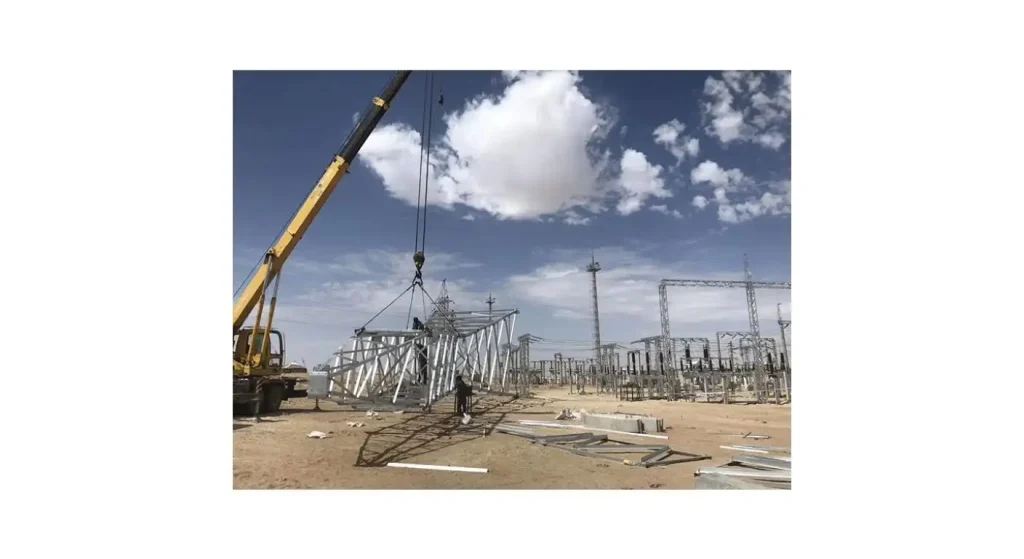
XY Tower's power transmission steel tower services include design, fabrication and installation support to minimize the gap between engineering documents and finished products.
What should be checked prior to design approval?
Prior to approval, the engineering team should ensure that the model has the correct tower function and load cases, materials properties, etc. The Tower reactions will be issued to the foundation designer and the foundation assumptions will be verified against the site investigation.
Electrical clearances need to be checked not only when the tower is in the unloaded state, but as applicable to the various conductor positions. Under Chinese design requirements, minimum clearances for power‑frequency, switching‑surge and lightning‑surge conditions shall all be satisfied.
The independent calculation check or design review is of particular value in the design of new tower families, extreme loading conditions and projects that are subject to unfamiliar national standards.
| Review Gate | Required Output | Main Risk Controlled |
| Input review | Approved design criteria | Incorrect project assumptions |
| Geometry review | Tower outline and clearance check | Electrical clearance conflicts |
| Analysis review | Load cases and member utilization | Structural underdesign |
| Detailing review | Connections and fabrication drawings | Manufacturing or assembly errors |
| Prototype review | Trial assembly report | Repeated production defects |
| Final release | Controlled drawings and material lists | Revision inconsistencies |
What does Good Engineering do to Reduce Total Project Cost?
Weight saving of steel is one of the potential savings. Good engineering can also help to reduce foundation loads, field assembly errors and fabrication time while also improving container utilisation.
Standardised connections and repeatable tower modules ensure more predictable production. Accurate packing lists help to ensure no members are lost and clear erection drawings minimise sorting and crane time on the construction site.
The benefits can be better assessed through the analysis of steel tower projects of comparable voltage, terrain and environmental conditions which have been accomplished. While the lowest tower price might not create the lowest installed project cost.
Conclusion
Steel tower engineering is the orchestration of the conversion of electrical, environmental and route information to a safe, manufacturable and site ready structure. Not only is it useful in terms of structure stability, but it is also useful in controlling the interfaces between line design and tower analysis, detailing, production and erection.
Technical risk and avoidable cost of a project are minimized through early input validation, disciplined design reviews and close manufacturing coordination. Engineering requirements and line data can be provided via the contact page of the XY Tower for a custom technical assessment by project teams.
FAQ
Q1. What information is needed for engineering of steel towers?
They take input such as voltage, circuit configuration, conductor data, spans, line angle, wind, ice, terrain and the design rule used as input. When available, the foundation and transport constraints should be provided as well.
Q2. Is there an exclusive set of towers that is just determined by voltage?
No. Towers of the same voltage in different situations might have to be different heights, members and foundations due to different conductors, spans, terrain, and environmental loads.
Q3. Why do you need to assemble a prototype?
Pre-production assembly is used to validate the fit of all the members, the alignment of holes, geometries, and part identification for batch production. This helps to decrease the chance of repeating a detailing error on several towers.
Q4. Is it possible to use the same tower design on the whole transmission line?
Usually not. The routes will need suspension, angle and strain structures of varying strength, as well as body extensions and/or leg extensions for terrain changes on most routes.
Q5. What documents need to be sent with an engineered tower?
The typical documents comprise design criteria, calculations, tower schedule, general arrangement drawings, shop drawings, bills of materials, erection drawings and reaction of foundation.

Hey, I’m Chunjian Shu
"X.Y. Tower: Reliable, innovative solutions for high-quality towers and electrical equipment with professional service.
