
Corrosion Resistant Tower: Protection Starts Before Galvanizing
2026-08-26
The finish that a transmission tower receives when it leaves the galvanizing plant can be excellent.
Bright zinc. Clean steel. No visible rust.
That's an indication of how the tower was on shipping day. It cannot simply tell you what the same structure will look like after years of exposure to the sea or after being safely housed in a humid industrial corridor or wet/dry cycles.
This is why you should not be specifying a corrosion resistant tower, and stating “All steel shall be galvanized” on one line.
Corrosion protection is achieved at an earlier stage.
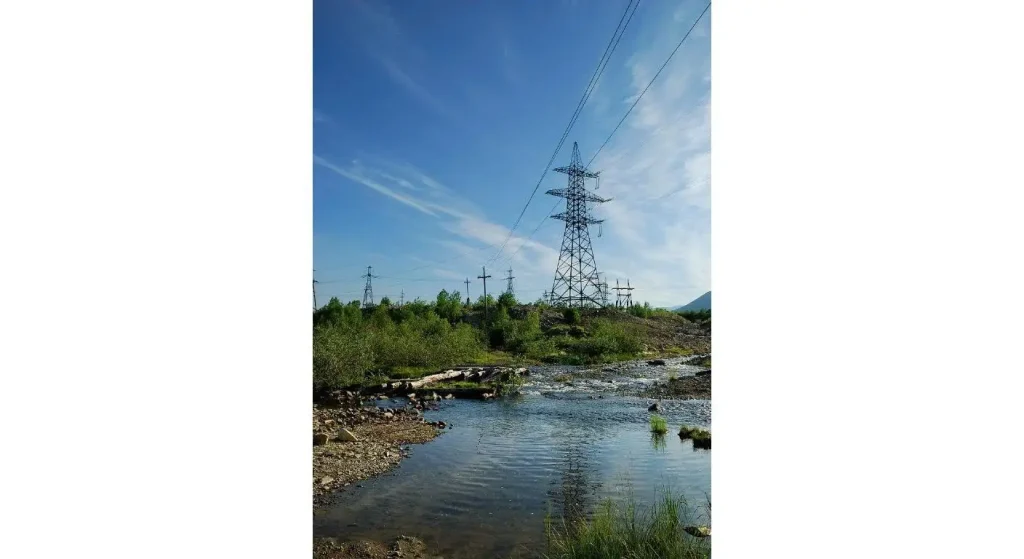
It begins with the project team determining the location of the tower, what will contact the steel surface and where water will be present, detailing components, and determining the method to be used to inspect the coating and what should be done if the coating is damaged during transportation or installation.
XY Tower's Tower Design Solutions involve more than just choosing between surface treatment options—it's about engineering to the project and hot dip galvanized steel.
It's the more helpful way of considering durability.
Don't describe all challenging locations as a "Harsh Environment".
There are many tower specifications that state “harsh environment”.
Is of little value alone.
An inland tower (away from a coastline) is exposed differently from a tower near a coastline. High levels of humidity, salts in the air, industrial contaminants and frequent rainfall and alternating wet and dry conditions can alter the corrosion problem.
Determine the real exposure before choosing the protection system to use.
This information should be located next to the wind and terrain and other site information for a transmission structure—not tacked on when the steel is complete. Local environmental information is also not just a detail in the construction of your existing tower design, but part of the design basis.
| Site Question | Why It Matters |
| Is the route coastal or inland? | Helps define salt-related exposure concerns |
| Is humidity frequently high? | Influences time-of-wetness conditions |
| Are industrial pollutants present? | May increase coating demand |
| Does the site experience frequent rain? | Makes drainage detailing more important |
| Will steel be stored outdoors before erection? | Adds temporary exposure and handling risk |
| Can future inspections reach critical joints? | Affects long-term maintenance planning |
However, if the environment hasn’t been specified, “corrosion resistant” is still a good wish.
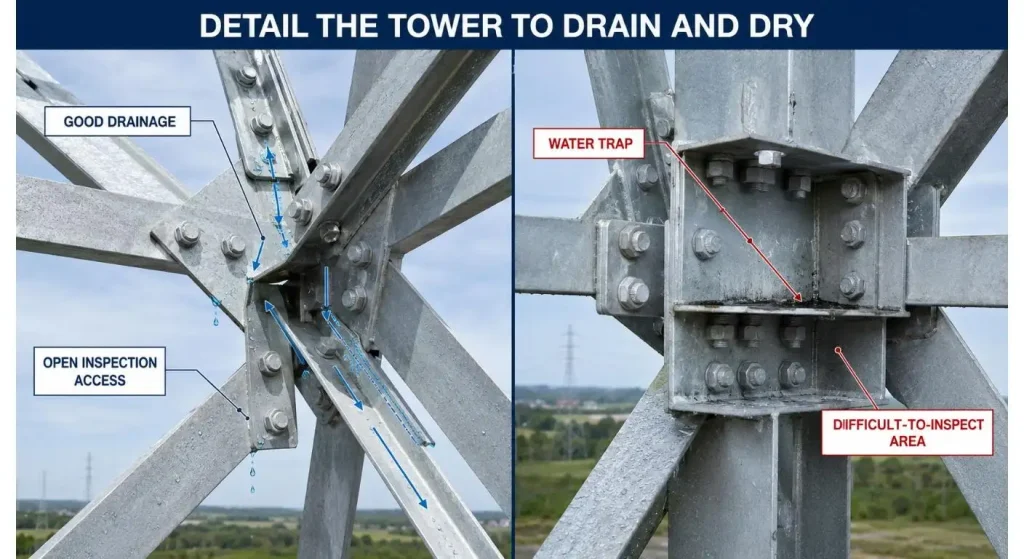
The first step to achieving good corrosion resistance is to start with geometry.
Most people are immediately searching for the coating.
The form or shape of the structure is also examined by an experienced reviewer.
Inquire about the route taken by rainwater.
Drains naturally or can be around a connection? Are there any difficult to access places due to closely fitted surfaces? Do horizontal details tend to collect dirt and moisture? Is it possible to verify the critical steel later on by inspection teams?
Those questions are important because the performance of a coating is based on the geometry that the designer presents.
A project-specific Transmission Line Steel Tower can be customized for a particular terrain and operating requirements and hot dip galvanizing is the main method of corrosion protection.
Galvanizing must be done as a means of good detailing, not the answer to poor detailing.
A tower which stores moisture continuously in uncomfortable interfaces requires more protection than the tower which drains and dries itself out.
The most critical coating number is not necessarily the sole number.
The coating thickness is given attention as this is measurable.
That makes sense.
However, there should be no end to a corrosion-protection review.
The project also requires trust in the continuity of the coating, coverage of fabricated parts, repaired parts, coating around holes and edges, and survival of the fabricated part to the coating process.
The galvanizing process of XY Tower's High Voltage Steel Transmission Tower is hot dip galvanizing process which is under the ISO 1461 requirements. The previously mentioned content also states that ISO 1461:2022 is about properties and testing of hot dip galvanized fabricated steel articles.
It is the whole coated piece which is of interest to the purchaser.
Any single measurement.
Galvanizing can help to protect the steel and can still present another problem.
The "unsavory" aspect of corrosion protection.
The coating process can have an impact on the fabrication details.
If there is too much zinc, it will interfere with holes. Low thickness materials can rotate. Coated surfaces are susceptible to damage caused by handling. Identification marking may be challenging.
These are risks identified by your previous tower material and suggested to be checked along with assembly related features after galvanising.
This is crucial when using lattice towers, since the dozens of individually acceptable pieces need to align with each other properly.
Therefore, there are two questions that the factory must have after coating:
Is there steel protection?
And:
Is it possible to make the protected steel the approved tower?
There is no mutually exclusive relationship between the two questions.
Transport is included in the Corrosion-Control Plan.
The protection is ongoing after the tower has left the galvanizing line.
Members are bundled, loaded into containers and/or trucks, unloaded, stored and loaded again before being erected. There are potential opportunities for coating damage at each handling step.
This is more critical with tower steel for overseas projects or remote locations where the steel may be in transit for significant periods of time, or in temporary outdoor storage.
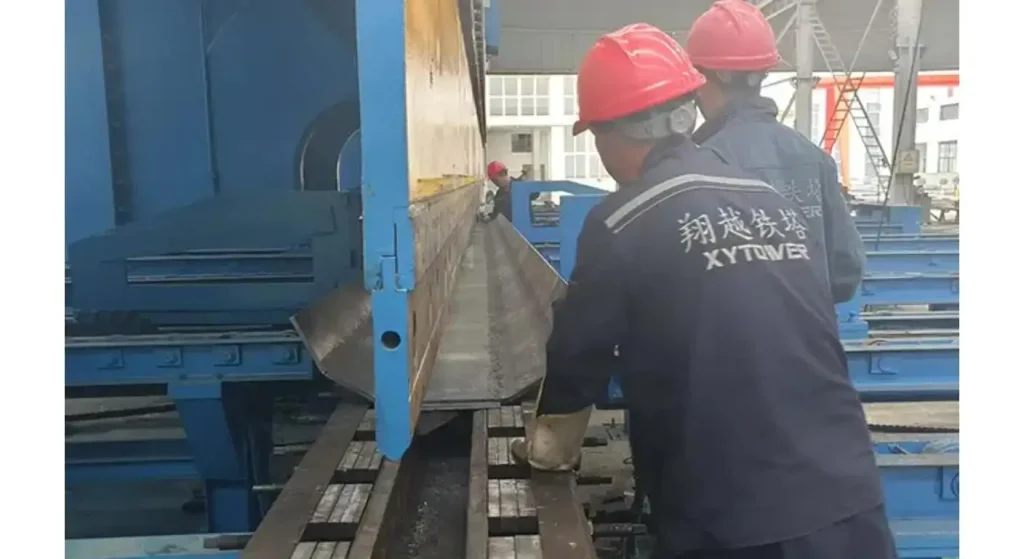
Thus, a wide-spread Transmission Line Services approach incorporates inspection, manufacture, galvanizing, packing and field delivery considerations and does not consider the tower to be "finished" at the factory gate. Hot dip galvanizing and packing inspection is a part of the quality process for transmission lines at XY Tower.
Packing must ensure that there is no need for packing to cause any unnecessary steel to steel damage and that the site crew are able to identify components.
Scratch marks and mixed and poorly stored galvanized tower are value that has been paid for, but lost already.
Pay Special Attention to Connections and Site Work.
When a tower is built up, there are always interfaces.
Bolted joints, splice areas, tower legs, ground connections and attachments and erection handling points are areas that should be checked since they have been altered from the state in which the tower was shipped from the factory.
The site personnel also require explicit instructions as to how to handle the coating damage.
Any kind of "on the job" grinding, cutting, enlarging of holes or any other kind of repairs or coatings that are not controlled should not be an accepted construction practice.
Especially in the case of custom-built structures. XY Tower's Custom Tower Design service takes into account the project-specific site and loading requirements and hot dip galvanizing is used as the general surface-treatment method.
| Project Stage | Control to Confirm |
| Design | Exposure assumptions and drainage-friendly detailing |
| Fabrication | Clean, correctly formed members and connections |
| Galvanizing | Coverage, condition and project-required inspection |
| Post-Galvanizing | Holes, distortion, marks and repair areas |
| Packing | Protection against avoidable handling damage |
| Erection | Approved treatment of coating damage |
| Operation | Accessible inspection and planned maintenance |
It is not to act as if damage to coatings cannot occur.
It's to be a premeditated action that is determined to occur when it does.
Corrosion Resistance Post Energization
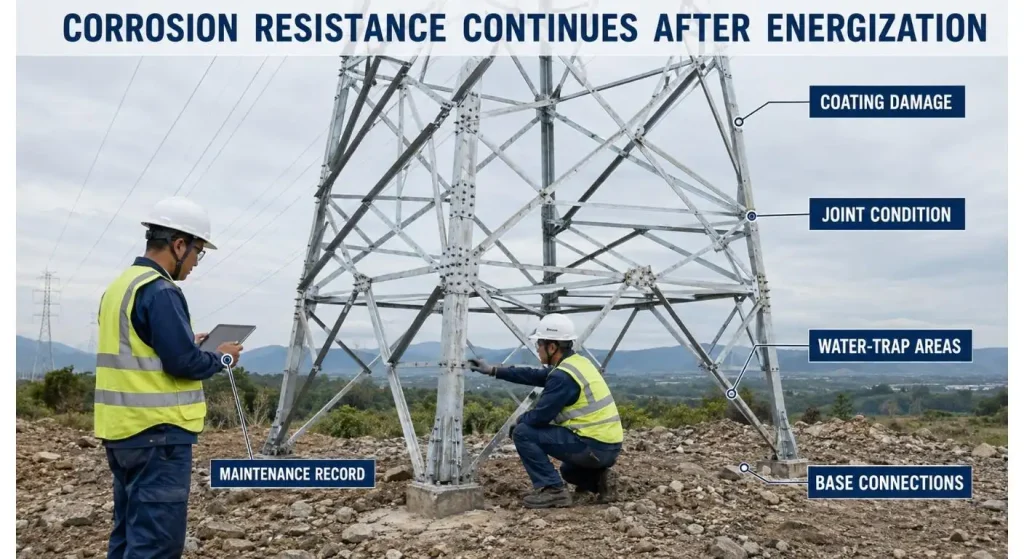
Corrosion resistant tower is not a no maintenance tower.
That distinction matters.
During the years of service, the inspection team can experience some localized damage, contamination, deterioration of the coating or areas where moisture is retained longer than anticipated. If they are coastal or especially aggressive, it may be advisable to take a closer look at them than at relatively benign inland locations.
That's where the initial design decisions begin to make an impact.
Are there access ways for inspectors to reach critical areas?
Are connections visible?
Is it possible to determine and fix the damage in a damaged location without having to have to guess what is going on underneath layers of dirt or corrosion products?
The following factors help in durability if planning for inspection has been done in the design of the tower:
The optimum corrosion approach for the asset owner is thus not the one that promises the longest service life.
It's the one that makes deterioration slow, visible and manageable.
Request a Corrosion-Control Package, NOT One Certificate
Once an EPC contractor has let towers that are susceptible to corrosion, there should be a story told in the evidence.
In what type of environment is the tower to be used?
Which protection system was provided?
What was inspected?
What was the method used to repair them?
Were members coated and were they dimensionally acceptable?
What was done to avoid damage to coatings in the packing process?
Your existing steel tower documentation system already considers galvanizing reports as only a small component in the documentation package, not as standalone.
This is where that attitude comes in handy.
It's not about more paperwork.
The aim is to be able to explain to the site that the tower they are receiving is in fact the corrosion resistant tower that was ordered.
Conclusion
Dipping an ordinary tower in zinc at the end of the fabrication process will not create a corrosion resistant tower.
The first step to protection is exposure data.
Good structural detailing to provide tower with drainage and drying. Fabrication makes proper surface preparation and connections. The galvanizing is used to protect the steel. The result is checked by inspection. Packing is used for protection of the coating during transportation. During erection damage is controlled by site procedures; maintenance continues to monitor the areas most susceptible to damage.
That complete chain is more important than how the tower looks the day it's delivered.
The improved procurement question for utilities and EPC contractors is thus not:
“What is the thickness of the coating?”
It is:
“What is done to prevent corrosion from the environment to the erected tower?”
FAQs
Q1. What is a corrosion resistant tower?
It is a steel tower designed and protected to limit corrosion under its expected service environment. Corrosion resistance involves material protection, detailing, coating quality, transport, erection and future inspection.
Q2. Is hot-dip galvanizing enough for every transmission tower?
Hot-dip galvanizing is widely used for transmission structures, including XY Tower's transmission products. The actual project should still define its exposure conditions, inspection requirements and any special protection requirements.
Q3. Why should site environment be defined before tower production?
Exposure conditions affect the corrosion-control strategy. Coastal, humid, industrial and relatively dry inland sites should not automatically be treated as identical environments.
Q4. What should be inspected after galvanizing?
Check coating condition together with holes, distortion, piece-mark readability, handling damage and critical fit. Your supplied tower specification material identifies these as practical post-galvanizing concerns.
Q5. Can galvanized coating be damaged during transportation?
Yes. Bundling, lifting, shipping, unloading and storage can expose finished members to handling damage. Packing and site-handling procedures should therefore be included in the protection plan.

Hey, I’m Chunjian Shu
"X.Y. Tower: Reliable, innovative solutions for high-quality towers and electrical equipment with professional service.
