
Dead-End Tower: Where a Transmission Line Must Hold Its Ground
2026-08-26
There's a reasonably cooperative section of the line that is most transmission towers.
Conductors come from one side, and go from the other. Although not exactly the same, much of the tension in the line is offset by the continuity of the line in both directions.
Then the line stops co-operating.
It comes to a substation. Has a sharp change of direction. Section must be anchored. A specific line position needs to withstand forces that are not just carried through to the next position of the conductor, or the conductor arrangement is modified.
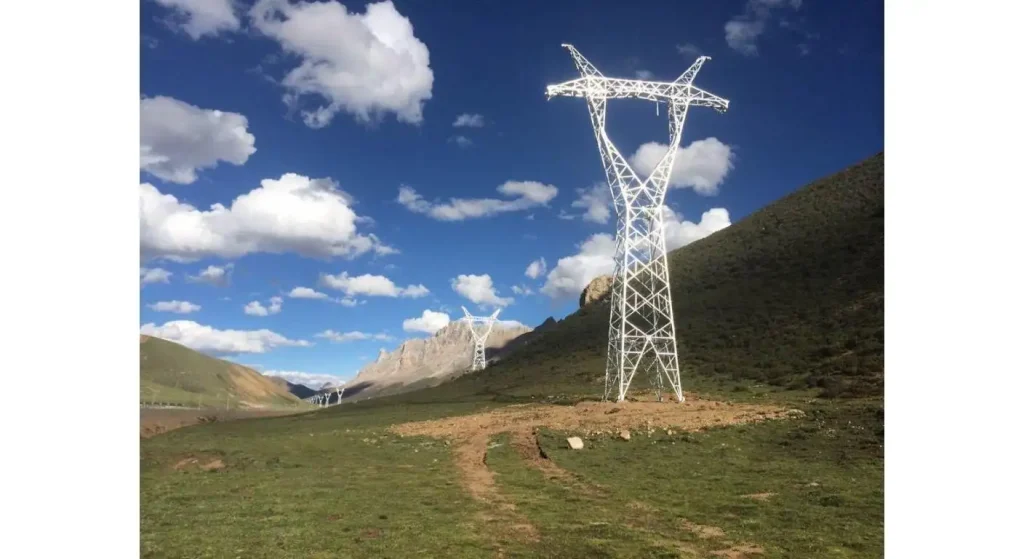
This is what a dead-end tower comes in handy.
It would be a strong understatement to say that this is “a stronger suspension tower.” A dead-end structure alters the way that conductor forces are applied to the tower and, ultimately, applied to the foundation.
That difference is what an EPC engineer or a utility buyer should know prior to considering tower weight, steel grade or quotation price.
A Dead-End Tower is one that's told to do what the line tells it to.
The name can be confusing as not all dead-end towers are at the end of the transmission route.
Dead-end structures are known by other terms, such as tension, strain or anchor towers, depending on the project. This family of structures, in which a transmission line ends, changes direction or is required to withstand a great deal of tension, is referred to as the Tension Tower range by XY Tower.
Functional is this useful category, then.
A structure primarily designed to support the conductors along an uninterrupted path. It is important to design a dead-end structure to withstand significant longitudinal conductor forces and the resulting attachment and foundation reactions.
That means that line position is more important than appearance!
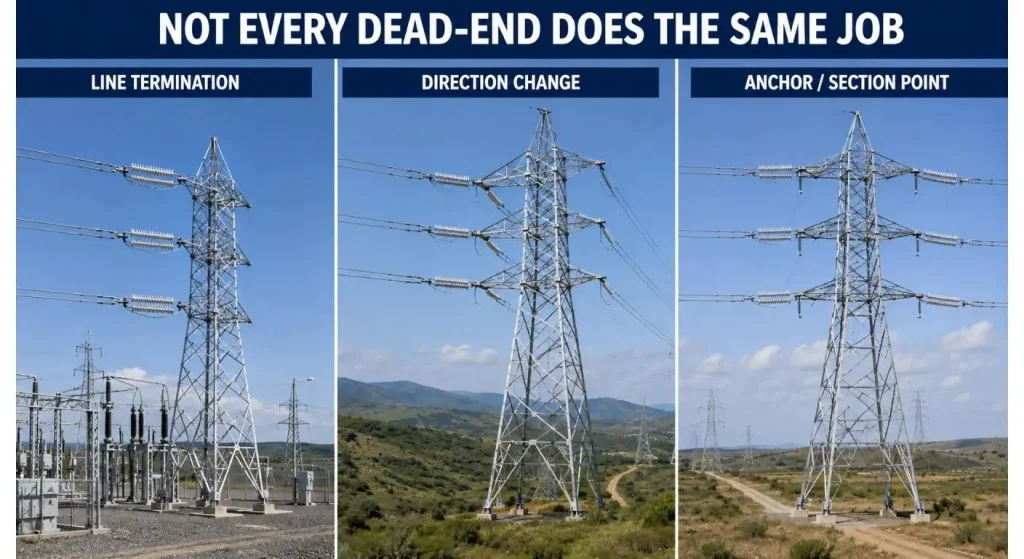
| Line Position | Main Question to Confirm | Design Focus |
| Line Termination | Where does conductor tension stop? | Unbalanced longitudinal load |
| Route Direction Change | What is the approved deviation angle? | Tension plus transverse load |
| Anchor / Section Point | What line sections are being separated? | Longitudinal load control |
| Substation Approach | How does the line connect to equipment? | Attachment and clearance geometry |
| Special Position | What makes this location different? | Project-specific load cases |
If you are going to specify one, first determine what it is that is occurring in that tower position.
Conductor Force Through the Tower
If you don't have to think about the entire tower but just one conductor, then a dead-end tower should be understood.
The conductor comes to a strain assembly. That force is transmitted through the insulator and the attachment hardware into the cross arm or body of the tower. From there it progresses to the main structural members, down the legs and finally into the foundation.
Each and every user interface between that path is important.
That's why it is essential that project-specific Tower Design Solutions start with loading and site conditions, and not with picking an outline tower that is familiar to the designer, and then strengthening members later. XY Tower's tower design strategy is tailored to the environmental and project-specific needs.
If change in the longitudinal load, effects may be more than on one brace.
It may be accompanied by a change of cross arm geometry, connections, leg forces and foundation reactions.
A dead-end tower should thus be considered a single load path.
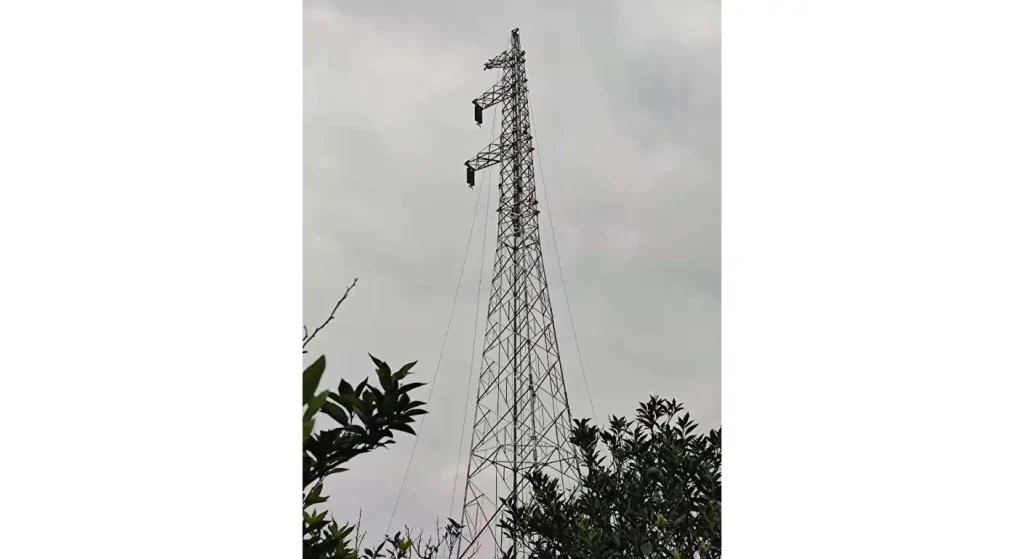
The Hardware Arrangement is Part of the Structural Problem:
Sometimes, steel and electrical hardware are analyzed by other teams.
That separation can be a costly affair at a dead-end position.
The points of entry of loads to the tower are dependent on the strain-insulator arrangement, conductor attachment points, jumper geometry, earth-wire positions and clearances. It can be more than just an electrical-detail change to make an attachment change after the structural design is well under way.
What is important is that the Transmission Line Steel Tower solutions offered by XY Tower are customizable to cater to the various voltage, terrain and project requirements as line hardware and tower geometry need to work in sync with each other.
Electrical and structural should agree on interfaces that are not movable later prior to publishing detailed tower drawings.
The exact same site question:
Was this link really intended for here or did it just come to be here?
Direction Change does not equal Line Termination!
The terminology of dead-end, strain and tension is often used interchangeably in RFQs.
The actual load case should NOT be.
The hardware configuration at a tower at the end of a section of line in the vicinity of a substation might be different from that at a tower which anchors two sections of line. Adding an angle position will add geometry of route deviation. Some additional requirements may be added in a special crossing.
XY Tower's 66KV Strain Tower is introduced specifically for mechanical tension and direction change service and not the normal straight line suspension service.
Therefore, instead of using the term “dead-end tower required” in the tower schedule it is necessary to state the actual duty.
Is it a line termination or "end of line"?
An anchor position?
Major deviation of road?
A sectionalizing point?
Those words give rise to better engineering than just putting on more steel.
It is Time to Have an Earlier Conversation with Foundation Reactions
There are two towers, one of which is heavier.
Under ground, there's more of a foundation.
This is one of the reasons that the tower-foundation interface may be overlooked at the beginning of the procurement process.
Longitudinal conductor forces which eventually become foundation reactions are those that distinguish a dead-end tower. It is therefore necessary that these different design interfaces have equal attributes to account for base geometry, leg forces, uplift, compression and site soil conditions.
This is important if the tower and foundation packages are dealt with by different organisations.
Structural team shouldn't complete the tower and then inquire of the civil team whether it fits.
The information for a foundation reaction must be provided so as to be available to the foundation designer in time for the use of the actual approved tower configuration, rather than a "suspected" suspension tower configuration.
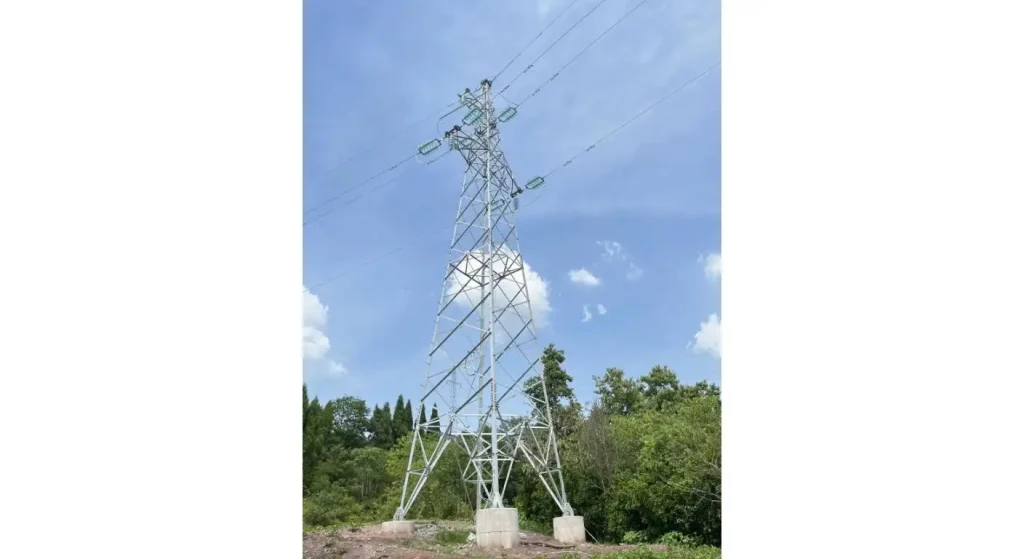
Rickard Sund's Broken Conductor Case brings the dialogue back.Rickard Sund's Broken Conductor Case redefines the discussion once again.
Transmission-line structure design is not just for normal operating conditions.
Conductor or earth-wire loading conditions may also generate unbalanced conditions that may need to be taken into account as part of the project specifications.
That is for a dead-end structure, and is something that needs to be looked at carefully, as the tower itself is in a position where longitudinal load is important.
The selection of the correct cases is based on the design criteria of the project, the conductor system and standard applicable to the project. They should be the result of the design basis that was approved and not of a generic tower catalogue.
Another reason for not being able to simply reduce tower selection to voltage.
Two towers at the same voltage could have entirely different mechanical functions.
Run a test fit the interfaces that would be difficult to complete on site.
Dead-end structures like towers, often have regions that are worth considering before volume production, such as heavily loaded cross-arm connections, strain-hardware attachment regions, tower heads and other complex interfaces.
This doesn't necessarily imply completing each production tower!
Trial assembly is for the purpose of answering specific questions.
Are the mating members able to put together easily? Is it feasible to access the bolts? Are the orientations of the members correct? Are attachment interfaces as per approved drawings?
In your previous tower design you also focus most heavily on trial assembly with configurations that are new or critical, so it's not something you do for every configuration.
If a tower is going to be a dead-end, check out what parts would be most unwelcome to mess around with, half way up a tower.
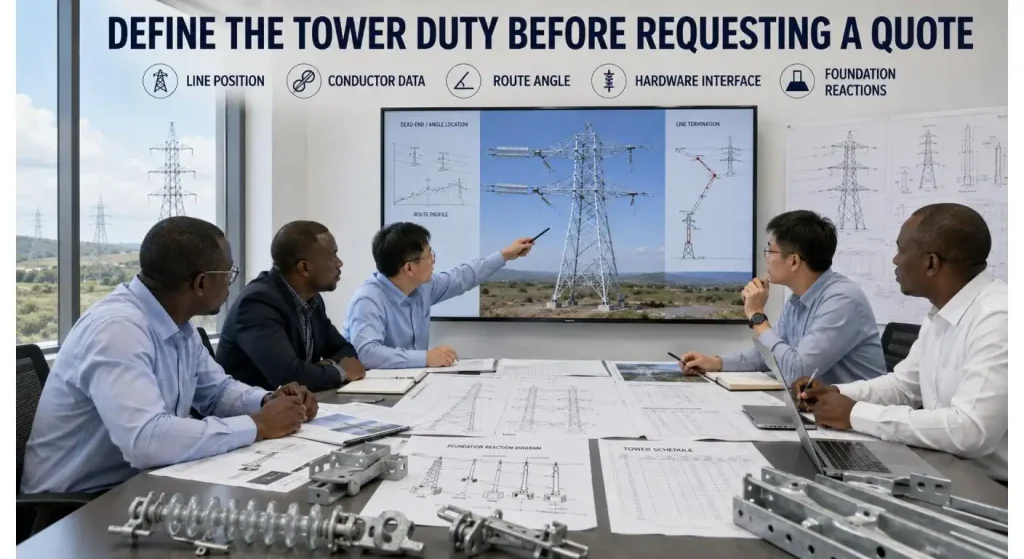
Specify the Line position, NOT just the voltage, to the supplier.
When an RFQ expresses a requirement as, “220 kV dead-end tower, please quote,” there is too much engineering behind it.
Useful procurement data should relate to the actual location of the tower on the line.
Conductor and earth-wire information, route angle, span information, attachment geometry, climatic criteria, tower height/extension requirements, foundation interface and quantities are all important, as well as voltage and circuits.
XY Tower's wide range of Transmission Line Services encompasses suspension, tension and dead-end terminal tower types in customized transmission applications.
| RFQ Input | What It Defines |
| Voltage & Circuit | Electrical configuration |
| Conductor / Earth Wire | Mechanical loading inputs |
| Tower Duty | Termination, anchor or angle function |
| Route & Span Data | Position-specific geometry |
| Hardware Arrangement | Tower attachment interfaces |
| Climate Criteria | Environmental loading |
| Foundation Interface | Reactions and base requirements |
Assumptions should be made apparent in a good quotation.
If the supplier has to make an estimate as to the conductor tension or the duty of the tower, the project is not at a meaningful price.
Conclusion
The dead-end tower is important as it does not allow the line to simply pass on their longitudinal forces.
It must hold them.
This alters the conductor attachment, the structural load path, tower members and foundation reactions. It also adds an increased level of co-ordination as compared to an ordinary straight-line position, between electrical design, structural design and civil works.
So in looking at a dead-end tower proposal, don't start the analysis with looking at how heavy the tower is.
Start with a more basic one:
What is this tower being asked to do; stop, turn or anchor?
Then it all becomes clear – the steel.
FAQs
Q1. What is a Tower that has a Dead End?
The dead end tower is a type of transmission tower which is able to withstand large longitudinal conductor tension. Can be utilized on line terminations, anchor sites, direction changes and others where tension is a factor.
Q2. What is difference between dead end tower and tension tower?
Transmission projects can often involve a combination of the terms. It is important that it is the designated tower duty, loading condition and attachment configuration that's important and not the label itself.
Q3. Which is a stronger tower, a dead-end tower or a suspension tower?
Suspension tower normally operates under more evenly-distributed conductor forces along its length. Dead-end structure should be able to withstand and transfer large forces of unbalanced tension into the tower and foundation.
Q4. Is it possible to choose a dead end tower based on its voltage?
No. Only voltage cannot determine the route angle, conductor tension, span, tower height, environmental loading or foundation reactions. Should also be included in design basis these conditions.
Q5. What to include in a dead-end tower RFQ?
Details on voltage, circuits, conductor and earth-wire data, tower duty, route geometry, spans, climatic criteria, attachment requirements, foundation interface, quantities and applicable project standards.

Hey, I’m Chunjian Shu
"X.Y. Tower: Reliable, innovative solutions for high-quality towers and electrical equipment with professional service.
