
Does a Guyed Mast Tower Cost Less Than a Monopole Tower?
2025-12-15
Yes, in most cases, a guyed mast tower costs significantly less to manufacture and install than a monopole tower of the same height. This is primarily because guyed towers use a lightweight lattice structure supported by tensioned cables (guy wires), requiring far less steel than the thick, heavy plates needed for a self-supporting monopole. For heights above 100 feet, the material savings can be substantial—often making guyed towers 40% to 60% cheaper in upfront structural costs.
However, the "total project cost" depends heavily on land value. While the tower itself is cheaper, lattice guyed towers require a much larger land footprint to anchor the guy wires. If you are building in an urban area where land is expensive or space is limited, the land acquisition costs for a guyed tower might exceed the structural savings, making a monopole the more budget-friendly option for that specific site.
The Economics of Tower Design: Why Materials Matter
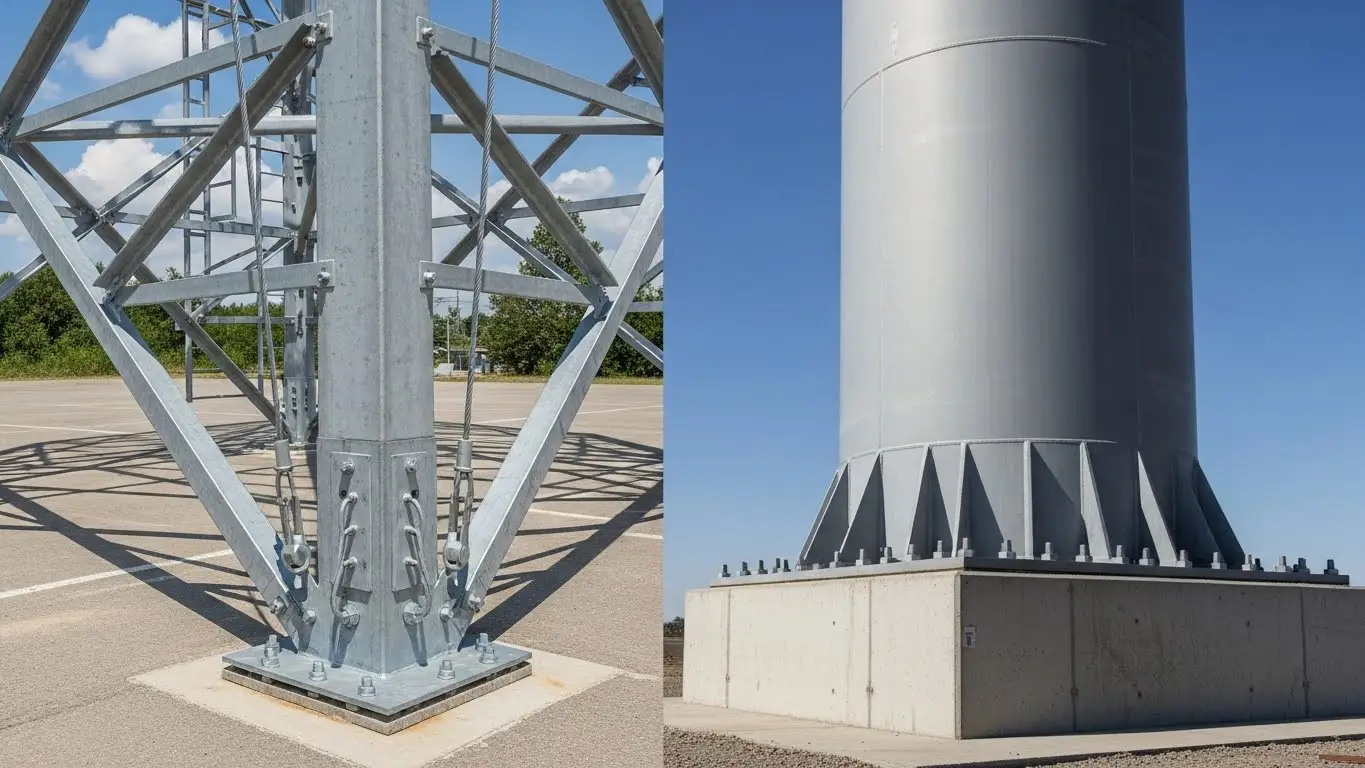
When you compare the raw costs of tower construction, weight is money. Guyed towers are incredibly efficient structures. They rely on the tensile strength of steel cables to hold them upright, allowing the mast itself to be thin and lightweight. This efficient use of materials is a major factor in reducing manufacturing and shipping costs.
In contrast, a monopole is a single, self-supporting tube. To resist wind loads and keep the structure stable without wires, the base of a monopole must be massive, often requiring thick steel plates and complex fabrication. This heavy steel consumption drives up the price. For telecommunications companies looking to cover vast rural areas, the lower material cost of guyed masts makes them the industry standard for high-altitude transmission.
Comparison Table: Guyed Mast vs. Monopole Costs
| Cost Factor | Guyed Mast Tower | Monopole Tower |
| Material Cost | Low: Uses minimal steel; lightweight lattice design. | High: Uses heavy steel plates; thick tapered tubes. |
| Foundation Cost | Moderate: Requires multiple small anchors, but less concrete volume centrally. | High: Requires a massive, deep central foundation (caisson). |
| Land Requirement | High: Needs a large radius for guy wire anchors. | Low: Minimal footprint; ideal for tight spaces. |
| Installation | Moderate: Easier to stack, but tensioning wires takes time. | Fast: Sections slip-fit together quickly with a crane. |
| Height Potential | Excellent: Most cost-effective for 300ft+ heights. | Limited: Becomes exponentially expensive above 150-200ft. |
What Determines the "Hidden" Costs of Installation?
While the steel price tag favors the guyed mast, installation and site preparation introduce other variables. Monopoles are often preferred in suburban or semi-urban environments because they are aesthetically cleaner and require a tiny footprint—sometimes just 15 to 20 feet square.
However, you must consider the foundation. Monopoles act like a giant lever against the ground. This requires a massive drilled pier foundation (caisson) that can be very expensive to pour, especially in rocky soil. Guyed towers spread the load out. While they need more anchors, the individual foundations are smaller.
Additionally, checking the benefits of lattice steel tower designs reveals that the open structure allows wind to pass through more easily than a solid monopole. This reduced wind load means the tower suffers less stress during storms, potentially lowering long-term maintenance costs for the structure itself.
Which Tower is Best for Rural vs. Urban Areas?
For rural areas, guyed towers are the clear winner.
In rural locations where land is plentiful and relatively cheap, the large footprint of a guyed tower is rarely an issue. You can easily secure the necessary radius for the anchors. The cost savings on the steel structure make it the most economical choice for reaching high elevations needed for long-range broadcasting or rural internet coverage.
For urban areas, monopoles are usually required.
In cities, buying the acres of land required for guy wires is cost-prohibitive or simply impossible. A monopole can be installed in a parking lot or a small leased compound. Even though the tower costs more to buy, it is the only feasible option when space is at a premium.
People Also Ask
How much land does a guyed tower need?
A guyed tower typically requires a land radius of 60% to 80% of the tower's height. For example, a 300-foot tower might need anchors placed roughly 180 to 240 feet away from the center base. This results in a large triangular plot of land that must be cleared and secured, which is the primary trade-off for the lower steel cost.
What is the lifespan of a monopole vs. a guyed tower?
Both tower types generally last 30 to 50 years or more with proper maintenance. However, guyed towers require more frequent inspections. The tension in the guy wires must be checked and adjusted regularly, and the wires themselves are susceptible to corrosion over decades. Monopoles have fewer moving parts and generally require less frequent structural maintenance, though their finish (galvanization or paint) needs monitoring.
Can you extend the height of a monopole tower?
It is very difficult and often impossible to significantly extend the height of an existing monopole. Because monopoles are engineered with specific tapering and wall thickness for their original height, adding more weight to the top can exceed the structural limits of the base. Guyed towers, due to their lattice design, are sometimes easier to reinforce or modify, though height extensions still require rigorous engineering analysis.
Frequently Asked Questions
Q: Are guyed towers safe in high winds?
A: Yes, they are extremely stable. The tensioned cables anchor the tower securely, preventing it from swaying excessively. The open lattice design also reduces wind resistance compared to solid structures.
Q: Which tower is faster to build?
A: Monopoles are generally faster to erect once the foundation is cured. The sections are slip-jointed and can be stacked quickly with a crane. Guyed towers take longer because the wires must be precisely tensioned and calibrated during installation.
Q: Do monopoles look better than guyed towers?
A: Generally, yes. Monopoles are considered less visually intrusive. They look like standard utility poles and lack the complex web of wires, making them easier to permit in residential or commercial zones.
Q: What is the cost per foot of a cell tower?
A: Costs vary wildly by steel prices and location, but generally, guyed towers cost significantly less per vertical foot than self-supporting towers or monopoles once you exceed 100 feet in height.
Key Takeaways
- Material Savings: Guyed mast towers are 40-60% cheaper to manufacture than monopoles for heights over 100ft due to less steel usage.
- Land vs. Steel: The cost advantage of a guyed tower can be erased if land prices are high, as they require a much larger installation footprint.
- Application: Use monopoles for urban/suburban sites with limited space; use guyed towers for rural sites where height is needed and land is cheap.
- Maintenance: Monopoles require less ongoing maintenance, while guyed towers need regular cable tensioning and inspection.
Conclusion
If your priority is minimizing the upfront cost of the structure and you have ample land available, the guyed mast tower is the most cost-effective solution. It offers superior height capabilities for a fraction of the steel cost. However, for sites with tight spatial constraints, the monopole remains the standard choice despite the higher manufacturing price tag.
Are you planning a tower installation and need a precise quote based on your terrain and height requirements? Contact XY Tower today to discuss whether a lattice or monopole design fits your budget best.

Hey, I’m Chunjian Shu
"X.Y. Tower: Reliable, innovative solutions for high-quality towers and electrical equipment with professional service.
