
How Do I Install a Modular Mobile Tower Step by Step?
2025-12-16
To install a modular mobile tower, you must follow a five-phase process: Site Preparation (soil leveling), Base Deployment (outriggers/jacks), Mast Assembly (connecting sections), Erection (hydraulic or winch lift), and Safety Guying. Unlike permanent towers, modular units require strict attention to leveling jacks and ground stability to prevent tipping during the telescoping phase.
Phase 1: Site Survey & Preparation
Before you unload a single bolt, you must verify the ground can hold the weight. A modular tower is only as stable as the dirt beneath it.
1. Check Soil Bearing Capacity
Don't guess. Use a penetrometer or consult a geotechnical report. If the soil is soft (clay/sand), you must use spreader plates or timber cribbing under the outrigger jacks to distribute the load.
- Tip: If your boot sinks into the mud, the tower outrigger will sink too.
2. Verify Overhead Clearance
Look up. Are there high-voltage power lines? Trees? The "Fall Zone" (radius equal to tower height + 10%) must be clear.
Phase 2: Unloading & Staging
Proper staging prevents "double handling" of heavy steel sections.
- Inspect for Damage: Before lifting, inspect the hot-dip galvanizing on every section. Look for deep scratches or "white rust" caused by ocean transport. Touch up minor scrapes with zinc-rich cold galvanizing paint immediately.
- Sort by Section Number: Modular towers are tapered. Section 1 (Base) is widest; the top section is narrowest. Layout the sections in order on timber blocks to keep them off the dirt.
Phase 3: Base Setup & Leveling
This is the most critical step. If the base isn't level, the tower will lean dangerously as it extends.
- Deploy Outriggers: Extend all four stabilization arms fully.
- Install Grounding Rods: Drive copper earth rods into the ground now, not later. Connect them to the chassis.
- Level the Chassis: Use the screw jacks on the outriggers. Place a 2-foot carpenter's level on the main frame. Adjust until the bubble is dead center in both X and Y axes.
- Warning: Never use the vehicle's suspension to level the tower. The weight must rest entirely on the jacks.
Phase 4: Assembly & Bolt Tensioning
Most modular towers use flange connections. This is where steel grade quality matters—high-quality Q345B steel flanges will align perfectly; cheap steel may warp.
The Bolt Tightening Sequence
Don't just tighten bolts in a circle.
- Insert Drift Pins: Use tapered drift pins to align the holes of the mating flanges.
- Insert Bolts: Place all bolts in the holes.
- Star Pattern Tightening: Tighten bolts in a "Star" or "Criss-Cross" pattern (like changing a car tire). This ensures the flange sits flat.
- Torque to Spec: Use a calibrated torque wrench. "Hand tight" is not enough for safety compliance.
Phase 5: Erection & Guying
Now, you raise the mast.
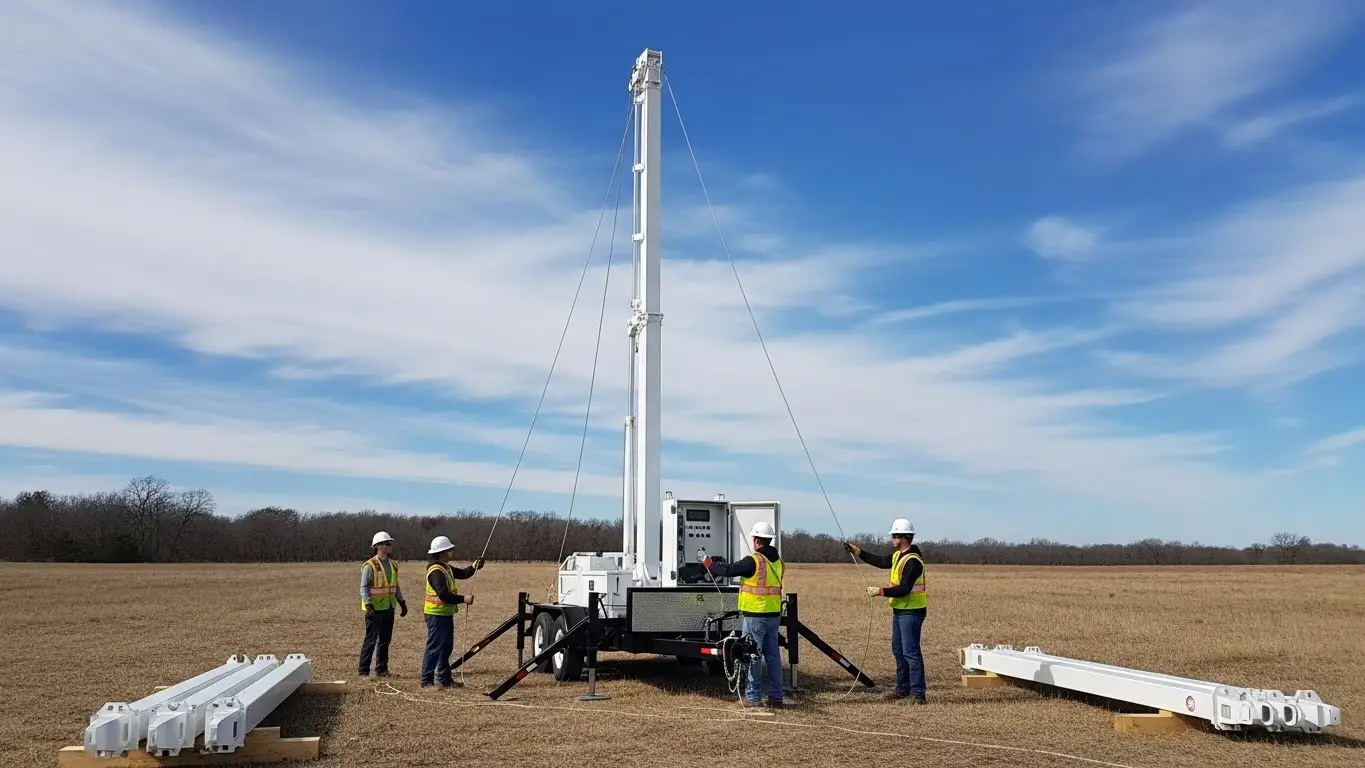
1. The Lift
- Pneumatic/Hydraulic: If using a powered mast, engage the compressor/pump. Watch the pressure gauge.
- Winch: If using a manual winch, crank steadily. Listen for strange noises.
- Stop & Check: Raise it 2 meters, then stop. Check the guys/cables. Raise another 2 meters.
2. Install Guy Wires (If Required)
For heights over 15 meters or in high wind zones, guy wires are mandatory.
- Anchor Points: These should be placed at 120-degree intervals from the tower base.
- Tensioning: Use turnbuckles to tighten the wires until the tower is plumb (vertical). Do not over-tighten, or you will bow the mast structure.
Tools You Will Need
Don't show up empty-handed.
- Spud Wrenches: For aligning holes and tightening nuts.
- Drift Pins: Essential for aligning heavy steel sections.
- Torque Wrench: To meet TIA-222-H specs.
- Digital Level: For precise base leveling.
- Tag Lines: Rope to control the load during lifting.
Common Mistakes to Avoid
- ❌ Ignoring the "Nesting" limit: If you are using a telescoping mast, ensure the sections overlap by the manufacturer's specified amount (usually marked with a red line). Over-extending weakens the tower.
- ❌ Using Aluminum bolts on Steel: Never mix metals. Use galvanized steel bolts (A325 or Grade 8.8) to prevent galvanic corrosion. Read our aluminum vs. steel comparison to understand material compatibility.
- ❌ Forgetting the Cotter Pins: On winch systems, always install the safety cotter pins on pulleys and shackles.
Frequently Asked Questions
A standard 30-meter mobile tower can be deployed by a trained 3-person crew in 2 to 4 hours. This assumes the site is prepared and the ground is level.
Not always. "Self-erecting" or telescoping mobile towers have built-in electric or hydraulic lift systems. However, if you are stacking lattice sections manually, a small boom truck or gin pole is required.
Yes, but only if the outrigger jacks have enough "stroke" (vertical travel) to level the chassis. If the slope is >5 degrees, you may need to excavate a flat pad first.
Never attempt to erect a tower if wind speeds exceed 30 km/h (20 mph). The structure is most vulnerable when it is half-raised and not yet guyed.
Yes. "Bolt relaxation" occurs within the first 24 hours. You should perform a "nut check" 1 week after installation to ensure everything remains tight.
Key Takeaways
- Foundation First: Level ground and proper outrigger padding are non-negotiable.
- Check Your Steel: Inspect galvanizing and flanges for damage before lifting.
- Torque Matters: Use a star pattern and a torque wrench, not just an impact gun.
- Guy It Down: Even "self-supporting" mobile towers benefit from guying in high winds.
Conclusion
Installing a modular mobile tower is a precision operation, not a brute-force job. By following the "Level, Align, Torque, Lift" protocol, you ensure your infrastructure is safe and compliant. Remember, a safe installation starts with the right materials—ensure your manufacturer adheres to ISO 9001 standards before the tower even arrives at the site.

Hey, I’m Chunjian Shu
"X.Y. Tower: Reliable, innovative solutions for high-quality towers and electrical equipment with professional service.
