
Monopole vs. Lattice Towers: Best Choice for Urban Sites
2025-12-15
For urban sites, Monopole towers are the superior choice over lattice towers. Their single-pole design requires 80-90% less ground space, making them ideal for expensive city real estate and tight zoning areas. While lattice towers offer higher load capacity and wind resistance for rural areas, monopoles dominate urban deployments because they are faster to install (minimizing traffic disruption) and can be camouflaged as trees or flagpoles to satisfy community aesthetic standards.
The Core Comparison: Urban Constraints
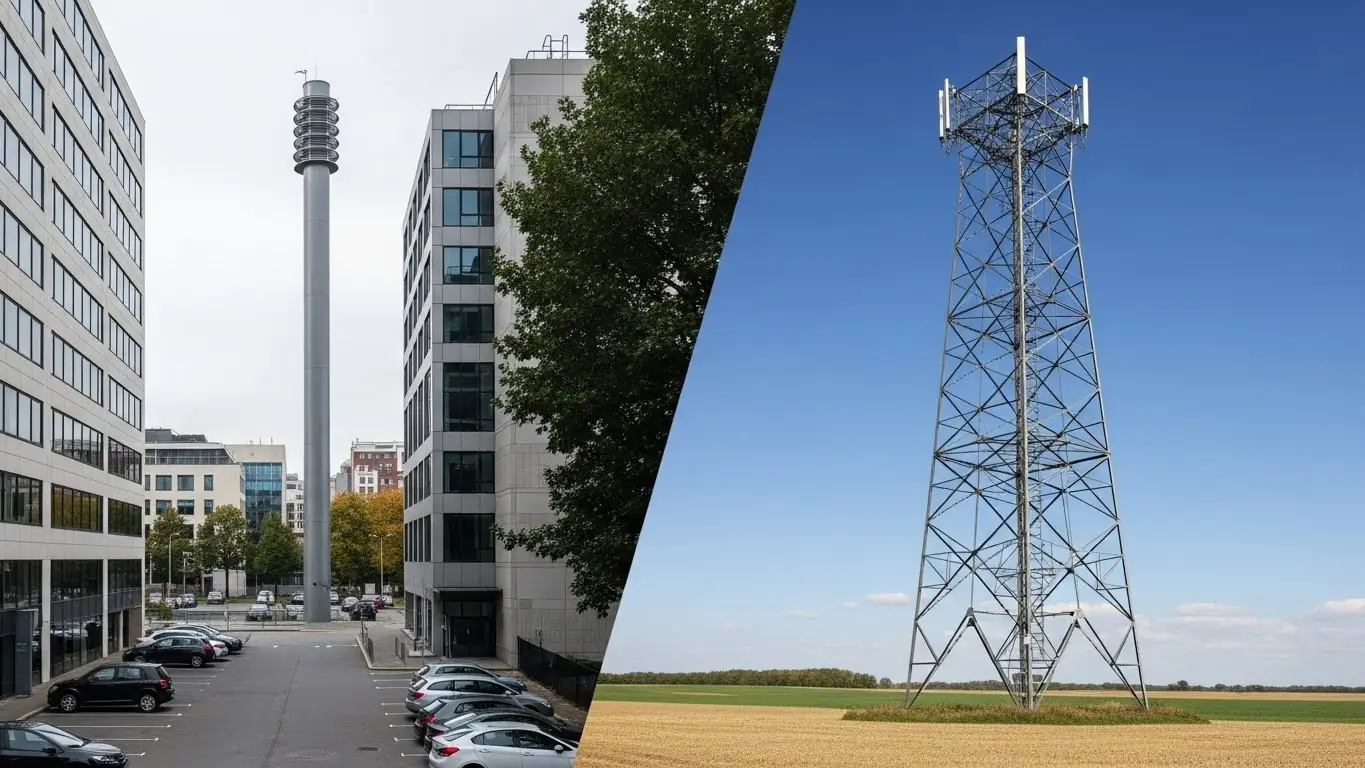
In a wide-open field, a lattice tower is often cheaper and stronger. But cities aren't wide-open fields. Urban deployment is a battle against three constraints: Space, Time, and Aesthetics.
| Feature | Monopole Tower | Lattice Tower |
| Footprint Required | Ultra-Small (1–10 m²) | Large (30–100 m²) |
| Aesthetics | Sleek, concealable (Camouflage ready) | Industrial, "Eiffel Tower" look |
| Installation Speed | Fast (1 day typical) | Slow (3–5 days assembly) |
| Wind Load | High deflection (sway) | Rigid (wind passes through) |
| Urban Suitability | ✅ Excellent | ❌ Poor |
1. The Real Estate Argument (Footprint)
In downtown metro areas, land lease costs are premium.
- Lattice towers rely on a wide, triangular base to support their weight. This might require a 10x10 meter plot.
- Monopoles rely on deep caisson foundations. The visible footprint is often just a single 1-2 meter wide circle.
Why it matters: Leasing 100 square feet in a city center is exponentially cheaper than leasing 1,000 square feet. For many projects, the monopole telecom towers design benefits—specifically the reduced footprint—offset the higher manufacturing cost of the steel itself.
2. Zoning and "NIMBY" Approval
Getting a permit is often the hardest part of an urban build. Residents and city councils often oppose "industrial-looking" structures (the "Not In My Backyard" or NIMBY effect).
- Lattice Towers: Difficult to camouflage. They look like high-voltage transmission lines.
- Monopoles: Can be painted to match the skyline or disguised as pine trees ("monopines"), flagpoles, or light standards.
If you are struggling with permit approvals, understanding telecom monopole towers explained can help you present better aesthetic options to city councils.
3. Installation Speed & Traffic
In a city, you cannot block a main road for a week.
- Lattice towers are often built piece-by-piece like an erector set, requiring days of crane work and large laydown areas for parts.
- Monopoles arrive in slip-joint sections. A crane can stack them in a single day, drastically reducing road closure permits and traffic control costs.
Technical Trade-Off: The "Sway" Factor
It's important to be honest about the monopole's weakness: Deflection.
Because it is a single pole, a monopole sways more in the wind than a rigid lattice structure.
- The Risk: Excessive sway can misalign highly directional microwave backhaul dishes (point-to-point links).
- The Solution: For urban sites requiring tight microwave links, engineers must over-design the monopole diameter or use "stiffeners" to reduce twist and sway. Lattice towers naturally avoid this due to their truss design, but they simply don't fit in the alleyway behind a supermarket.
Frequently Asked Questions
Strictly speaking, lattice towers are cheaper to manufacture because they use standard steel angles rather than heavy, tapered steel plates. However, monopoles are often cheaper overall for urban projects when you factor in land lease savings, faster installation (less crane time), and lower foundation complexity.
Generally, no. Lattice towers are structurally superior for massive loads (heavy remote radio heads, multiple tenants). However, modern urban monopoles are designed to easily support the standard 3-4 carrier load required for 5G/4G densification.
Yes. While they sway more, they are engineered to withstand hurricane-force winds (often 100+ mph) without structural failure. The "sway" is a flexibility feature, not a defect, preventing the steel from snappi
Yes. Monopoles typically use a single, very deep drilled shaft (caisson) foundation. Lattice towers usually use a mat foundation or individual pier anchors for each leg, which requires more surface excavation.
Key Takeaways
- Choose Monopoles for cities, suburbs, and highway corridors where space is tight and looks matter.
- Choose Lattice Towers for rural areas, wide-open industrial zones, or when you need to mount massive loads at heights exceeding 60 meters.
- Cost Reality: Monopoles save money on land and labor, even if the steel costs more.
- Speed: Monopoles minimize traffic disruption with rapid 1-day stacking installation.
Conclusion
When building in the concrete jungle, the Monopole is the clear winner. Its ability to deliver essential connectivity while respecting the tight constraints of urban real estate makes it the standard for modern city networks. While lattice towers hold the crown for raw strength in the countryside, the monopole wins on agility, aesthetics, and economics in the city.
Ready to plan your urban site? Explore our guide on monopole tower designs to find the right fit for your project.

Hey, I’m Chunjian Shu
"X.Y. Tower: Reliable, innovative solutions for high-quality towers and electrical equipment with professional service.
