
Steel Pole vs Concrete Pole: Complete 2026 Comparison Guide
2025-12-21
Steel poles weigh 60-70% less than concrete poles—a 40-foot Class 2 steel pole typically weighs 3,500-4,500 lbs versus 9,000-12,000 lbs for concrete. Both materials last 50-75+ years, but concrete requires minimal maintenance while galvanized steel needs recoating every 15-20 years in corrosive environments. Steel costs 20-30% less upfront but concrete delivers 15-25% lower total ownership costs over 25 years in permanent installations.
Your choice depends on three factors: site access, environmental conditions, and maintenance budget.
Quick Comparison: Steel vs Concrete Utility Poles
| Feature | Steel Poles | Concrete Poles |
|---|---|---|
| Weight (40-ft) | 3,500-4,500 lbs | 9,000-12,000 lbs |
| Lifespan | 50-60 years | 50-75+ years |
| Initial Cost | $2,500-4,000 | $3,500-5,500 |
| Maintenance | Recoat every 15-20 yrs | Minimal (5-10 yr inspections) |
| Installation Time | 4-6 hours | 6-8 hours |
| Corrosion Resistance | Requires coating | Inherent resistance |
| Modification Flexibility | High | Limited |
| Fire Resistance | Moderate | Excellent |
In our 17 years manufacturing transmission and distribution structures at X.Y. Tower, we've supplied both steel monopole poles and worked alongside concrete suppliers across Africa, Southeast Asia, and South America. Here's what actually matters for your project.
Steel Utility Poles: What You Need to Know
Steel poles dominate where weight matters. With our 40,000-ton annual production capacity, we manufacture galvanized steel poles ranging from 25 to 120 feet, all conforming to ASTM A588 weathering steel or ASTM A123 hot-dip galvanizing standards.
Weight and Handling Advantages
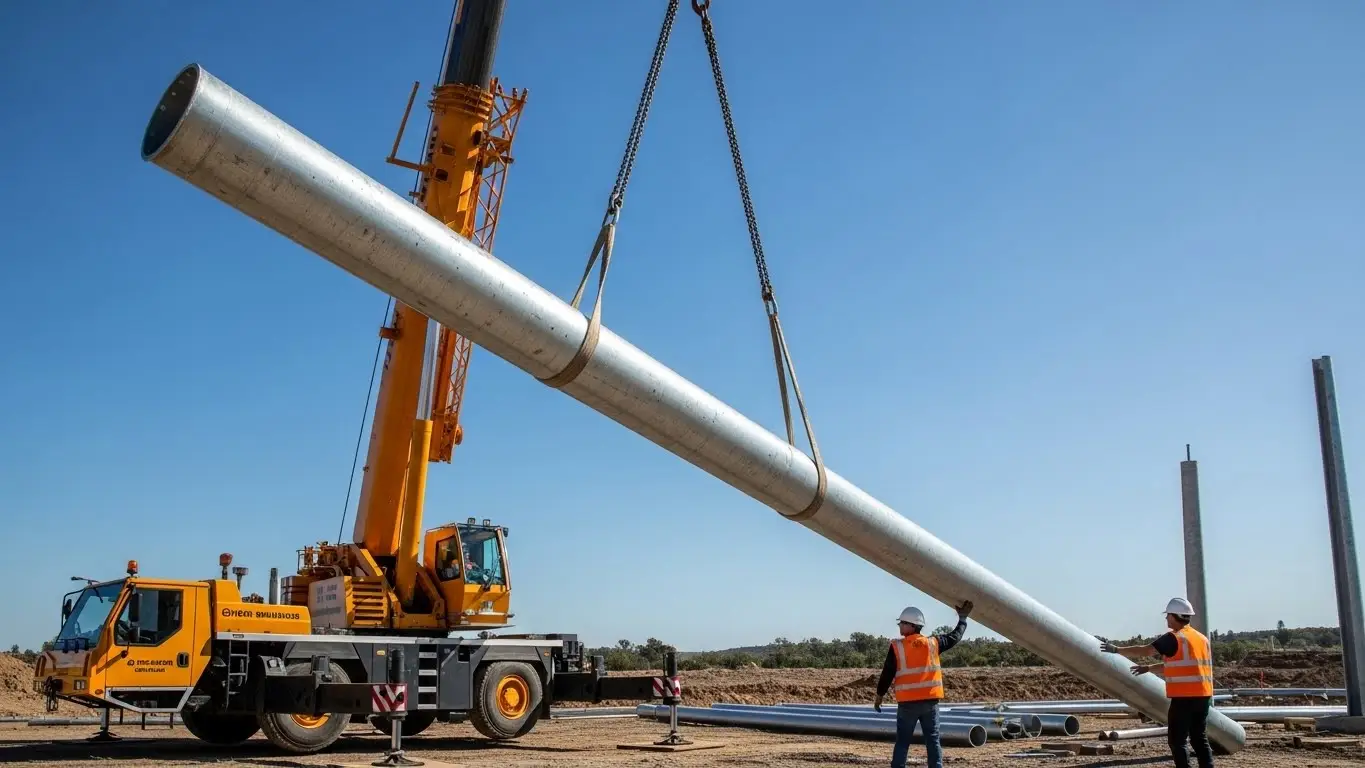
A 50-foot Class 1 steel pole weighs roughly 5,000 lbs. The equivalent concrete pole? 13,000-15,000 lbs.
This matters most in these scenarios:
- Remote mountain installations with limited crane access
- Island projects where heavy equipment rental costs $2,000-5,000 daily
- Emergency restoration work requiring rapid deployment
- Urban retrofits with overhead line restrictions
Our engineering team recently completed a project in mountainous Myanmar where equipment access limited lifts to 8,000 lbs. Steel monopole towers were the only viable option.
Technical Specifications
Materials: ASTM A588 weathering steel provides 4x the corrosion resistance of standard carbon steel. For coastal installations, we apply hot-dip galvanization per ASTM A123, achieving 3.5-4.5 oz/ft² zinc coating thickness.
Load Capacity: Tubular steel poles designed to ASCE 48 standards typically handle 15-25 kip-ft bending moments at groundline, depending on diameter and wall thickness.
Service Life: Properly maintained galvanized steel poles last 50-60 years. In our galvanizing factory, we've tested samples showing less than 2% zinc loss after 15 years in industrial atmospheres.
The Corrosion Reality
Steel's main weakness? Ground-line corrosion.
Even with galvanization, steel poles in coastal zones (within 1 mile of salt water) require protective coatings that need reapplication every 15-20 years. Budget $800-1,500 per pole for recoating, including access equipment and labor.
Inland installations fare better. We've inspected 25-year-old poles in desert climates showing minimal coating degradation.
Concrete Utility Poles: The Long-Term Investment
Spun-cast prestressed concrete poles manufactured to ASTM C1089 standards represent the longest-lasting option—regularly exceeding 75 years in service with minimal maintenance.
Why Concrete Lasts Longer
Prestressed concrete uses high-strength steel reinforcement (ASTM A416) stressed to 70% of ultimate capacity. This creates a compressive force that counteracts service loads and prevents cracking.
The manufacturing process matters. Spun-cast poles create denser concrete (typically 6,000-8,000 psi compressive strength) compared to static-cast variants. The centrifugal spinning process also forms a smooth interior surface—ideal for internal cable routing.
The Weight Challenge
That same 50-foot Class 1 pole now weighs 13,000-15,000 lbs.
Installation requires:
- Crane capacity: 18,000-25,000 lbs minimum
- Larger auger for direct embedment (30-36 inch diameter)
- 3-4 person crew vs 2-3 for steel
- Additional site prep for heavy equipment access
We've seen projects where crane rental doubled from $1,200/day for steel installations to $2,400/day for concrete, purely due to required lifting capacity.
Maintenance-Free Advantage
Concrete poles eliminate ground-line corrosion entirely. Your main inspection points:
- Circumferential cracks (rare in well-manufactured poles)
- Surface spalling in freeze-thaw climates
- Prestressing wire integrity (visual inspection every 10 years)
A utility we work with in coastal Southeast Asia spec'd concrete for a 15-mile distribution line in 2005. Their maintenance log shows zero structural repairs over 19 years—only anchor hardware replacement.
Where Each Material Wins
Choose Steel Poles For:
Remote Locations: Mountainous terrain, islands, or areas with limited heavy equipment access benefit from steel's lighter weight. We shipped tubular steel poles to a Pacific island project where the largest available crane lifted 9,000 lbs—concrete wasn't an option.
Quick Installation: Emergency restoration, temporary installations, or phased projects where speed matters. Steel poles install in 4-6 hours versus 6-8+ for concrete.
Design Flexibility: Projects requiring frequent modifications. Steel accepts drilling, welding, and bracket additions far easier than concrete.
Budget-Constrained Initial Capital: When upfront cost drives the decision and long-term maintenance budget exists.
Choose Concrete Poles For:
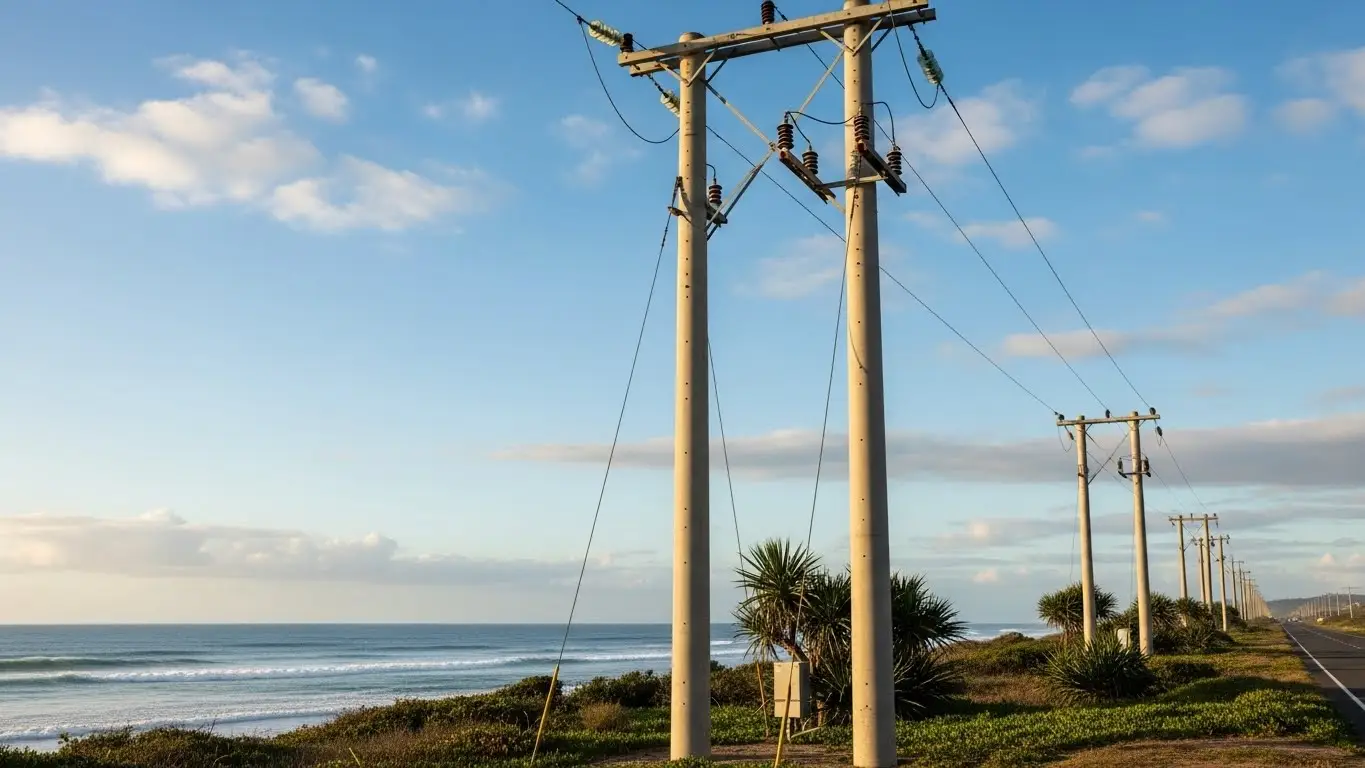
Coastal Environments: Salt spray destroys steel coatings. Concrete thrives where steel fails. For projects within 3 miles of coastline, concrete typically pays for itself in avoided maintenance costs.
Wildfire Zones: Concrete's fire resistance matters. We've seen distribution systems survive forest fires that destroyed adjacent wooden poles while concrete stood intact.
Permanent High-Value Installations: Transmission line applications and critical infrastructure benefit from concrete's 75+ year lifespan and minimal maintenance.
High Wind Regions: While both materials handle wind loads, concrete's mass provides inherent stability. Typhoon-prone regions often mandate concrete for distribution lines above 33kV.
Industrial Atmospheres: Chemical plants, refineries, and heavy industrial zones where airborne corrosives attack steel coatings.
Cost Reality: 25-Year Analysis
Here's actual data from a 100-pole distribution project (40-foot Class 2 poles):
Steel Poles:
- Material & delivery: $320,000
- Installation: $85,000
- Year 15 recoating: $95,000
- Total 25-year cost: $500,000
- Cost per pole per year: $200
Concrete Poles:
- Material & delivery: $445,000
- Installation: $110,000
- Maintenance (inspections only): $18,000
- Total 25-year cost: $573,000
- Cost per pole per year: $229
The crossover happens at year 18. Projects with shorter planning horizons favor steel. Infrastructure planned for 30+ years favors concrete.
Installation Requirements Comparison
Steel Pole Installation
Equipment needed:
- Crane: 8,000-12,000 lb capacity
- Auger: 24-30 inch diameter
- Crew: 2-3 personnel
- Foundation: Concrete backfill or engineered base plate
Average installation: 4-6 hours per pole
Concrete Pole Installation
Equipment needed:
- Crane: 18,000-28,000 lb capacity
- Auger: 30-36 inch diameter (for direct embedment)
- Crew: 3-4 personnel
- Foundation: Direct embedment with gravel base
Average installation: 6-8 hours per pole
The equipment difference drives cost. In emerging markets where heavy crane rental is scarce, steel's lighter weight becomes decisive.
Standards You Need to Reference
Steel Pole Standards:
- ASTM A588: Weathering steel specification
- ASTM A123: Hot-dip galvanizing coating specification
- ASCE 48: Design of steel transmission pole structures
- NEMA TT1: Tapered tubular steel structures
Concrete Pole Standards:
- ASTM C1089: Spun-cast prestressed concrete poles
- ASTM C935: Static-cast prestressed concrete poles
- ACI 318: Building code requirements for reinforced concrete
- ASTM A416: Prestressing steel strand specification
All transmission tower projects must also comply with local National Electrical Safety Code (NESC) requirements and IEEE standards.
Environmental Suitability Matrix
| Environment | Steel Performance | Concrete Performance | Recommended |
|---|---|---|---|
| Coastal (<1 mile) | Poor (heavy coating maintenance) | Excellent | Concrete |
| Industrial/Chemical | Moderate (coating dependent) | Excellent | Concrete |
| Desert/Arid | Excellent | Excellent | Either (steel for cost) |
| High Humidity | Good (with quality galvanizing) | Excellent | Concrete |
| Arctic/Cold | Good | Good (with air entrainment) | Either |
| Urban | Excellent | Excellent | Either (steel for aesthetics) |
| Wildfire-Prone | Moderate | Excellent | Concrete |
| High Wind/Typhoon | Good | Excellent | Concrete |
At our galvanizing factory in Guanghan, we process steel meeting specifications for diverse climates. But we're honest with clients: severe environments favor concrete.
Modification and Future-Proofing
Steel poles accept modifications readily:
- Drill holes for additional equipment brackets
- Weld mounting plates
- Add crossarms or equipment platforms
- Relocate hardware positions
Concrete resists modification. Drilling compromises prestressed reinforcement. Plan carefully—what you install initially is largely what you're stuck with for 75 years.
This matters for telecommunication infrastructure where equipment upgrades happen every 5-10 years. Steel's flexibility has value beyond initial specs.
What the Data Shows
Australian utility research tracking 12,000 poles over 40 years found:
Steel poles (galvanized):
- Ground-line failure rate: 1.2% at 30 years
- Coating failure requiring intervention: 28% at 25 years
- Overall reliability: 96.5% at 40 years
Concrete poles (spun-cast):
- Structural failure rate: 0.3% at 40 years
- Major maintenance required: 4% at 40 years
- Overall reliability: 99.1% at 40 years
These numbers explain why critical infrastructure increasingly specifies concrete despite higher initial cost.
Making Your Decision
Start here:
Step 1: Map your environmental conditions
- Distance from ocean
- Industrial atmosphere presence
- Fire risk assessment
- Wind/weather severity
Step 2: Evaluate access constraints
- Available crane capacity
- Road width/weight limits
- Remote location challenges
Step 3: Calculate true lifecycle budget
- Include maintenance in year 15-20
- Factor crew training and equipment
- Consider replacement cycles
Step 4: Review regulatory requirements
- Local building codes
- Utility specifications
- Environmental restrictions
Step 5: Plan for future needs
- Equipment upgrade likelihood
- System expansion plans
- Technology evolution
Most projects don't need exotic analysis. If you're replacing existing infrastructure, match the original unless compelling reasons exist to switch.
For new installations, concrete delivers superior long-term value in harsh environments. Steel wins where access or budget constraints dominate.
Frequently Asked Questions
Steel poles last 50-60 years with proper maintenance, including recoating every 15-20 years in corrosive environments. Spun-cast prestressed concrete poles regularly exceed 75 years with minimal maintenance—primarily periodic inspections. In benign environments, both materials can approach 80+ years of service life.
Steel poles weigh 60-70% less than equivalent concrete poles. A 40-foot Class 2 steel pole weighs approximately 3,500-4,500 lbs, while the same class concrete pole weighs 9,000-12,000 lbs. This weight difference significantly impacts transportation costs, installation equipment requirements, and project timelines.
Steel poles cost 20-30% less initially but require maintenance costing $800-1,500 per pole every 15-20 years. Total cost of ownership over 25 years typically favors concrete by 15-25% for permanent installations. However, for projects under 20-year planning horizons or in benign environments, steel maintains cost advantage throughout the service life.
Yes, concrete poles perform excellently across all climates when properly manufactured. ASTM C1089-compliant spun-cast poles include air entrainment for freeze-thaw resistance and can withstand temperatures from -40°F to 140°F. They excel in coastal, industrial, high-humidity, and wildfire-prone areas where steel struggles with corrosion and fire damage.
Concrete poles strongly outperform steel in coastal environments. Salt spray accelerates steel corrosion dramatically, requiring expensive protective coatings and 10-15 year recoating cycles. Concrete's inherent corrosion resistance eliminates this maintenance burden. For installations within 3 miles of coastline, concrete delivers superior long-term value despite higher initial investment.

Hey, I’m Chunjian Shu
"X.Y. Tower: Reliable, innovative solutions for high-quality towers and electrical equipment with professional service.
