
Steel Tower Delivery Time from China: 10-35 Days Complete Guide
2025-12-21
Steel tower delivery time from China typically ranges from 33 to 85 days from order confirmation to site delivery. This includes 10-30 days for production (depending on tower complexity), 2-5 days for hot-dip galvanizing, and 25-40 days for sea freight or 7-10 days for air freight. Rush orders can be completed in 25-35 days using expedited production and air shipment, though costs increase by 30-60%.
The actual delivery time depends on several factors: tower type, order volume, customization requirements, and shipping method. Understanding these timelines helps you plan infrastructure projects more accurately and avoid costly delays.
Understanding Steel Tower Production and Delivery Timelines
Let's break down what "delivery time" actually means in steel tower manufacturing. It's not just production—it's the total time from when you confirm your order to when towers arrive at your construction site.
Chinese manufacturers have become competitive in delivery speed for three reasons. First, vertical integration. We control raw material sourcing through galvanizing and shipping. Second, production scale. A 40,000-ton annual capacity means your order gets production slots within 5-7 days, not weeks. Third, established logistics networks. After 7 years exporting to 20+ countries, shipping routes and customs processes are streamlined.
The industry benchmark is 50-65 days for standard towers shipped via sea freight. Your actual timeline might be faster or slower based on your specific requirements.
Complete Phase-by-Phase Delivery Timeline Breakdown

Here's exactly how the 33-85 day timeline breaks down:
| Phase | Activity | Minimum Days | Average Days | Maximum Days |
|---|---|---|---|---|
| 1 | Design Approval & Order Confirmation | 1 | 3-5 | 7 |
| 2 | Production & Manufacturing | 10 | 15-20 | 30 |
| 3 | Hot-Dip Galvanizing | 2 | 3-4 | 5 |
| 4 | Quality Inspection & Packaging | 1 | 2 | 3 |
| 5 | Shipping to Port (Sea Freight) | 25 | 30-35 | 40 |
| 5 | Shipping to Port (Air Freight) | 7 | 8-9 | 10 |
| Total (Sea) | 39 | 53-66 | 85 | |
| Total (Air) | 21 | 31-37 | 55 |
Phase 1: Design Approval & Order Confirmation (3-7 Days)
Your technical drawings go through our engineering team's review process. We verify load calculations, material specifications, and compliance with your local standards—whether that's ANSI, IEC, or regional codes.
Once approved, you pay the deposit (typically 30-40%) and we allocate your production slot. The faster you provide complete specifications and confirm the design, the faster this phase moves. Incomplete drawings can add 5-10 days here.
Phase 2: Production & Manufacturing (10-30 Days)
Production time varies significantly by tower complexity:
| Tower Type | Voltage Class | Typical Production Days |
|---|---|---|
| Standard lattice tower | 66kV-132kV | 10-15 days |
| Medium lattice tower | 220kV-330kV | 15-20 days |
| Heavy-duty lattice tower | 400kV-500kV | 20-30 days |
| Monopole tower | 33kV-132kV | 12-18 days |
| Custom design (any voltage) | Add 10-15 days to standard |
Our 10 automated production lines process cutting, punching, bending, and welding simultaneously. A standard 66kV transmission tower requires roughly 280-350 individual components. Each component gets CNC-cut for precision, then welded and assembled.
Order volume matters. A 5-ton order moves faster through production than a 100-ton order that requires batching. However, our 40,000-ton annual capacity means we handle large orders efficiently.
Phase 3: Hot-Dip Galvanizing (2-5 Days)
This step is non-negotiable. Hot-dip galvanizing protects steel towers from corrosion and ensures the 35-40 year service life you need.
Our dedicated HDG factory applies zinc coating per ISO 1461 and ASTM A123 standards. The process involves degreasing, pickling, fluxing, galvanizing at 450°C, and cooling. Typical coating thickness ranges from 70-100 microns depending on steel thickness.
Most manufacturers outsource galvanizing, which adds 3-5 extra days for transport. We control this in-house, cutting 2-3 days from the timeline.
Phase 4: Quality Inspection & Packaging (1-3 Days)
Every tower undergoes pre-shipment inspection. We verify dimensions, galvanizing thickness, weld quality, and perform assembly tests where required.
Export packaging follows international standards. Components get bundled, labeled with identification marks, and secured for container loading. If you've requested third-party inspection (SGS, BV, etc.), add 3-5 days to this phase.
Phase 5: Shipping & Transit Time (7-40 Days)
This is where your choice of shipping method creates the biggest time difference.
Sea Freight takes 25-40 days depending on destination:
- West Coast North America: 14-18 days
- East Coast North America: 30-35 days
- Europe: 28-35 days
- Middle East: 18-25 days
- Southeast Asia: 7-14 days
- Africa: 25-35 days
Air Freight reduces transit to 7-10 days globally but costs 5-8x more per ton.
Add 3-7 days for customs clearance at destination, plus 1-2 days for last-mile delivery to your project site.
Steel Tower Delivery Time by Order Volume
Order size directly impacts production scheduling. Here's what to expect:
| Order Size | Production Days | Why | Total Timeline (Sea) |
|---|---|---|---|
| 1-10 tons | 12-18 days | Single batch, faster processing | 45-60 days |
| 10-50 tons | 15-22 days | Optimal efficiency range | 50-65 days |
| 50-200 tons | 20-28 days | Multiple batches, staged production | 55-70 days |
| 200+ tons | 25-35 days | Phased delivery often recommended | 60-80 days |
Small orders move faster but have higher per-ton costs. Large orders benefit from economies of scale but require more production time due to galvanizing capacity limits.
Real Example: We recently completed an 80-ton telecom tower project for a Southeast Asian client. Timeline: 5 days design approval, 22 days production, 4 days galvanizing, 2 days inspection, 12 days sea freight to Singapore. Total: 45 days from order to delivery.
Sea Freight vs. Air Freight: Complete Cost-Time Comparison
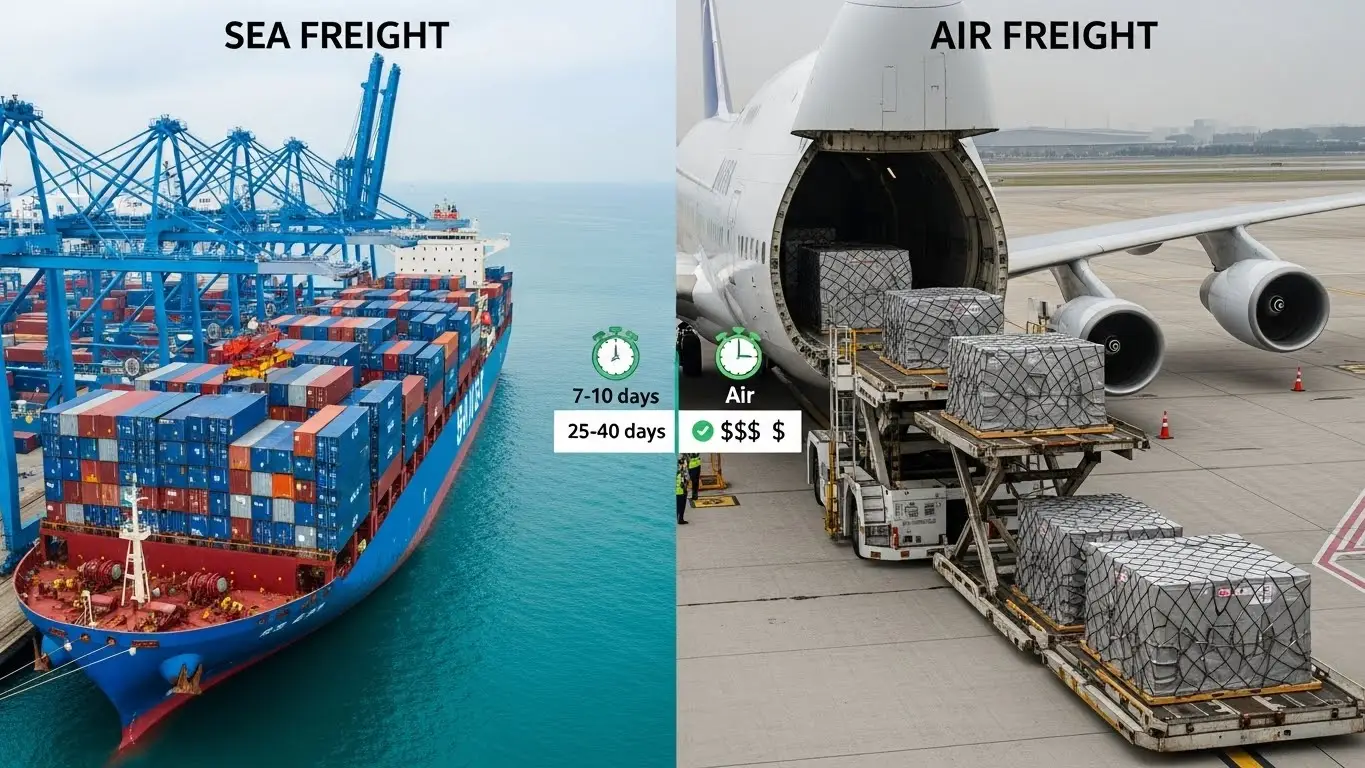
Your shipping method choice represents a fundamental trade-off between cost and speed.
Sea Freight (Standard Option)
Most steel tower shipments use sea freight. It's economical for the weight-to-value ratio of steel structures.
| Shipping Method | Transit Days | Cost/Ton (Est.) | Container Type | Best For |
|---|---|---|---|---|
| Sea freight (FCL) | 25-40 days | $800-1,500 | 20ft/40ft container | Standard orders |
| Sea freight (LCL) | 30-45 days | $1,200-2,000 | Shared container | Small orders <15 tons |
| Air freight | 7-10 days | $4,000-8,000 | Cargo plane | Rush orders, remote sites |
| China-Europe rail | 14-24 days | $2,000-3,500 | Rail container | European buyers |
We ship from Chengdu to major Chinese ports (Shanghai, Qingdao, Shenzhen) via rail or truck. From there, ocean carriers handle international transit.
Container capacity matters. A standard 40-foot high-cube container holds roughly 25-28 tons of lattice tower components or 18-22 tons of heavier monopole sections.
Air Freight (Express Option)
Air freight makes sense in specific scenarios:
- Project delays where liquidated damages exceed the premium
- Emergency tower replacements after storm damage
- Remote locations where road access limits sea freight viability
- When 2-3 week time advantage prevents project timeline extensions
Cost example: A 10-ton order via sea freight costs $10,000-15,000. Same order via air costs $40,000-80,000. You're paying 5-8x more to save 20-30 days.
China-Europe Rail Freight (Emerging Middle Option)
Belt & Road Initiative rail corridors now connect China to Europe in 14-24 days. This splits the difference between sea and air costs while delivering faster than ocean freight.
Currently best for European buyers ordering 20-80 ton volumes. Not yet widely available for other continents.
Factors That Impact Steel Tower Delivery Time
Six variables determine whether your order takes 35 days or 85 days:
1. Tower Complexity & Customization
Standard designs ship faster. We manufacture common 66kV-220kV lattice towers regularly, so production is streamlined.
Custom designs require engineering review, potentially new tooling, and trial assembly. This adds 10-15 days. Complex features like ice-loading calculations, seismic reinforcement, or unusual heights increase this further.
Monopole towers with varying wall thickness fall somewhere in between—more complex than basic lattice towers but simpler than fully custom structures.
2. Manufacturing Capacity & Production Queue
Peak season (September-December) sees higher order volumes globally. Production slots might be 7-10 days out instead of 3-5 days during slower periods (January-March).
Our 10 production lines and 180 employees maintain consistent output, but even with 40,000-ton annual capacity, timing matters. Order during off-peak months for faster allocation.
3. Chinese Holiday Schedules
This catches many international buyers by surprise. Chinese New Year (late January/early February) shuts down manufacturing for 2-3 weeks. Golden Week in October closes operations for 7 days.
Planning tip: Place orders 4 months before your project deadline. If you need towers by March, order in November. December orders won't begin production until mid-February post-holiday.
| Month | Production Risk | Recommendation |
|---|---|---|
| Jan-Mar | Low (post-CNY restart) | Good time to order |
| Apr-May | Low | Optimal ordering window |
| Jun-Aug | Medium | Moderate demand |
| Sep-Dec | High (peak export season) | Order early, expect delays |
4. Raw Material Availability
Steel prices fluctuate based on global commodity markets. When Q235 or Q345 steel costs spike, some manufacturers struggle with material sourcing.
We maintain relationships with multiple steel mills across Sichuan Province, ensuring material availability doesn't delay your order. This is one advantage of working with established manufacturers.
5. Quality Control Requirements
Standard pre-shipment inspection is included. If you require third-party inspection (SGS, Bureau Veritas, TÜV), schedule them in advance. Last-minute inspection requests add 5-7 days.
Specialized testing—like vibration testing, load testing, or accelerated corrosion testing—requires advance notice and adds time. Discuss requirements upfront during the design approval phase.
6. Destination Country Regulations
Some countries require pre-shipment certification or import permits. Nigeria requires SONCAP certification. Some Middle Eastern countries mandate COC (Certificate of Conformity). European Union has CE marking requirements for certain tower types.
Research your country's import requirements early. We can assist with documentation, but the process takes time if you discover requirements after production begins.
Rush Delivery Options: Can You Get Steel Towers Faster?
Yes, but understand the realistic limits and cost implications.
Fastest possible timeline: 25-35 days total
This requires:
- Expedited production (12-18 days instead of 20-30 days)
- Priority galvanizing scheduling (2 days instead of 4 days)
- Air freight (7-10 days instead of 30-35 days)
- Pre-arranged customs clearance
| Delivery Type | Production | Galvanizing | Shipping | Total | Cost Premium | Success Rate |
|---|---|---|---|---|---|---|
| Standard (sea) | 20-25 days | 3-4 days | 30-35 days | 53-64 days | Baseline | 95%+ |
| Rush (sea) | 12-15 days | 2 days | 30-35 days | 44-52 days | +15-25% | 85-90% |
| Express (air) | 12-15 days | 2 days | 7-10 days | 21-27 days | +50-80% | 75-85% |
Real case study: An African telecom operator needed emergency tower replacement after storm damage. Standard timeline would be 65 days. We delivered in 28 days using: 14-day expedited production, 2-day priority galvanizing, air freight to Nairobi (9 days), express customs clearance (3 days). Total cost was 60% higher than standard delivery, but avoided $45,000 in network downtime penalties.
Rush delivery works best for:
- Orders under 20 tons (easier to expedite)
- Standard tower designs (no engineering delays)
- Direct air freight routes to your country
- When premium cost is justified by avoiding penalties
How to Reduce Your Steel Tower Delivery Time
Eight proven strategies to accelerate delivery without necessarily paying rush premiums:
Strategy 1: Order During Off-Peak Seasons
January-March and June-August see lower global demand. Production slots are available within 3-5 days instead of 7-10 days during peak season.
Strategy 2: Provide Complete Technical Specs Upfront
Incomplete drawings cause the most delays. Include: loading requirements, wind speed calculations, soil conditions, voltage class, connection details, and galvanizing specs. Every round of clarification adds 2-3 days.
Strategy 3: Choose Standard Designs Over Custom
We manufacture standard 66kV, 132kV, and 220kV transmission towers regularly. These designs require minimal engineering review and use proven production processes. Custom designs add 10-15 days even when everything goes smoothly.
Strategy 4: Work with High-Capacity Manufacturers
Manufacturers with larger capacity (30,000+ tons annually) maintain consistent production schedules. Smaller operations often face production bottlenecks during busy periods.
Strategy 5: Pre-Arrange Shipping & Logistics
Don't wait until production finishes to book shipping. Secure container space 2-3 weeks in advance, especially during peak export season when container shortages occur.
Strategy 6: Build Long-Term Supplier Relationships
Repeat customers get priority production scheduling. After your first order, subsequent orders move faster because designs are on file and production processes are refined.
Strategy 7: Plan Around Chinese Holidays
Use this simple calculation: Needed delivery date minus 85 days = latest order date (for sea freight). This builds in buffer for Chinese New Year, Golden Week, and unexpected delays.
Strategy 8: Consider Partial Air Freight for Critical Components
Ship the critical path items via air (tower top sections, specialized fittings) while sending bulk components via sea. This hybrid approach can reduce project delays without paying full air freight costs.
Top Chinese Steel Tower Manufacturers & Their Delivery Performance
Production capacity directly correlates with delivery reliability. Here's what to look for:
| Factor | Small Manufacturer | Medium (Us) | Large Manufacturer |
|---|---|---|---|
| Annual capacity | <10,000 tons | 40,000 tons | 100,000+ tons |
| Production lines | 2-4 lines | 10 lines | 20+ lines |
| Average delivery | 65-80 days | 50-65 days | 45-60 days |
| Rush capability | Limited | Available | Regularly available |
| Own galvanizing | Rare | Yes (in-house HDG) | Usually yes |
In our 17 years of manufacturing experience since 2008, we've learned that delivery reliability comes from three things: adequate production capacity, vertical integration (owning galvanizing facilities), and established export processes.
Questions to ask potential suppliers:
- What's your current production queue? (Should be <2 weeks)
- Do you own your galvanizing facility or outsource?
- How many projects have you exported to my region?
- What's your on-time delivery rate? (Should be >90%)
- Can you provide references from similar projects?
Total Delivery Time Calculator: Order to Site Delivery
Let's calculate three real scenarios:
Scenario 1: Standard 66kV Project, USA (West Coast)
- Tower specs: 66kV lattice transmission tower
- Order: 25 tons
- Shipping: Sea freight to Los Angeles
- Timeline calculation:
- Design approval: 4 days
- Production: 16 days
- Galvanizing: 3 days
- Inspection/packaging: 2 days
- Inland transport to Shanghai port: 2 days
- Sea freight to Los Angeles: 16 days
- Customs clearance: 4 days
- Last mile to site: 2 days
- Total: 49 days
Scenario 2: Rush 132kV Project, Middle East
- Tower specs: 132kV lattice tower, standard design
- Order: 12 tons (urgent replacement)
- Shipping: Air freight to Dubai
- Timeline calculation:
- Design approval: 2 days (pre-approved design)
- Expedited production: 13 days
- Priority galvanizing: 2 days
- Inspection/packaging: 1 day
- Air freight to Dubai: 8 days
- Express customs: 3 days
- Delivery to site: 1 day
- Total: 30 days
Scenario 3: Large 220kV Project, Africa
- Tower specs: 220kV heavy-duty lattice towers
- Order: 120 tons (transmission line project)
- Shipping: Sea freight to Lagos
- Timeline calculation:
- Design approval: 6 days (custom specifications)
- Production: 26 days (large volume)
- Galvanizing: 4 days
- Inspection/packaging: 3 days
- Inland transport: 2 days
- Sea freight to Lagos: 32 days
- Customs clearance: 6 days
- Delivery to site: 3 days
- Total: 82 days
Safety buffer recommendation: Add 14-21 days to your calculated timeline. Weather delays, customs inspections, and minor production adjustments happen. Building buffer prevents project timeline stress.
Frequently Asked Questions About Steel Tower Delivery Time
Rush delivery achieves 25-35 days using expedited production (12-18 days), priority galvanizing (2 days), and air freight (7-10 days). However, this applies only to standard designs under 20 tons and costs 50-80% more than normal delivery. Most projects use standard sea freight timelines of 50-65 days.
Small orders (1-10 tons) complete production in 12-18 days and ship faster. Large orders (50+ tons) require 20-28 days due to production batching and galvanizing capacity limits. However, per-ton costs decrease with volume. The 10-50 ton range offers optimal balance of speed and cost efficiency.
The six most common delay causes: Chinese New Year shutdown (2-3 weeks), incomplete technical drawings (adds 5-10 days), third-party inspection scheduling conflicts (adds 5-7 days), peak season port congestion September-December (adds 3-7 days), custom design complexity (adds 10-15 days), and destination country import permit issues (adds 7-14 days).
Air freight costs 5-8x more but saves 20-30 days. It's worth it when project delay penalties exceed the shipping premium, emergency replacements are needed, or project timeline extensions would cause significant financial loss. For routine projects with proper planning, sea freight remains the optimal choice.
Chinese manufacturers typically deliver standard towers 20-30% faster despite longer shipping distances. This advantage comes from vertical integration (owning galvanizing facilities), high production capacity (40,000+ tons annually reducing queue times), and streamlined export processes. However, total landed cost must include shipping, duties, and import fees for fair comparison.
Reputable manufacturers provide realistic delivery windows (±5 days) rather than absolute guarantees. Force majeure events (typhoons, port strikes, pandemic-related shutdowns) occasionally cause delays beyond manufacturer control. Choose suppliers with documented on-time delivery rates above 90% and established contingency processes. We maintain 92% on-time delivery across our 7 years of export experience.
Production time encompasses raw material cutting and fabrication, component punching and bending, welding and assembly, quality testing, hot-dip galvanizing (2-5 days), post-galvanizing inspection, and export packaging. It does NOT include shipping transit time, customs clearance, or last-mile delivery to your project site.
Chinese New Year (late January/early February) causes 2-3 week factory shutdown. Production pauses approximately January 20 - February 10 (dates vary annually). Place orders 4 months before your required delivery date. December orders won't begin production until mid-February. September-November represents the optimal ordering window for February-April deliveries.

Hey, I’m Chunjian Shu
"X.Y. Tower: Reliable, innovative solutions for high-quality towers and electrical equipment with professional service.
