
Mobile vs. Fixed Cell Towers: How to Choose, Costs and Deployment Time
2026-02-24
Use of mobile cell tower or fixed tower location is one of the major decisions that telecom operators, the police, and the planners of infrastructure have to make. Each solution has its own benefits in terms of prices, deployment time, elasticity and cost-effectiveness.
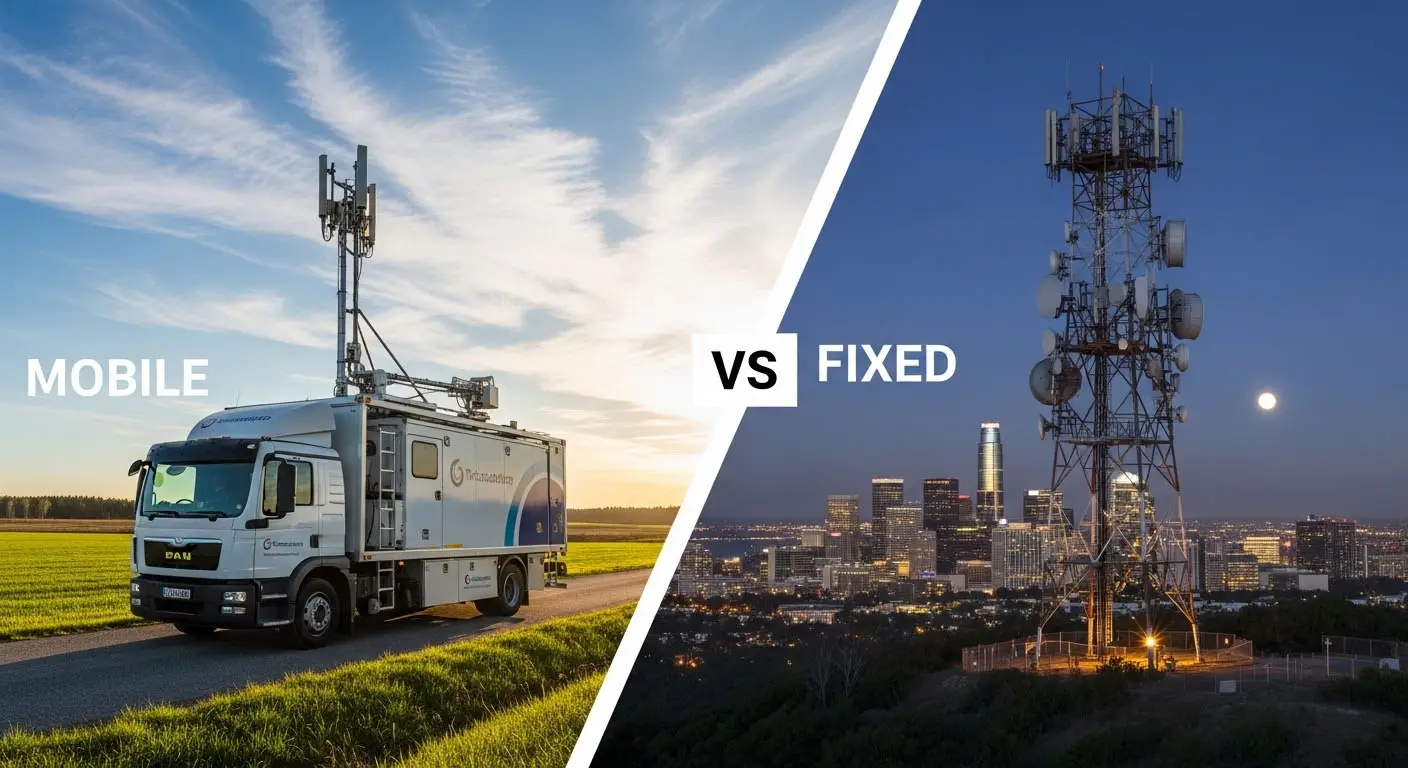
In order to locate the proper solution, it is necessary to understand the differences between this kind of towers and aspects that should be the most important to your project. This tutorial makes a comparison between the mobile and fixed cell towers, cost and time comparison and how to select the best one that fits your network goals.
What Is a Fixed Cell Tower?
A fixed cell tower is a permanent telecommunications tower that is mounted on the site that has been prepared. The types of commonly used designs are monopole, lattice, and guyed towers. These installations are designed to have long-term network coverage and high capacity.
Typical characteristics include:
-
Permanent foundation
-
Higher structural capacity
-
Multi-tenant capability
-
Long service life
-
Extensive permitting requirements
In the United States, many new macro cell sites cost roughly $200,000 to $300,000 on average, though complex builds can exceed $1 million depending on site conditions and specifications.
Fixed towers are the backbone of nationwide cellular networks.
What Is a Mobile Cell Tower?
Mobile cell towers are portable communication systems designed for rapid deployment. They often appear as:
-
Cell on Wheels (COW)
-
Trailer-mounted towers
-
Telescopic mast systems
-
Skid-mounted units
Unlike permanent towers, mobile systems arrive pre-engineered and ready to deploy.
Typical features include:
-
Transportable platform
-
Telescoping aluminum mast
-
Integrated power systems
-
Minimal site preparation
-
Rapid setup capability
Mobile towers typically cost between $70,000 and $250,000, depending on height, payload, and onboard equipment.
Deployment Speed Comparison
Fixed Tower Timeline
Permanent tower projects involve multiple phases:
-
Site acquisition
-
Zoning and permitting
-
Environmental review
-
Foundation construction
-
Tower erection
-
Equipment installation
Because of these steps, deployment can take several months or longer.
Permitting alone can significantly extend schedules, especially in urban or regulated areas.
Mobile Tower Timeline
Mobile towers are engineered for speed. Most units:
-
Require minimal site preparation
-
Arrive pre-assembled
-
Use telescoping masts
-
Operate from trailers or pads
Technicians can often deploy and commission a mobile tower in a single shift, making them ideal for urgent coverage needs.
Cost Comparison
Fixed Tower Costs
Fixed tower expenses typically include:
-
Land purchase or lease
-
Site preparation
-
Foundation construction
-
Tower materials
-
Labor and crane work
-
Permitting and compliance
-
Backhaul installation
While basic installations may fall below $200,000, complex multi-tenant sites can exceed $1 million.
However, fixed towers often provide lower cost per user over time due to higher capacity and longer lifespan.
Mobile Tower Costs
Mobile tower costs are generally lower upfront because they avoid:
-
Permanent foundations
-
Extensive site work
-
Long permitting cycles
Most systems fall between $70,000 and $250,000.
That said, mobile solutions may require relocation, fuel, or operational support depending on the use case.
Flexibility and Use Cases
When Mobile Towers Make Sense
Mobile towers excel in situations requiring speed and mobility.
Best use cases:
-
Emergency response
-
Disaster recovery
-
Temporary events
-
Remote operations
-
Military deployments
-
Network gap filling
-
Maintenance backup
Because they are portable, operators can reposition them as coverage needs change.
When Fixed Towers Are Better
Permanent towers remain the preferred solution for long-term network infrastructure.
Ideal scenarios:
-
Nationwide coverage expansion
-
Dense urban networks
-
Multi-carrier leasing
-
High-traffic corridors
-
Long-term rural coverage
Their higher structural capacity supports heavier antenna loads and more tenants.
Site Preparation Requirements
Fixed Towers
Permanent installations often require:
-
Geotechnical surveys
-
Land clearing
-
Grading
-
Concrete foundations
-
Utility connections
These steps increase both cost and timeline.
Mobile Towers
Mobile systems require far less preparation. Most only need:
-
Stable ground surface
-
Clearance radius
-
Power source
The absence of permanent foundations significantly reduces upfront work and long-term site commitments.
Regulatory Considerations
Fixed Tower Permitting
Permanent towers must comply with:
-
Local zoning laws
-
Building codes
-
FAA lighting rules
-
Environmental reviews
These requirements can extend project timelines.
Mobile Tower Permitting
Mobile towers may qualify as temporary wireless facilities in some jurisdictions, which can simplify approvals and shorten lead time.
This regulatory flexibility is a major advantage for rapid deployments.
Return on Investment (ROI)
Choosing between mobile and fixed towers often comes down to ROI.
Fixed Tower ROI
Best for:
-
Long-term revenue generation
-
Multi-tenant leasing
-
Permanent coverage
Telecom operators typically measure ROI through expanded coverage and new subscriber growth.
Mobile Tower ROI
Best for:
-
Rapid coverage expansion
-
Emergency readiness
-
Temporary demand spikes
-
Tactical communications
Mobile systems help prevent service gaps and support mission-critical operations.
Key Decision Factors
When selecting between mobile and fixed towers, evaluate:
-
Deployment urgency
-
Budget constraints
-
Coverage duration
-
Site availability
-
Regulatory environment
-
Capacity requirements
-
Future scalability
Most large networks use a hybrid strategy—fixed towers for backbone coverage and mobile units for surge or emergency support.
Conclusion
Both mobile and fixed cell towers are significant in the current infrastructure of wireless. Fixed towers are capable of offering long-term capacity and network stability whereas mobile towers are capable of offering unparalleled speed and flexibility.
Investing in a fixed tower is generally superior when permanent coverage and multi-tenant revenue are of great concern. Mobile towers are evidently beneficial in case of quick deployment, provisional coverage or mobile operation.
The telecom planners are able to select the tower solution that provides the most operational value by a close assessment of costs, schedules, and mission needs.

Hey, I’m Chunjian Shu
"X.Y. Tower: Reliable, innovative solutions for high-quality towers and electrical equipment with professional service.
