
What Are the Types of Electrical Power Towers?
2026-02-24
Modern transmission networks cannot function without electrical power towers. They carry overhead conductors and facilitate passage of electricity in a safe manner between power plants and substations and the end users. Due to the varying terrain, mechanical loading, and electric demand of the transmission routes, depending on the exact terrain and mechanical loading requirements, the engineers employ several types of towers to ensure their proper functioning.
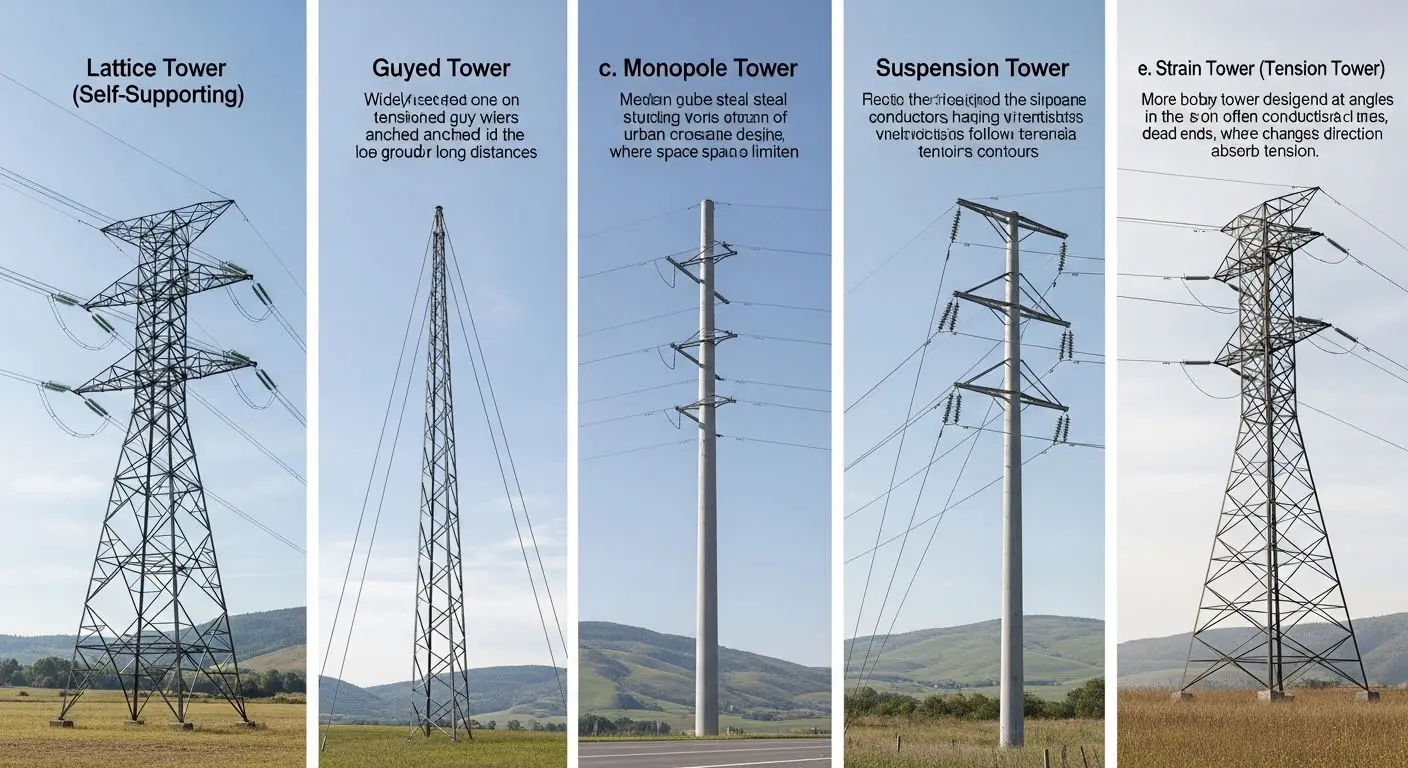
The knowledge of the key categories of electrical power towers assists utilities, EPC contractors, and project planners to determine the proper structure to use in a given application. This guide describes the typical classifications and how they are used in the modern day power systems.
What Is an Electrical Power Tower?
An electrical power tower (sometimes termed transmission tower or electricity pylon) is a high tower, meant to support high-voltage overhead transmission lines over a long distance. These towers are the pillars of the grid, which provides safe conductor clearance and mechanical stability.
Transmission towers are constructed of steel lattice or tubular designs because they are strong and durable, but in some lower-voltage cases, concrete and wood could be used.
Classification by Function
One of the most common ways to categorize electrical power towers is by their operational role along the transmission line.
Suspension (Tangent) Towers
Suspension towers are the most widely used type. They are installed along straight sections of the transmission route where the conductor direction does not significantly change.
Key characteristics:
-
Support vertical conductor loads
-
Minimal longitudinal tension
-
Cost-effective for long straight runs
-
High installation quantity
In these towers, conductors are simply suspended from insulator strings, making them suitable for continuous straight alignments.
Tension (Strain or Dead-End) Towers
Tension towers are designed to withstand significant longitudinal forces from conductor tension. They are typically installed where the line changes direction or at critical mechanical points.
Typical applications:
-
Line angle locations
-
Long span sections
-
River or valley crossings
-
Sectionalizing points
Because they must resist unbalanced loads, tension towers are heavier and more robust than suspension towers.
Angle Towers
Angle towers are a subtype of tension towers used specifically where the transmission line changes direction.
Features:
-
Handle moderate to large line deviations
-
Maintain conductor geometry
-
Provide structural stability at bends
Engineers select different angle strengths depending on the deviation degree.
Terminal Towers
Terminal towers are installed at the end of transmission lines, where the overhead line connects to substations or transitions to underground cable systems.
Functions:
-
Anchor the final span
-
Interface with substation equipment
-
Manage high mechanical loads
These towers play a critical role in system termination and grid interconnection.
Transposition Towers
Transposition towers are specialized structures used to swap the physical positions of phase conductors along a transmission line.
Purpose:
-
Balance electrical impedance
-
Reduce electromagnetic interference
-
Improve system performance
By periodically rotating conductor positions, these towers help maintain equal electrical characteristics across phases.
Crossing Towers
Crossing towers are extra-tall or specially reinforced structures used when transmission lines pass over obstacles.
Common crossing scenarios:
-
Rivers
-
Highways
-
Railways
-
Valleys
Their increased height ensures safe clearance over the obstacle.
Classification by Structural Form
Electrical power towers can also be categorized based on their physical structure.
Lattice Towers
Lattice towers are the most traditional and widely deployed design. Their open steel framework provides excellent strength while keeping weight relatively low.
Advantages:
-
High strength-to-weight ratio
-
Good wind resistance
-
Economical for long distances
-
Easy transportation in sections
The lattice configuration is especially common in high- and extra-high-voltage transmission projects.
Monopole (Tubular) Towers
Monopole towers consist of a single steel pole supporting the conductors. They are increasingly popular in urban and suburban environments.
Benefits:
-
Small footprint
-
Cleaner appearance
-
Faster installation
-
Reduced right-of-way
These towers are often selected where space is limited or visual impact must be minimized.
Guyed Towers
Guyed towers use tensioned guy wires for additional stability. They require less steel but need more ground area for anchor points.
Best suited for:
-
Flat terrain
-
Long spans
-
Cost-sensitive projects
However, they are less common in dense urban areas due to space requirements.
Classification by Line Configuration
Single-Circuit Towers
These towers carry one three-phase circuit. They are typically used in lower-capacity transmission corridors.
Double-Circuit Towers
Double-circuit towers support two independent circuits on the same structure.
Advantages:
-
Higher transmission capacity
-
Reduced corridor width
-
Improved redundancy
This configuration is common in major transmission backbones.
Multi-Circuit Towers
Used in high-density corridors, these towers carry three or more circuits to maximize right-of-way efficiency.
Special-Purpose Tower Types
In addition to standard categories, engineers sometimes deploy specialized towers for unique conditions.
Examples include:
-
River-crossing towers
-
Mountain towers
-
Compact urban towers
-
Heavy-ice region towers
-
Ultra-high-voltage (UHV) towers
These designs are customized based on environmental and electrical requirements.
How to Choose the Right Tower Type
Selecting the proper electrical power tower depends on several project factors:
-
Voltage level
-
Line route geometry
-
Terrain conditions
-
Environmental loads
-
Right-of-way limitations
-
Construction budget
In practice, a single transmission line typically uses a combination of tower types to achieve optimal performance and cost balance.
Conclusion
Power towers of electricity are of numerous types, designed to fulfill a given role in the transmission system. Suspension towers on straight routes, the heavy-duty tension and terminal towers at key locations all presently enhance safe and efficient delivery of electricity.
By knowing these classifications as determined by function, structure and configuration, the project developers can be in a position to develop more dependable and cost effective power lines. With the world increasing its power demand, the choice of the type of transmission towers will remain a critical component in the development of a strong and future-proof energy infrastructure.

Hey, I’m Chunjian Shu
"X.Y. Tower: Reliable, innovative solutions for high-quality towers and electrical equipment with professional service.
