
Steel Tower Africa Market: Why One Tower Specification Cannot Fit a Continent
2026-08-24
It's an easy trap to fall into if one talks about the steel tower market in Africa: to consider Africa as one project environment.
It is not.
A tower transmission sent to a damp, coastal region in West Africa could may be confronted with a different corrosion environment when compared to one put inland. Questions regarding logistics and foundation differ between the two types of projects: a tower installed in an East African mountain region vs. a substation project at a fairly accessible site. Two projects that have the same nominal voltage might require different tower families, extensions, loading criteria and erection plans.
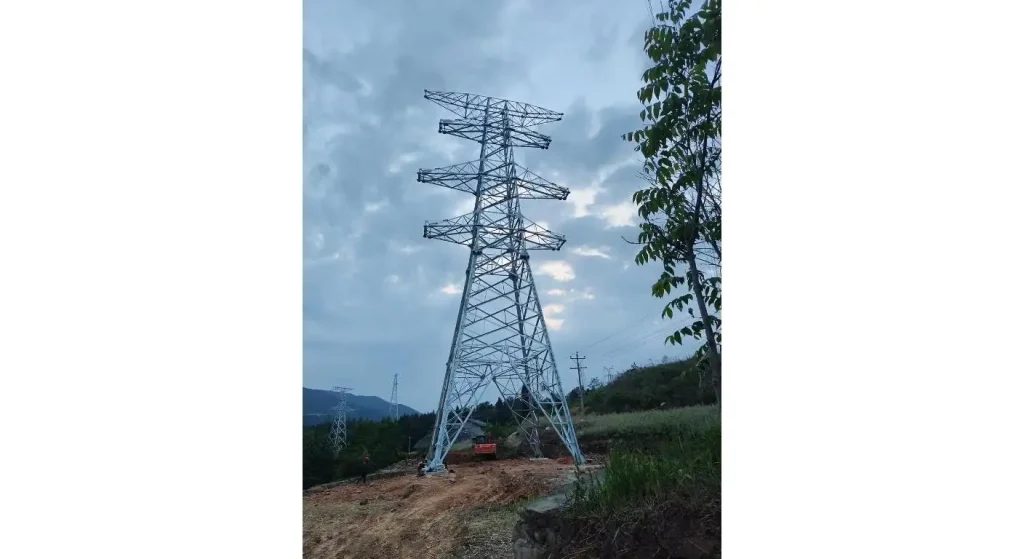
That distinction makes more of a difference as you start to invest in more transmission. In West Africa alone, over 4,000 km of HV regional interconnection has been realised in WAPP-supported projects and new interconnections are further enhancing power exchange in eastern and southern Africa.
So the pertinent one for buyers is not:
Is it true that you are supplying towers to Africa?”
It is:
“Are you able to provide the suitable tower system for this project in Africa?”
Transmission Corridor, NOT the Country Name.
The location of a project is not very informative when written as Project Location: Africa on an RFQ.
Much more useful the route.
Before the tower configuration can be meaningfully reviewed the supplier must have an understanding of terrain, wind conditions, exposure environment, line voltage, conductor configuration (phase), spans, route angles, access conditions and any unusual crossings.
This is why it is important to have project-specific Tower Design Solutions rather than selecting a tower from an existing catalogue.
In the case of an African EPC project, information doesn't have to be ideal. However the assumptions should be made apparent. Ensure that wind data, conductor information or route surveys are preliminary if they are preliminary – don't simply let them be manufacturing assumptions.
| Project Input | Why the Supplier Needs It |
| Route & Survey Data | Confirms terrain, tower positions and extensions |
| Wind / Climate Criteria | Defines structural environmental loads |
| Conductor Configuration | Determines tower head and attachment geometry |
| Span & Route Angles | Helps assign suspension, angle and tension duties |
| Corrosion Environment | Guides protection requirements |
| Site Access | Influences member size, bundling and erection planning |
That practice helps to avoid a vast amount of redesign later.
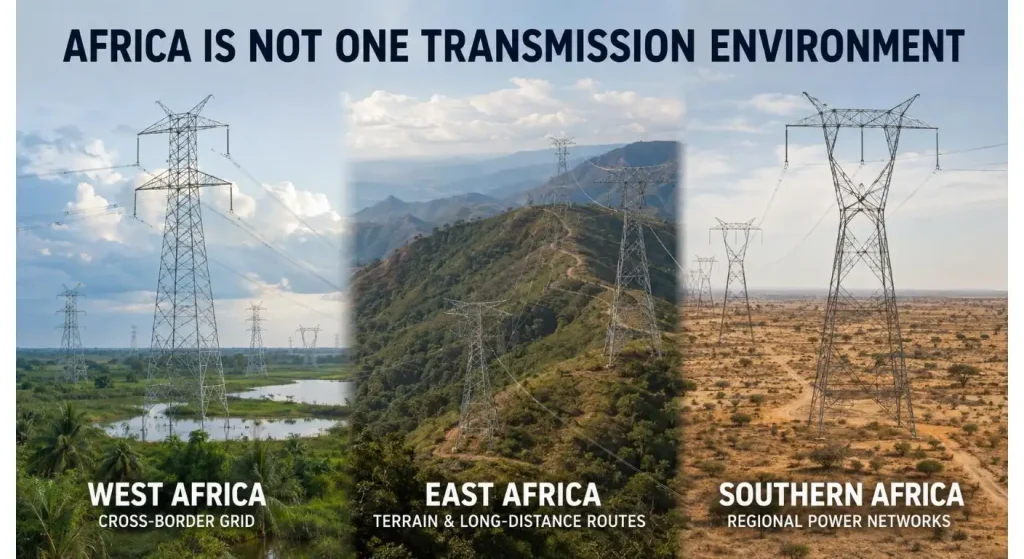
Aimed at West, East and Southern Africa, the project focuses on the creation of different project questions.
The “standard African transmission route” is of no value.
Cross-border grid projects are becoming more and more common in West Africa. WAPP has been contributing to making national systems compatible with each other via the implementation of 225kV and 330kV infrastructure, where the issues of compatibility, staged delivery and multi-country project coordination become more relevant.
East Africa introduces an additional pattern which is that of long-distance connection of generation resources with the demand centres. For instance, Ethiopia-Kenya electricity highway is over 1000 km long and is part of a regional electricity grid.
Another procurement example is in southern Africa where power trading and investment in transmission is growing via the Southern African Power Pool.
That doesn't imply that a supplier will need three separate manufacturing systems.
It implies that the proposed Transmission Line Steel Tower family needs to be evaluated according to the task of the transmission line, and not be sold under the banner of “suitable for Africa.”
Harsh Climate is too Broad a Specification.
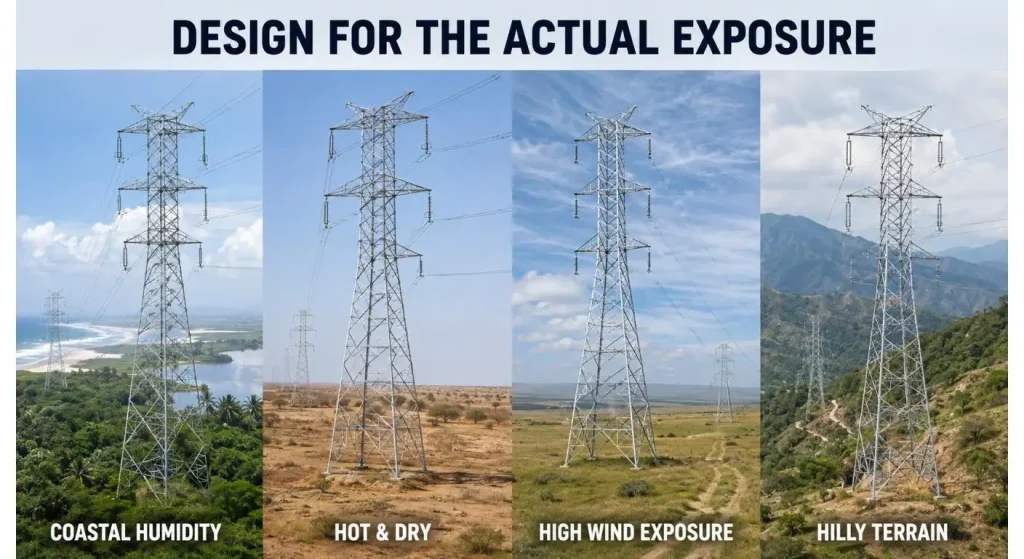
The word “harsh” in the “Designed for harsh African conditions” is reassuring. It is not an engineering requirement (not required by a law of engineering).
Which condition?
There are not the same durability questions when it comes to a hot inland environment, humid coast, high rainfall zone and high elevation route, etc.
An obvious example is corrosion protection. Although most towers used for transmissions are hot dip galvanized, coating requirements should still be correlated to the project specifications, exposure and expected service requirements, and not just the question of whether or not a tower is “galvanized.”
XY Tower's High Voltage Steel Transmission Tower range is specifying hot dip galvanised steel transmission towers but as the buyer needs to define the project environment this becomes a meaningful specification.
Similarly, wind and terrain can not be replaced with an assumption across the continent.
Climate is data for your project and not a marketing term.
Logistics Can Change the Best Tower Choice: If the other parameters are the same, you can use logistics to reduce costs.
Two alternatives for towers might appear to be structurally equivalent.
However, as projects, they can be quite different on-site.
Take into account what happens once the container arrives at the port.
Members can still be moved hundreds of kilometres by road, to secondary roads, exposed outdoors and using minimal equipment and access, carried to tower positions. At some point in that process the metric of “lowest steel weight” ceases to be a valuable one.
It should therefore be seen that a practical Transmission Line Services perspective is to link the design of the towers with the packaging and identification, transport and erection planning as opposed to delivery starting after fabrication.
Readable piece marks and erection-based bundles can be very useful in corridors in far-ranging locations in Africa. Giving up ½ day due to multiple efforts in several similar bundles is not an engineering failure, but is certainly a project failure.
Local Construction Reality to be included in the Design Review.
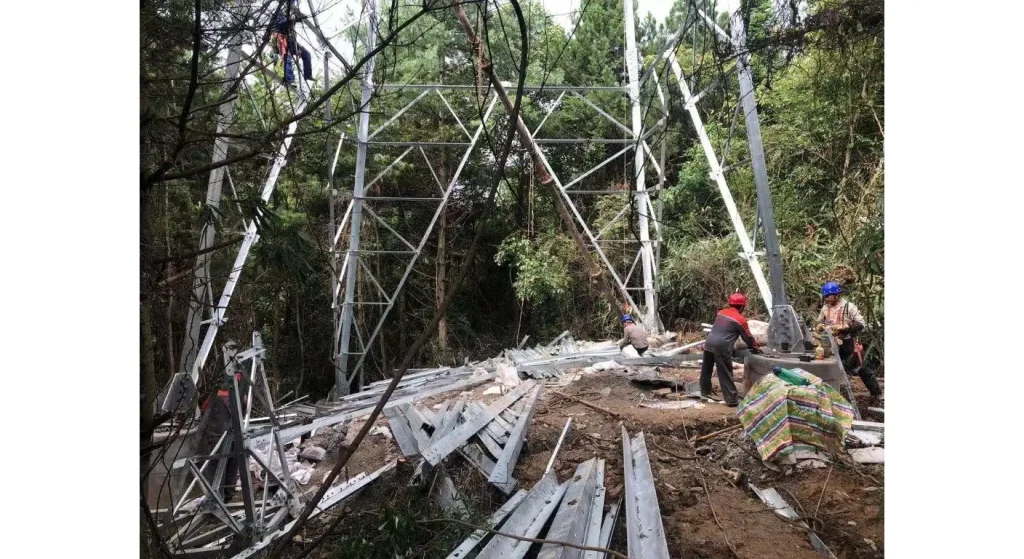
A tower doesn't show up on a perfectly controlled floor in the factory ready for assembly.
Reaches a construction site.
The foundation interface, leg configuration and erection process should reflect the actual capability of the crews to construct the foundation at each location.
Unequal legs can minimize unnecessary excavation if the slope of the terrain is not level. Geometry of the tower may require modification on constrained sites. Completely different structural duties may be the case at crossings, tension points or terminal positions.
So, the solutions offered by the larger Steel Tower Infrastructure Solutions must be flexible to the site conditions and not fit them all into the same solution.
Thus, allowing controlled variants is good for an African-market proposal.
It should not be open for freely improvisation.
The lowest tower price is far from the project price.
Unit price can be very apparent in tenders for African infrastructure.
The costs incurred after award are not so apparent.
An inexpensive package for a tower may not be as desirable when the purchaser requires engineering changes, special bolts, replacement members, and/or extensive galvanizing repairs, tower repacking, or port sorting or site assistance.
That's why scope alignment should always be the first step of commercial comparison.
Is the quote Design Responsible? Fabrication drawings? Bolts? Galvanizing? Inspection? Reassembly of the parts in trial? Packing? Documentation? Replacement-part procedures?
When evaluating EPCs as a buyer, you want to have a like-for-like scope, before a like-for-like price.
| Comparison Item | Confirm Before Award |
| Engineering | Design responsibility and revision scope |
| Tower Supply | Members, plates, bolts and accessories included |
| Protection | Galvanizing and inspection requirements |
| Testing | Prototype or trial assembly requirements |
| Documentation | Drawings, certificates and inspection records |
| Delivery | Packing method, shipping scope and replacement process |
If you compare two quotes which look as though they are offering the same price for the same tower, then they may be quoting for different obligations.
Africa's Grid Expansion is rewarding suppliers who think outside the box when it comes to shipping steel.
There is still large unmet electricity demand in Africa, and investments are going towards generation, transmission, interconnection and distribution. The IEA estimates that about 600 million people in Africa are still without access to electricity, and the African Development Bank and World Bank continue to sponsor big electrification and grid projects.
That opens up opportunity to tower manufacturers but also their expectations.
It's not enough for a supplier to enter the market of steel tower in Africa on the basis of production capacity and export price. For utilities and EPC contractors, it is important to have structures that conform to their route, documentation that can withstand a long project chain, packaging that makes sense at site and engineering support when conditions deviate from the assumption.
Since the start of international sales, XY Tower says it has been supplying its export customers (such as projects in Africa) with its own towers rather than supplying generic towers from China.
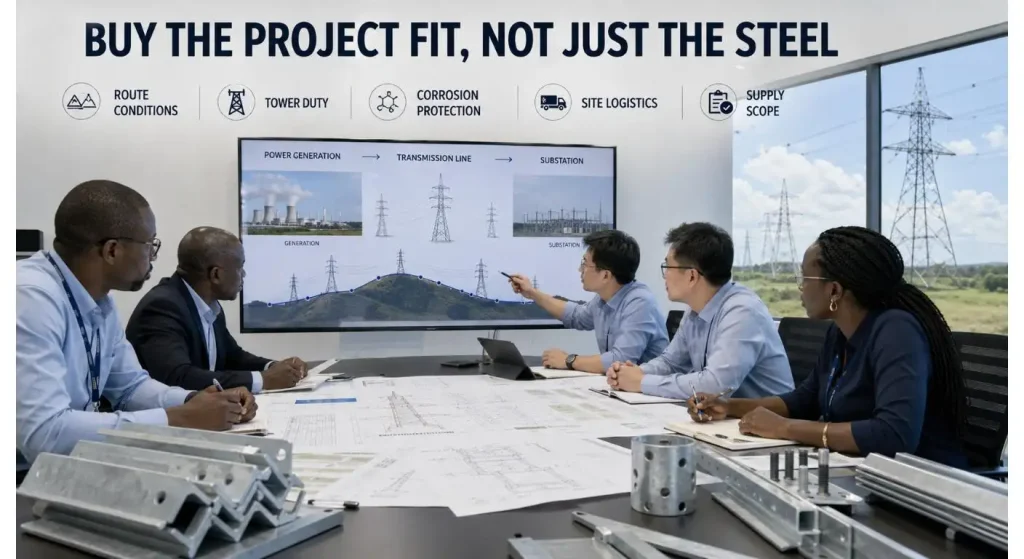
Conclusion
The Africa market should be tackled on a corridor-by-corridor and a project-by-project basis using the steel tower solution.
While voltage is an important factor, other factors such as climate, terrain, tower duty, road access, foundation interfaces, corrosion exposure and construction sequence are also important.
To be a successful tower package, therefore, it is not enough to have steel which is strong enough to stand.
It is a building which is planned, built, safeguarded, loaded and shipped in a sensible manner, at the location where it will be constructed.
FAQs
Q1. Do they have any one particular standard steel tower design for the Africa market?
No because there are many factors that differ from voltage to wind to terrain to the corrosion exposure, conductor configuration, and local project standards to name a few. The design of the tower should correspond with the real situation and mission of the project.
Q2. Is galvanized steel tower appropriate for transmission project in Africa?
A wide variety of materials are used, but for long-term outdoor infrastructure, corrosion protection is a significant factor and for that reason, hot dip galvanized steel is often used. Even so, project conditions and client requirements should be considered when deciding on the required coating specification.
Q3. What should be shared by an African EPC contractor with the tower supplier?
Use voltage as the starting point, route profile, conductor data, tower schedule, span and angle requirements, climatic criteria, foundation concept and delivery requirements. Early survey and access information also is valuable.
Q4. Are lattice towers suitable in the remote project sites in Africa?
They can be very practical since they can be divided up into sections and members can be individually carried and assembled. Access for the routes, erection equipment, loads and project economics should also be taken into consideration for the final choice.
Q5. What are some factors that buyers should consider when deciding on a supplier for their African steel tower?
Consider engineering scope, materials, fabrication, corrosion protection, inspection DOC's, packing and delivery responsibilities and support – not just price per tonne.

Hey, I’m Chunjian Shu
"X.Y. Tower: Reliable, innovative solutions for high-quality towers and electrical equipment with professional service.
